Section 07-01: Transmission, Automatic—AODE | 1994 Mustang Workshop Manual |
DIAGNOSIS AND TESTING
On-Board Diagnostic Quick Tests—5.0L
The Quick Tests are in the Powertrain Control/Emissions Diagnosis Manual
. These tests can be used to diagnose the powertrain control module (PCM) (12A650), sensors and actuators of the AODE transmission.
The following is a guide for using the On-Board Diagnostic Quick Tests,
with some special considerations to remember:
Quick Test 1.0
Perform the Visual Check and Vehicle Preparation procedures as outlined
in the Powertrain Control/Emissions Diagnosis Manual
Inspect the following:
- Engine air cleaner (ACL) (9600) and engine air cleaner intake tube and duct (9A673)
- All engine vacuum hoses for damage: leaks, cracks, blockage, proper
routing etc.
- PCM system wiring harnesses for proper connections, bent or broken pins,
corrosion, loose wires, proper routing, etc.
- Powertrain control module, sensors and actuators for physical damage
- Engine coolant for proper level
- Transmission fluid for level, condition and for external leakage
- Any non-factory installed items wired into the transmission or PCM
harnesses
NOTE: Perform all necessary servicing before continuing with Quick Tests.
Quick Test 2.0
Connect SUPER STAR II Tester 007-0041A or equivalent to data link connector (14489).
NOTE: The SUPER STAR II Tester must be used on fast mode to display the DTCs
properly.
NOTE: If SUPER STAR II Tester is unavailable, refer to the Powertrain Control/Emissions Diagnosis Manual
for alternate methods
to run the Self-Test.
The following are procedures to run the EEC-IV On-Board Diagnostics.
NOTE: The Self-Test can be entered only once each time the ignition switch is
turned to RUN. To re-enter the Self-Test, turn the ignition switch OFF and wait
10 seconds.
Vehicle and SUPER STAR II Tester Preparation
Prepare the vehicle as follows:
- Transmission range selector lever in PARK
- Engine to operating temperature
- Apply parking brake control (2780)
- Block wheels (1007)
- Turn OFF all electrical loads including A/C and defroster (if A/C is on,
DTC 539 will set).
- Connect SUPER STAR II Tester 007-0041A or equivalent to the vehicle.
Refer to Powertrain Control/Emissions Diagnosis Manual
for specific vehicle test lead location.
Prepare the SUPER STAR II Tester as follows:
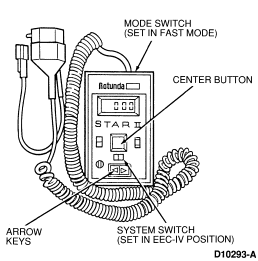
- Place system switch in the EEC-IV position.
- Tester in fast mode only (necessary to display three-digit codes).
- Keep tester leads away from any moving parts.
- Deactivate Self-Test by making sure the button in the middle is up. If
not, press button once to unlatch.
- Speaker switch on, if desired.
- Turn tester to the ON position.
 CAUTION: Do not replace parts based on a code, perform Pinpoint Tests first.
NOTE: If Super Star Tester or equivalent is unavailable, refer to Powertrain Control/Emissions Diagnosis Manual
for
alternate methods for performing On-Board Diagnostics tests.
Quick Test 3.0 Key On, Engine Off (KOEO)
Some special considerations for Key On, Engine Off Quick Test include the
following:
- The KOEO test provides both "hard" Diagnostic Trouble Codes (DTCs)
(present at the time of testing) and continuous memory DTCs.
- Always service the "hard" DTCs first. These are displayed first on the
tester.
Performing KOEO Self-Test
- Activate Self-Test by pressing center button on SUPER STAR II tester
(grounding Self-Test Input (STI)).
- Turn ignition switch to RUN position.
- Super Star II will run Self-Test and then output "hard" DTCs (or Code
111-pass test). "Hard" DTCs are repeated to make it easier to verify sequence.
After "hard" DTCs have been repeated (or Code 111 repeated) a single pulse
occurs to signal that next set of DTCs will be from continuous test (or Code
111-pass).
- To display DTCs, unlatch center button and use memory buttons to scroll
through codes.
Quick Test 4.0 Continuous Memory Codes
Continuous memory DTCs are from concerns which were detected during
normal vehicle operation. These DTCs are retained for 40 warm up cycles.
After servicing any KOEO or KOER "hard" DTCs and a pass code 111 is
received on both, service the continuous memory DTCs.
Some special considerations for Continuous testing include the following:
- The cause of some Continuous Memory Codes may have been eliminated if
KOEO and/or KOER DTCs were serviced. Always re-test and service any DTCs that
still remain.
- If DTCs are present, go to the On-Board Diagnostic Trouble Code
Description Chart in this Section for service information. Erase DTC, perform Drive Cycle Test
and repeat the Quick Test after completing service on the DTCs.
- If the continuous test passes (111) and a concern is still present, refer
to the Diagnosis by Symptom charts, Oasis and TSBs for concern
diagnostics.
CAUTION: DTCs in continuous memory can be erased by disconnecting the battery (10653) or by ungrounding the Self-Test Input (STI) while the codes are being
displayed during the KOEO Self-Test. This STI is ungrounded by disconnecting
the small data link connector
or unlatching the Star Tester button. Always write down the DTCs to
avoid losing information that can be used to diagnose the customer's concern.
- Service any non-transmission DTCs first as they can directly affect the
operation of the transmission. Repeat the Quick Test and Road Test to verify
the correction.
Special Test Modes
- Wiggle test mode:
- After all DTCs have been received the wiggle test mode may be entered by
pressing center button on star tester twice. This will unlatch and relatch STI.
- The wiggle test allows the technician to attempt to re-create an
intermittent malfunction. Tap, move and wiggle the suspected sensor and/or wire
harness. When a malfunction is detected the Self-Test Output (STO) will be
turned on as long as the concern is present. STO ON will cause the SUPER STAR
II Tester to sound a continuous tone. The Malfunction Indicator Lamp (MIL) will
also illuminate.
- Output cycling test mode:
- After all KOEO DTCs have been received, the output test mode is entered.
Actuator outputs will turn ON and OFF each time the throttle is pressed to WOT
and then returned to closed position.
Quick Test 5.0 Key On Engine Running (KOER)
The Engine Running Self-Test provides "hard" DTCs only.
Some special considerations for Engine Running Self-Test include the
following:
- After the engine ID code (STO LO flashes) is received, apply and release
the brake pedal, press and release the TCS.
- If a DTC appears after the KOER test, a malfunction is present. Refer to
and look up the DTC on the EEC-IV On-Board Diagnostic Trouble Code Description
Chart in this Section for service information.
Performing KOER Self-Test
NOTE: Engine must be warm or DTC 116—ECT out of Self-Test range
will occur.
- Connect SUPER STAR II Tester (if not already connected) with mode switch
set to FAST mode.
- Start and run engine until engine reaches operating temperature.
- Turn OFF engine and wait 10 seconds.
- Activate Self-Test (press center button on SUPER STAR II Tester).
- Start engine.
- Self-Test begins when the engine ID code is received. (This code consists
of the number of cylinders divided by 2 plus an added zero.)
| Number of Cylinders |
Engine ID Code |
| 8 |
40 |
- After the ID code is received, the technician must cycle the TCS. Then
press and release the brake service pedal to check BOO switch.
- A single output pulse (10) is sent to signal the technician to quickly
press the throttle to WOT and immediately release. SUPER STAR II TESTER will
display the word DYNAMIC.
- Diagnostic Trouble Codes (DTCs) are then sent.
- The Engine Running wiggle test may be entered upon completion of the KOER
Self-Test.
Special Test Mode
- Wiggle test mode:
- After all KOER DTCs have been received the wiggle test mode may be
entered by pressing the center button of the SUPER STAR II Tester twice. This
will unlatch and latch STI.
The wiggle test allows the technician to attempt to re-create an
intermittent malfunction. Tap, move and wiggle the suspected sensor and/or wire
harness. When a malfunction is detected the STO will be turned on as long as
the concern is present. STO ON will cause the STAR Tester to sound a continuous
tone. The malfunction indicator lamp (MIL) will also illuminate.
Quick Test 6.0 Computed Timing Check
This Quick Test is used to diagnose engine idle concerns only. Any engine
concerns or DTCs should be serviced BEFORE the transmission
concerns are serviced. Refer to the Powertrain Control/Emissions Diagnosis Manual