Section 03-03: Engine Cooling | 1994 Mustang Workshop Manual |
DIAGNOSIS AND TESTING
Component Tests
Cooling System Pressure Test
- Turn the engine OFF.
 WARNING: NEVER REMOVE THE RADIATOR CAP (8100)
UNDER ANY CONDITIONS WHILE THE ENGINE IS OPERATING.
FAILURE TO FOLLOW THESE INSTRUCTIONS COULD RESULT IN DAMAGE TO THE COOLING
SYSTEM OR ENGINE AND/OR PERSONAL INJURY. TO AVOID HAVING SCALDING HOT COOLANT
OR STEAM BLOW OUT OF THE RADIATOR (8005)
, USE EXTREME CARE WHEN REMOVING THE RADIATOR CAP
FROM A HOT RADIATOR
. WAIT UNTIL THE ENGINE HAS COOLED, THEN WRAP A THICK
CLOTH AROUND THE RADIATOR CAP
AND TURN RADIATOR CAP
SLOWLY TO THE FIRST PRESSURE STOP. STEP BACK WHILE THE
PRESSURE IS RELEASED FROM THE COOLING SYSTEM. WHEN CERTAIN ALL THE PRESSURE HAS
BEEN RELEASED, PRESS DOWN ON THE RADIATOR CAP
(STILL WITH A CLOTH), TURN AND REMOVE RADIATOR CAP
.
WARNING: NEVER REMOVE THE RADIATOR CAP (8100)
UNDER ANY CONDITIONS WHILE THE ENGINE IS OPERATING.
FAILURE TO FOLLOW THESE INSTRUCTIONS COULD RESULT IN DAMAGE TO THE COOLING
SYSTEM OR ENGINE AND/OR PERSONAL INJURY. TO AVOID HAVING SCALDING HOT COOLANT
OR STEAM BLOW OUT OF THE RADIATOR (8005)
, USE EXTREME CARE WHEN REMOVING THE RADIATOR CAP
FROM A HOT RADIATOR
. WAIT UNTIL THE ENGINE HAS COOLED, THEN WRAP A THICK
CLOTH AROUND THE RADIATOR CAP
AND TURN RADIATOR CAP
SLOWLY TO THE FIRST PRESSURE STOP. STEP BACK WHILE THE
PRESSURE IS RELEASED FROM THE COOLING SYSTEM. WHEN CERTAIN ALL THE PRESSURE HAS
BEEN RELEASED, PRESS DOWN ON THE RADIATOR CAP
(STILL WITH A CLOTH), TURN AND REMOVE RADIATOR CAP
.
NOTE: If the engine coolant is to be replaced, the remainder of this procedure
may be omitted.
- Check engine coolant for dirty or rusty appearance. Dirty or rusty coolant
requires replacement to protect the cooling system from corrosion damage.
Replace the engine coolant. Refer to Cooling System, Draining Filling and
Bleeding as outlined under Cleaning and
Inspection.
If coolant condition is satisfactory, check coolant
concentration for proper protection level. Use a Rotunda Battery and
Anti-Freeze Tester 021-00046 or equivalent, or a Hydrometer for testing.
Maintain a protection level of at least -30°C
(-20°F) to preserve anti-rust corrosion protection and ensure
proper engine operating temperature. If concentration level is low, partially
drain the engine cooling system by opening the radiator drain cock (8115)
or by partially removing the lower radiator hose (8286)
. Secure the radiator drain cock
or hose clamp and add 100 percent concentration of
Premium Cooling System Fluid E2FZ-19549-AA or B (in Canada, Motorcraft CXC-8-B)
or equivalent meeting Ford specifications ESE-M97B44-A and ESE-M97B43-A to
obtain the recommended protection level. Wet the rubber sealing surface of the radiator cap
before installing the radiator cap
tightly on the radiator
.
Coolant Specification: Use only a
permanent-type coolant such as Premium Cooling System Fluid E2FZ-19549-AA or B
(in Canada, Motorcraft CXC-8-B) or equivalent meeting Ford specifications
ESE-M97B44-A and ESE-M97B43-A.
- Disconnect the electrical connector from the water temperature indicator sender unit (10884)
and remove the water temperature indicator sender unit
from the engine.
With the radiator cap
installed and the cooling system pressure relieved, only
a small amount of engine coolant will be lost when the water temperature indicator sender unit
is removed.
- Install the adapter fitting from Rotunda Radiator/Heater Core Pressure
Tester 021-00012 or equivalent (male thread on one end, and a hose connector on
the other end to accommodate the tester hose) tightly into the intake manifold (9424)
or cylinder head (6049)
in place of the water temperature indicator sender unit
.
- Disconnect radiator overflow hose (8075)
from the radiator
. Install a separate hose, making sure hose is firmly
installed on the radiator overflow hose nipple and is in good condition. Insert
the free end of the radiator overflow hose
into a container of water.
- Attach the pressure pump and gauge to the adapter fitting and pressurize
the engine cooling system to the radiator cap lower limit as shown in the test
chart.
No bubbles should appear in the water container when the
system is pressurized to the lower limit. If the system is satisfactory at the
lower limit, gradually increase the system pressure until a slight stream of
bubbles appears in the water container. This is the upper pressure limit of the radiator cap
.
Replace any radiator cap
that exceeds the specified upper limit pressure without
discharging bubbles.
- If the radiator cap
does not hold pressure, remove and wash the radiator cap
in clean water to dislodge all foreign particles from
the gaskets. Check the sealing surface in the radiator filler neck.
Then inspect the cam lock flanges on both sides of the filler
neck for maximum radiator cap engagement.
NOTE: Small amount of "weeping" from water pump bleed hole is normal.
- Pressurize the engine cooling system as outlined in Step 6 (using a radiator cap
that operates within the specified upper and lower
pressure limits) and observe the gauge reading for approximately two minutes.
Refer to Specifications. Pressure should not drop during this time.
RESULTS: If the pressure drops, check for leaks
at the engine to heater water hoses (18472)
, engine-to-radiator hoses, bypass hose,
water valve hose (if applicable), water thermostat housing gasket, radiator
and heater core (18476)
and other connections. Also refer to engine system
checks if a leak cannot be located in cooling system. Any leaks which are found
must be corrected and system rechecked.
If the system holds pressure, proceed to Step 9.
- Release system pressure by loosening the radiator cap
and remove the adapter. Install the water temperature indicator sender unit
, check engine coolant level and replenish, if
necessary, with the correct coolant solution.
Radiator Cap Pressure Test
- Remove radiator cap
from radiator filler neck following outlined precautions.
NOTE: The adapter is designed to accept both deep and shallow neck radiator caps
.
- Use water to clean the radiator cap
in the area of the rubber seal and the vacuum relief
valve. Refer to Cleaning and
Inspection for procedure. Immerse the radiator cap
in water and install on the shallow filler neck of the
Rotunda Radiator/Heater Core Pressure Tester 021-00012 or equivalent.
NOTE: The filler neck seal is reversible so that it may be used on either a
deep or shallow radiator filler neck. It will also fit either end of the
radiator cap pressure test adapter.
- Immerse the filler neck seal in water and install in the filler neck
adapter.
- Install the filler neck adapter with filler neck seal on the deep filler
neck end to the radiator cap pressure test adapter.
- Connect the female quick connect fitting of the pressure test pump to the
male quick connect fitting of the filler neck adapter.
NOTE: If the plunger of the pump is depressed too fast, an erroneous pressure
reading will result.
- Slowly depress the plunger of the pressure test pump
until the pressure gauge reading stops increasing and note the highest pressure
reading obtained.
- Release the pressure by turning the pressure relief screw counterclockwise.
Then tighten the pressure relief screw and repeat Step 6 (at least twice) to
ensure the pressure test reading is repeatable within the acceptable gauge
reading limits of the radiator cap
and is not erratic. Refer to Specifications.
- If the pressure test gauge readings are not within the acceptable gauge
reading limits, replace the radiator cap
. If the pressure test gauge readings are within the
acceptable gauge reading limits, perform the Cooling System Pressure Test.
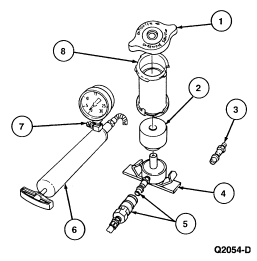
| Item |
Part Number |
Description |
|
1
|
8100
|
Radiator Cap
|
|
2
|
—
|
Filler Neck Seal (Part of 021-0012)
|
|
3
|
—
|
Temperature Sender Pressure Hose Adapter (Part of 021-00012)
|
|
4
|
—
|
Filler Neck Adapter (Part of 021-00012)
|
|
5
|
—
|
Quick Disconnect Fittings
|
|
6
|
021-00012
|
Radiator/Heater Core Pressure Tester
|
|
7
|
—
|
Pressure Relief Screw (Part of 021-00012)
|
|
8
|
—
|
Radiator Cap Test Adapter (Part of 021-00012)
|
Coolant Recovery System
In the event no engine coolant is observed in the radiator coolant recovery reservoir (8A080)
, or when a coolant level change does not occur, check
the system as follows:
- With the engine cold, remove the radiator cap
, and inspect the filler neck sealing gasket for foreign
material between the gasket and
diaphragm. Refer to Radiator
Cap Cleaning and Inspection. Rinse radiator cap
in clean water. The radiator cap
used on this system is unique; replace only with the
proper radiator cap
.
- Remove the radiator overflow hose at the radiator connection. Remove
radiator coolant recovery reservoir from fender apron and flush with clean
water.
- Inspect the radiator overflow hose for obstructions, cracks or cuts.
Replace if necessary.
- Install radiator coolant recovery reservoir and connect radiator overflow
hose at the radiator connection.
- Replenish the engine coolant in the radiator and add coolant to radiator
coolant recovery reservoir as required.
- Install the radiator cap
.
Water Thermostat Test
When investigating a concern of overheating or an insufficient
heater/defroster performance, perform the following:
- Check and service any leaks:
- Radiator cap.
- Heater hoses.
- Radiator hoses.
- Water outlet connection gasket.
- Head gasket.
- Water pump gasket.
- Check the cold engine coolant level in the radiator
.
- If the level is below the filler neck, fill to the filler neck with proper
coolant concentrate. Add coolant concentrate to the radiator coolant recovery reservoir
to the FULL COLD mark.
- If the cold coolant level in the radiator coolant recovery reservoir
is sufficient, run the vehicle for 10 minutes with the radiator cap
on and check for coolant circulation through the heater
and radiator hoses. If the coolant drops below the FULL HOT mark, add coolant
to the filler neck. Repeat the above procedure until all the air is purged from
the cooling system.
When this procedure has been completed, feel the heater inlet and outlet
hoses and the underside of the upper radiator hose (8260)
. The water thermostat (8575)
should be removed only if these
hoses are cold after 10 minutes of operation.
Radiator Leak Test, Removed from Vehicle
Clean the radiator
before leak testing to prevent contaminating the test
tank. Leak test the radiator
in clean
water with 138 kPa (20 psi) air pressure. Do
not leak test an aluminum radiator
in the same water that copper/brass radiators
are tested in. Flux and caustic cleaners may
be present in the tank and they will damage aluminum. A separate clean test
tank is necessary for aluminum radiators
. If conditions do not allow a separate tank
for aluminum radiator leak testing, thoroughly clean the test tank each time
before testing an aluminum radiator
in the tank.
When a tank is removed to service a tube-to-header leak, the core can be
leak tested by clamping the tank (with an O-ring gasket in place) to the core
and leak testing with air under water. When service is completed, install the
tank. Refer to Radiator Tank Installation.
Always install plugs in the transmission oil cooler fittings before leak
testing or cleaning any radiator
equipped with a transmission oil cooler (7A095)
.
Poor Heater and Defroster Performance
A low engine coolant level in the cooling system can cause poor heater
and defroster performance. (Any level below the filler neck is considered low.)
If this condition exists, perform the following:
- With cold engine, remove radiator cap
.
- With 50/50 mixture of specified antifreeze solution and water, fill cooling
system and replace radiator cap
. Observe the level of fluid in the radiator coolant recovery reservoir
. Adjust 50/50 mixture of antifreeze solution and water
to the FULL COLD mark on the radiator coolant recovery reservoir
.
- Start the engine and run until the water thermostat
opens.
- Shut off the engine and allow it to cool down. This permits engine coolant
to be drawn into the radiator
.
- Observe the level of coolant in the radiator coolant recovery reservoir
. The minimum level should be as specified in Step 2. If
not, adjust engine coolant level by adding coolant mixture.
- Check coolant level in radiator
when engine has cooled. Radiator
should be full. Add engine coolant if necessary.
Repeat Steps 3, 4 and 5.
- Check for leakage at:
- All hoses and hose connections.
- Radiator seams, radiator core and radiator drain cock
.
- All cylinder block core plugs and drain plugs.
- Edges of all cooling system gaskets.
- Transmission oil cooler fittings (if equipped).
- Vehicle heating system components.
- Water pump (8501).
- Examine oil level indicator (6750)
for evidence of engine coolant in engine oil.
- Check radiator
for evidence of oil in engine coolant (leakage at transmission oil cooler
).
Install cooling system analyzer to assist in testing the
cooling system. Follow the manufacturer's recommended connections and testing
procedures.
Coolant Condition and Protection Check
Remove radiator cap
following outlined precautions. Check coolant for dirty
or rusty appearance.
If coolant is not dirty or rusty in appearance, check coolant level and
concentration as outlined in the following procedures.
If coolant is dirty or rusty in appearance, drain the cooling system,
flush and refill as outlined.
Check coolant concentration for recommended protection level using
Rotunda Battery and Anti-Freeze Tester 021-00046 or equivalent. If
concentration is low, partially drain the cooling system and add 100 percent
anti-freeze solution such as Premium Cooling System Fluid E2FZ-19549-AA and B
(in Canada, Motorcraft CXC-8-B) or equivalent meeting Ford specifications
ESE-M97B44-A or ESE-M97B43-A, to obtain the recommended protection level.