Section 12-00: Climate Control System—Service
1993 Mustang Workshop Manual
DIAGNOSIS AND TESTING

Electrical

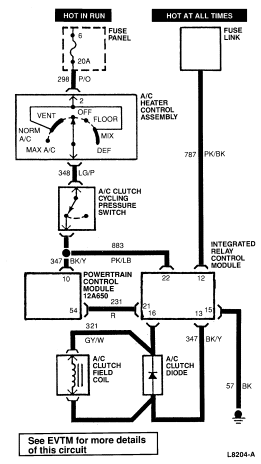
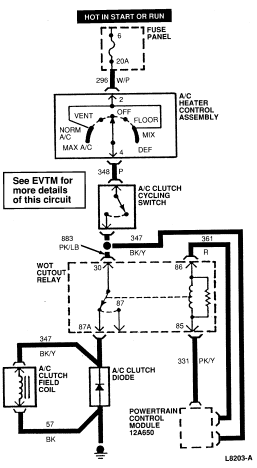
Refer to the Electrical and Vacuum Troubleshooting Manual for schematic and wire color information, system electrical wiring and continuity tests. The blower switch chart also provides blower motor voltage and current information for each blower switch position.

A/C System Wiring Diagram
2.3L


5.0L


PINPOINT TEST A: MANUAL A/C-HEATER SYSTEM VACUUM LEAK DIAGNOSIS


A1 CHECK CONNECTORS

Yes
RECHECK system for proper operation.

No
GO to A2.


A2 DETERMINE LEAKING VALVE

Yes
GO to A3.

No
GO to A5.


A3 CHECK SOURCE TUBE

  • Check vacuum source tube (black) from reservoir to control assembly for cut or disconnection.
  • Does hiss stop?
Yes
SERVICE tube. RECHECK system for proper operation.

No
GO to A4.


A4 PINCH OFF SOURCE TUBE

  • Pinch off source tube (black) at control assembly.
  • Does hiss stop?
Yes
REPLACE function selector switch valve. RECHECK system for proper operation.

No
RECHECK source tube (black), connections, reservoir and check valve. SERVICE or REPLACE as required.


A5 DETERMINE LEAKING HOSE(S)

  • Determine what color hose(s) are used in leaking function selector switch position(s). (Refer to airflow schematic and vacuum control chart).
  • Pinch off suspect hose(s), one at a time, near each respective vacuum motor.
  • Does hiss stop?
Yes
CHECK hose connection to vacuum motor and SERVICE and/or RECONNECT if loose or split. RECHECK for hiss. If hiss still continues, REPLACE vacuum motor. RECHECK system for proper operation.

 CAUTION: Never manually operate any vacuum motor or vacuum motor controlled door—this may cause internal damage to the vacuum motor diaphragm.

No
GO to A6.


A6 PINCH OFF SUSPECT HOSE(S)

  • Pinch off suspect hose(s), one at a time, near control assembly and/or in-line connector.
  • Does hiss stop?
Yes
CHECK hose for cut or damage. SERVICE as required. RECHECK system for proper operation.

No
REPLACE function selector switch.


PINPOINT TEST B: INSUFFICIENT OR NO A/C COOLING—FIXED ORIFICE TUBE CYCLING CLUTCH SYSTEM


B1 VERIFY THE CONDITION

  • Check system operation. Verify the charge in the system.
  • Does system cool properly?
Yes
INSTRUCT vehicle owner on proper use of the system.

No
GO to B2.


B2 CHECK COOLING FAN

  • Does vehicle have an electro-drive cooling fan?
Yes
GO to B3.

No
GO to B5.


B3 CHECK A/C COMPRESSOR CLUTCH

  • Does the A/C compressor clutch engage?
Yes
GO to B4.

No
REFER to clutch circuit diagnosis in this section.


B4 CHECK OPERATION OF COOLING FAN

  • Check to ensure electro-drive cooling fan runs when the A/C compressor clutch is engaged.
  • Is cooling fan operational?
Yes
GO to B5.

No
REFER to engine cooling fan circuit diagnosis, Section 03-03.


B5 COMPONENT CHECK

  • Underhood check of the following: Loose, missing or damaged compressor drive belt. Loose or disconnected A/C clutch or clutch cycling pressure switch wires/connectors. Disconnected resistor assembly. Loose vacuum lines or misadjusted control cables.
  • Inside vehicle check for: Blown fuse/proper blower motor operation. Vacuum motors/temperature door movement—full travel. Control electrical and vacuum connections.
  • Are components OK?
Yes
GO to B7.

No
SERVICE and GO to B6.


B6 CHECK SYSTEM

  • Check system operation.
  • Does system operate properly?
Yes
Condition corrected. GO to B1.

No
GO to B7.


B7 CHECK COMPRESSOR CLUTCH

  • Use refrigerant system pressure/clutch cycle rate and timing evaluation charts.
  • After preparing vehicle as follows: Hook up manifold gauge set. Set function control at MAX A/C. Set blower switch on HIGH. Set temperature lever full COLD. Close doors and windows. Use a thermometer to check temperature at center discharge register, record outside temperature. Run engine at approximately 1500 rpm with compressor clutch engaged. Stabilize with above conditions for 10-15 minutes.
  • Check compressor clutch off/on time with watch. Refer to charts for normal clutch cycle timing rates.
Compressor cycles very rapidly (5 seconds on) (5 seconds off)
GO to B8.

Compressor runs continuously (normal operation in ambient temperature above 27°C (80°F) depending on humidity conditions)
GO to B9.


B8 CHECK CLUTCH CYCLING PRESSURE SWITCH

  • Bypass clutch cycling pressure switch with jumper wire. Compressor on continuously.
  • Hand feel evaporator inlet and outlet tubes.
Outlet tube same temperature approximately -2°C-4°C (28°F-40°F) or slightly colder than inlet tube (after fixed orifice)
REPLACE clutch cycling pressure switch. Do not discharge system. Switch fitting has Schrader Valve. GO to B9.

Inlet tube warm or (after fixed orifice) colder than outlet tube
GO to B10.


B9 CHECK SYSTEM PRESSURES

  • Compare readings with normal system pressure ranges.
Clutch cycles within limits, system pressure within limits
System OK. GO to B1.

Compressor runs continuously (normal operation in ambient temperature above 27°C (80°F) depending on humidity conditions)
GO to B11.

Compressor cycles high or low ON above 259 kPa (52 psi) OFF below 144 kPa (20 psi)
REPLACE clutch cycling pressure switch. Do not discharge system. Switch fitting has Schrader valve. CHECK system. OK—GO to B1.

   
    NOT OK—RE-INSTALL original switch. GO to B10.
 

B10 CHECK SYSTEM

  • Leak check system.
  • Is system leaking?
Yes
SERVICE, discharge, evacuate and charge system. System OK, GO to B1.

No
Low refrigerant charge or moisture in system. Discharge, evacuate and charge system. System OK.


B11 CHECK CLUTCH CYCLING

  • Disconnect blower motor wire and check for clutch cycling off at 144 kPa (20 psi) (suction pressure).
Clutch cycles OFF at 144-179 kPa (20-26 psi)
CONNECT blower motor wire. System OK, GO to B1.

Pressure falls below 144 kPa (20 psi)
REPLACE clutch cycling pressure switch. Do not discharge system. Switch fitting has Schrader valve. System OK, GO to B1.


PINPOINT TEST C: A/C COMPRESSOR CLUTCH CIRCUIT DIAGNOSIS—2.3L


C1 CHECK SYSTEM OPERATION

  • Start engine.
  • Set the A/C control to MAX A/C.
  • Check battery voltage (If not 12.5 volts or more, refer to Charging System Diagnosis).
  • Does clutch engage?
Yes
Circuit functioning properly.

No
GO to C2.


C2 BYPASS PRESSURE SWITCH

  • Disconnect electrical connector from pressure switch on accumulator.
  • Jumper harness connector pins.
  • Engine must be running and system set at MAX A/C.
  • Does clutch engage?
Yes
GO to C3.

No
GO to C4.


C3 CHECK REFRIGERANT SYSTEM PRESSURES

  • Connect gauge set to service ports and observe pressure. Reading should be above 50 psi.
  • Is pressure above 50 psi?
Yes
REPLACE clutch cycling pressure switch. GO to C1.

No
CHECK refrigerant system for leaks. SERVICE as required. GO to C1.


C4 CHECK CLUTCH AIR GAP

  • Check air gap between clutch hub and pulley. Air gap must be within specified limits.
  • Is air gap within specifications?
Yes
REPLACE clutch field coil.

No
RESET air gap. REFER TO Section 12-03B. GO to C12.


C5 CHECK VOLTAGE AT PRESSURE SWITCH

  • Check for battery voltage at pressure switch electrical connector 883/347 circuit (P/LB and BK/Y).
  • Is there battery voltage?
Yes
GO to C10.

No
GO to C6.


C6 CHECK SUPPLY VOLTAGE TO PRESSURE SWITCH

  • Check for battery voltage at pressure switch Circuit 348 (LG/P).
  • Is there battery voltage?
No
GO to C7.

Yes
VERIFY that system pressure is above 50 psi. If above 50 psi, REPLACE pressure switch.


C7 CHECK FUSE

  • Check for voltage at fuse panel Circuit 298 (P/0).
  • Ignition switch must be in the ACC or RUN position.
  • Is voltage at least 12.5 volts?
Yes
GO to C8.

No
CHECK charging system operation and for high resistance in circuit. REFER to Section 14-00.

No voltage
CHECK fuse. SERVICE circuit as required. CHECK diodes in IRCM 9Pins 16 and 23) and across clutch coil for short. GO to C1.


C8 CHECK A/C SWITCH

  • Check for battery voltage at the A/C control switch outlet Circuit 348 (LG/P).
  • Is there battery voltage?
Yes
CHECK Circuit 348 between A/C switch and pressure switch for open. SERVICE as necessary.

No
GO to C9.


C9 CHECK POWER TO A/C SWITCH

  • Check for battery voltage at inlet of A/C switch Circuit 298 (P/O).
  • Is there battery voltage?
Yes
REPLACE A/C switch.

No
SERVICE wiring as necessary. GO to C1.


C10 CHECK CLUTCH CIRCUITS

  • Check for voltage across harness connector at clutch field coil.
  • Is there at least 10 volts?
Yes
GO to C12.

No
GO to C11.


C11 CHECK IRCM OUTPUT VOLTAGE

  • Check for voltage between Pins 16 and 23 of the IRCM.
  • Is there at least 10 volts?
Yes
CHECK clutch coil wiring harness for open circuit. SERVICE as necessary. GO to C1.

No
GO to C13.


C12 JUMP FIELD COIL

  • Disconnect field coil and jump battery voltage and ground to clutch field coil.
  • Does clutch engage?
Yes
SERVICE coil electrical terminals and RETEST.

No
GO to C14.


C13 CHECK CLUTCH SIGNAL AT IRCM

  • Check for a minimum of 11 volts at Pin 21 of the IRCM (Clutch input signal) with pressure switch jumped.
  • Is there at least 11 volts?
Yes
GO to C14.

No
Check circuit between A/C control and IRCM for open. SERVICE as necessary.


C14 CHECK A/C CUT-OUT SIGNAL

  • Remove wire from Pin 22 of IRCM harness connector. Then, start engine and set the EATC system at MAX A/C.
  • Does clutch engage?
No
REPLACE IRCM.

Yes
Powertrain Control Module (PCM) 12A650 is causing IRCM to interrupt compressor clutch circuit. Refer to Powertrain Control/Emissions Diagnosis Manual.


PINPOINT TEST D: A/C COMPRESSOR CLUTCH CIRCUIT DIAGNOSIS—5.0L


D1 CHECK SYSTEM OPERATION

  • Start engine.
  • Turn A/C on.
  • Check battery voltage (If not 12.5 volts or more, refer to Section 14-00 for charging system diagnosis).
  • Turn blower switch to HI.
  • Does compressor clutch engage after 5 second delay?
Yes
Circuit functioning properly.

No
GO to D2.


D2 BYPASS PRESSURE SWITCH

  • Disconnect electrical connector from pressure switch on accumulator.
  • Jumper harness connector pins.
  • Engine must be running and A/C turned to ON position.
  • Does clutch engage?
Yes
GO to D3.

No
GO to D4.


D3 CHECK REFRIGERANT SYSTEM PRESSURES

  • Connect gauge set to service ports and observe pressure. Reading should be above 50 psi.
  • Is pressure above 50 psi?
Yes
REPLACE clutch cycling pressure switch. GO to D1.

No
CHECK refrigerant system for leaks. SERVICE as required. GO to D1.


D4 CHECK CLUTCH AIR GAP

  • Check air gap between clutch hub and pulley. Air gap must be within specified limits.
  • Is air gap within specifications?
Yes
REPLACE clutch field coil.

No
SET air gap. REFER TO Section 12-03B.


D5 CHECK VOLTAGE AT PRESSURE SWITCH

  • Check for battery voltage at pressure switch electrical connector Circuit 348 (LG/P) to ground.
  • Is there battery voltage?
Yes
GO to D9.

No
GO to D6.


D6 CHECK A/C CONTROL SWITCH

  • Check for battery voltage at the A/C control switch 348 control (LG/P).
  • Is there battery voltage?
Yes
SERVICE wiring as necessary. GO to D1.

No
GO to D7.


D7 CHECK CONTROL SUPPLY VOLTAGE

  • Check for battery voltage at Control Assembly 298 Circuit (P/O).
  • Is there battery voltage?
Yes
REPLACE Control Assembly.

No
GO to D8.


D8 CHECK FUSE

  • Check for voltage at 298 circuit (P/O).
  • Ignition switch must be in the RUN position.
  • Is there battery voltage?
Yes
SERVICE wiring between fuse and control assembly. GO to D1.

No
CHECK fuse. If blown CHECK diode for short. SERVICE as required. GO to D1.

   
    CHECK charging system operation for high resistance in clutch circuit.
 

D9 CHECK CLUTCH CIRCUITS

  • Check for voltage across harness connector at clutch field coil.
  • Is there battery voltage?
Yes
GO to D11.

No
GO to D10.


D10 CHECK CLUTCH VOLTAGE

  • Check for voltage at clutch harness connector between 347 circuit (BK/Y) and ground.
  • Is there battery voltage?
Yes
GO to D12.

No
GO to D13.


D11 JUMP FIELD COIL

  • Disconnect field coil and jump battery voltage and ground to clutch field coil.
  • Does clutch engage?
Yes
CLEAN coil electrical terminals and RETEST.

No
GO to D4.


D12 CHECK CLUTCH GROUND

  • Check Circuit 57 (BK) at clutch harness connector for continuity to ground.
  • Must have continuity with minimum resistance.
  • Is there continuity?
No
SERVICE circuit and/or ground connection.

Yes
CHECK ground connection. CLEAN as required. GO to D1.


D13 CHECK VOLTAGE AT A/C CUT-OUT RELAY

  • Check for voltage at the A/C cut-out relay Circuit 883 (PK/LB) to ground.
  • Is there voltage?
No
SERVICE open circuit between A/C relay and pressure switch.

Yes
GO to D14.


D14 CHECK A/C CUT-OUT RELAY

  • Disconnect connector from relay.
  • Jumper across the connector Circuit 883 (PK/LB) to Circuit 347 (BK/Y).
  • With engine running and A/C ON, check for clutch engagement.
  • Does clutch engage?
Yes
GO to D15.

No
CHECK for shorted diode. SERVICE as required. GO to D1.


D15 CHECK A/C CUT-OUT RELAY OPERATION

  • With engine running and A/C ON, reconnect harness connector to A/C cut-out relay and check to see if relay energizes. The clutch circuit will open if the relay energizes.
  • Does relay energize?
No
REPLACE A/C cut-out relay.

Yes
PCM is causing IRCM to interrupt compressor clutch circuit. REFER to Powertrain Control/Emissions Diagnosis Manual.