Section 05-02A: Axle, Integral Carrier—7.5 Inch Ring Gear | 1993 Mustang Workshop Manual |
REMOVAL AND INSTALLATION
Pinion Oil Seal
Tools Required:
- Companion Flange Remover T65L-4851-B
- Companion Flange Holding Tool T78P-4851-A
- Pinion Seal Replacer T79P-4676-A
Removal
Replacement of pinion oil seal only involves removal and installation of
pinion nut and companion flange.
 CAUTION: This operation disturbs the pinion bearing preload, and this preload
must be carefully reset when assembling.
CAUTION: This operation disturbs the pinion bearing preload, and this preload
must be carefully reset when assembling.
- Raise the vehicle and install safety stands. Refer to Section 00-02. Remove
rear wheels and brake drums.
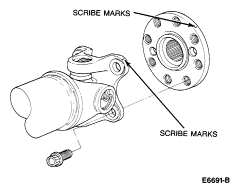
- Make scribe marks on the driveshaft axle end yoke and axle companion flange
to ensure proper position of the driveshaft during assembly. Disconnect the
driveshaft from the rear axle companion flange. Remove the driveshaft from the
transmission extension housing. Install an oil seal replacer tool in the
transmission extension housing to prevent oil leakage.
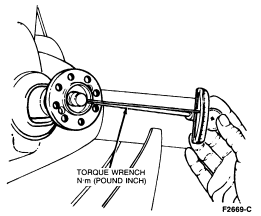
- Install a Nm (lb-in) torque wrench on the pinion nut.
Record torque required to maintain rotation of the pinion through several
revolutions.
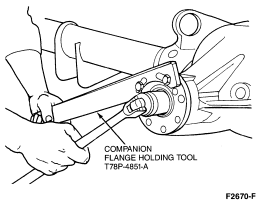
- While holding circular companion flange with Companion Flange Holding Tool
T78P-4851-A remove pinion nut.
- Clean area around oil seal. Place a drain pan under seal, or raise front of
vehicle higher than rear.
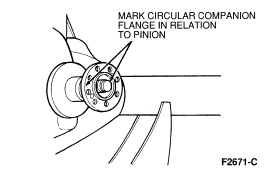
- Mark circular companion flange in relation to pinion shaft so flange can be
installed in same position.
CAUTION: The companion flange must never be removed with a hammer.
- Remove circular companion flange using Companion Flange Remover T65L-4851-B.
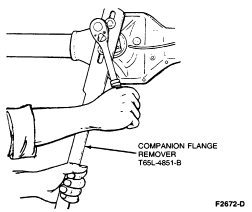
CAUTION: Do not damage housing while removing seal.
- Position screwdriver under flange of pinion seal and strike with hammer to
wedge screwdriver blade between metal flange of pinion seal and differential
housing.
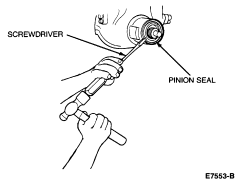
- Pry up on metal flange of pinion seal. Install gripping pliers and strike
with hammer until pinion seal is removed.
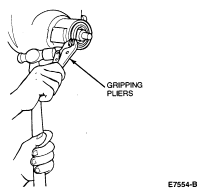
Installation
CAUTION: Installation without proper tool may result in early seal failure. If
seal becomes cocked during installation, remove and replace with new seal.
- Clean the pinion seal seat surface and install seal on Pinion Seal Replacer
T79P-4676-A and install seal in carrier. If not pre-greased, apply Premium
Long-Life Grease XG-1-C (ESA-M1C75-B) or equivalent, between the lips of the
seal.
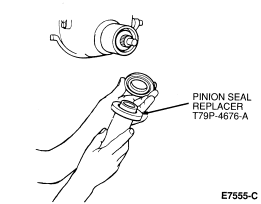
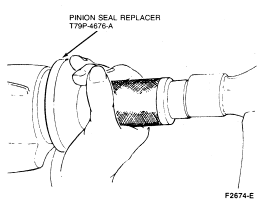
- Check splines on the pinion shaft to be sure they are free of burrs. If
burrs are evident, remove them by using a fine crocus cloth. Working in a
rotating motion, wipe the pinion clean.
- Install pinion seal in carrier.
- Apply a small amount of axle lubricant to circular companion flange splines.
- Align mark on the circular companion flange with the mark on the pinion
shaft. Install flange.
- Install a new nut on pinion shaft. Apply a small amount of axle lubricant
on the washer side of nut.
- Hold the circular companion flange with Companion Flange Holding Tool
T78P-4851-A while tightening the nut.
- Rotate pinion occasionally to ensure proper bearing seating. Take frequent
pinion bearing torque preload readings while tightening until the original
recorded preload reading is obtained.
- If the original recorded preload is less than specification, tighten to
specification. If the preload is higher than specification, tighten to original
reading as recorded.
Under no circumstances should the pinion nut be backed-off to
reduce preload. If reduced preload is required, a new collapsible pinion spacer
and pinion nut should be installed.
CAUTION: The circular companion flange must never be hammered on, or assembled
with power tools.
- Remove oil seal replacer tool from the transmission extension housing.
Install front end of driveshaft on the transmission output shaft.
- Connect the rear end of the driveshaft to the circular companion flange,
aligning the scribe marks on the driveshaft and circular companion flange.
Tighten the four bolts to 95-130 Nm (70-95 lb-ft).
- Add axle lubricant until it is 6-14mm (1/4-9/16 inch) below the bottom of
the fill hole with the axle in operating position. Do not exceed
this level. Refer to Specifications. Install fill plug. Tighten to 20-41 Nm
(15-30 lb-ft).
CAUTION: Overfilling axles can cause axle vent leakage.
- Ensure axle vent is not plugged with debris.