Section 03-13: Evaporative Emissions | 1993 Mustang Workshop Manual |
DIAGNOSIS AND TESTING
Fuel Tank Evaporative Emission System
Refer to the Powertrain Control/Emissions Diagnosis Manual for diagnosis of Engine Evaporative Emission System.
The following is a diagnostic guide for checking and/or servicing
concerns of internal fuel tank pressure build-up. A typical concern may be a
hissing sound as the fuel cap is removed for refueling.
The basic fuel tank venting system is typical for all vehicles.
The fuel evaporative emission system allows for controlled release of
fuel tank pressure through a carbon vapor storage canister. Under normal
operating conditions, this system will allow sufficient venting to prevent a
build-up of internal fuel tank pressure.
Some operating conditions may cause temporary build-up of internal fuel
tank pressure. Some of these conditions are:
- On warm or hot days, parking the vehicle after filling the fuel tank, the
fuel is cool from underground storage and vaporizes rapidly when warmed.
- Parking after driving over rough roads, washboard, etc., after filling
the fuel tank. Agitation of fuel increases vaporization.
- Parking after driving long distances in high temperature conditions.
- Climbing long grades, especially while towing a trailer, or while fully
loaded.
A normally functioning evaporative emission system will relieve the
pressure buildup.
No service is required if these conditions caused the customer concern. A
blocked fuel evaporative emission system can cause abnormal fuel tank pressure
and must be serviced. Refer to the chart for diagnosis and flow test.
PINPOINT TEST A: EVAPORATIVE EMISSIONS DIAGNOSIS (UNLEADED GASOLINE ONLY)
A1 CANISTER HOSE AND INLET TUBE BLOCKAGE TEST
- Test canister hose and inlet nipple for blockage.
Are hoses or inlet blocked?
 Yes
Yes
REMOVE blockage. No
GO to B1.
A2 FUEL EVAPORATIVE EMISSION SYSTEM BLOCKAGE TEST
- Test fuel evaporative emission system for blockage.
Are all system passages open?
Yes
REMOVE blockage or REPLACE component. No
GO to B2.
A3 VAPOR TUBE INSPECTION
- Inspect vapor tube and hoses for kinks or pinched areas.
Are tube or hoses kinked or pinched?
Yes
SERVICE or REPLACE tube or hoses. VERIFY service. No
GO to A4.
A4 VAPOR HOSE INSPECTION
- Inspect vapor hose routing between fuel tank and body for pinch.
Yes
LOOSEN fuel tank and reroute hose. VERIFY service. No
GO to A5.
A5 VAPOR SEPARATOR VALVE INSPECTION
- Remove vapor separator valve.
- Inspect valve for open air passage through orifice.
Yes
INSTALL valve in tank. INSTALL tank system test complete. No
REPLACE valve. VERIFY service.
PINPOINT TEST B: FLOW TEST—FUEL EVAPORATIVE SYSTEM (UNLEADED GASOLINE ONLY)
B1 FLOW TEST (FUEL CAP INSTALLED)
 CAUTION: Do not use other high pressure air supplies. Will result in damage to canister.
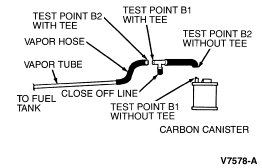
- Install hand pump and pressure gauge Rotunda 021-00014 Vacuum and Pressure Tester or equivalent in vapor hose at test point B1.
- Hand pump to a maximum of 17.2 kPa (2.5 psi).
Pressure drop:
Drops to zero immediately
System flow OK, no servicing required. Holds pressure or leaks down slowly
PERFORM Pinpoint Test Step A3.
B2 FLOW TEST (FUEL CAP REMOVED)
CAUTION: Failure to remove fuel cap may result in damage to fuel tank.
- Install hand pump and pressure gauge onto tee or canister nipple at test point B2.
- Hand pump to a maximum of 17.2 kPa (2.5 psi).
Pressure drop:
Drops to zero immediately
System OK, no servicing required. Holds pressure or leaks down slowly
PERFORM Pinpoint Test Step A4.