Section 11-02: Steering System, Power
1993 Mustang Workshop Manual
DIAGNOSIS

Power Steering Diagnosis

The diagnosis charts provide procedures to resolve typical customer concerns encountered with the power steering system. Follow the sequence indicated to save time during condition identification and corrective action.

Before any internal service is performed on the rack and pinion power steering, diagnosis of the condition must be performed. Ensure that the tire size is correct, with matched tires (front and rear), all inflated to specifications. The following conditions, possible sources and corrective action will assist in performing the proper service.
POWER STEERING DIAGNOSIS
ConditionPossible SourceAction
  • Wander: Condition Where Vehicle Wanders Side-To-Side On The Roadway When Being Driven Straight Ahead While The Steering Wheel Is Held In A Firm Position. Evaluation Should Be Conducted On A Level Road (Little Road Crown).
  • Loose tie rod ends.
  • Replace tie rod end assemblies.
 
  • Inner ball housing loose or worn.
  • Replace tie rod assemblies.
 
  • Gear assembly loose on No. 2 crossmember.
  • Tighten the two mounting nuts to specification.
 
  • Loose suspension struts or ball joints.
  • Adjust or replace as required.
 
  • Column intermediate shaft connecting bolts loose.
  • Tighten bolts to specification.
 
  • Column intermediate shaft joints loose or worn.
  • Replace intermediate shaft.
 
  • Improper wheel alignment.
  • Set alignment to specification.
  • Feedback—Rattle, Chuckle, Knocking Noises In the Steering Gear. Condition Where Roughness Is Felt In The Steering Wheel By The Driver When The Vehicle Is Driven Over Rough Pavement.
  • Column U-joints loose.
  • Replace if damaged or worn.
 
  • Loose tie rod ends.
  • Replace tie rod end assemblies.
 
  • Loose/worn tie rod ball.
  • Replace tie rod assemblies.
 
  • Gear assembly loose on No. 2 crossmember.
  • Tighten the two mounting nuts to specification.
 
  • Piston disengaged or loose on rack.
  • Replace rack assembly.
 
  • Column intermediate shaft connecting bolts loose.
  • Tighten bolts to specification.
 
  • Loose suspension struts or ball joints.
  • Adjust or replace as necessary.
  • Poor Returnability — Sticky Feel: Condition Where Poor Returnability Is Noticed When The Steering Fails To Return To Center Following A Turn Without Manual Effort From The Driver. In Addition, When The Driver Returns The Steering To Center, It May Have A Sticky Or Catchy Feel.
  • Misaligned steering column or column flange rubbing steering wheel and/or flange
  • Align column.
 
  • Check rotational torque of intermediate shaft joints.
  • If binding, replace intermediate shaft.
 
  • Tight inner tie rod ball joints.
  • Replace tie rod as required.
 
  • Tight tie rod end ball studs.
  • Replace tie rod end assemblies.
 
  • Binding in valve assembly.
  • Replace input shaft valve assembly.
 
  • Bent or damaged rack.
  • Replace rack assembly.
 
  • Bent or damaged No. 2 crossmember.
  • Replace as necessary.
 
  • Column bearing binding.
  • Replace bearing.
 
  • Tight suspension struts or lower control arm ball joints.
  • Adjust or replace as required
 
  • Improper wheel alignment.
  • Set to specification.
 
  • Contamination in system.
  • Flush power steering system.
  • Heavy Steering Efforts — Poor or Loss of Assist: Condition Where A Heavy Effort And Poor Assist Condition Is Recognized By The Driver While Turning Corners And Especially While Parking. A Road Test Will Verify This Condition.
  • Leakage/loss of fluid.
 
  • Low pump fluid.
  • Fill as necessary.
 
  • Valve seal cut or twisted.
  • Replace seal.
 
  • Damaged/worn Teflon piston seal.
  • Replace seal.
 
  • Loose/missing rubber backup piston O-ring.
  • Replace/install O-ring.
 
  • Loose rack piston.
  • Replace rack assembly.
 
  • Gear assembly oil passages restricted.
  • Clear/service as required.
 
  • Bent/damaged rack assembly.
  • Replace rack assembly.
 
  • Pump external leakage.
 
  • Improper drive belt tension.
  • Readjust belt tension.
 
  • Hose or cooler external leakage.
  • Replace as necessary.
 
  • Improper engine idle speed.
  • Readjust idle.
 
  • Pulley loose or warped.
  • Replace pulley.
 
  • Pump/flow pressure not to specification.
 
  • Hose/cooler line restrictions.
  • Clear or replace as required.
FORD INTEGRAL POWER RACK-AND-PINION STEERING GEAR
ConditionPossible SourceAction
  • Hissing Sound

    NOTE: There is some noise in all power steering systems. One of the most common is a hissing sound most evident at standstill parking. There is no relationship between this noise and the performance of the steering gear.

     CAUTION: Do not hold steering wheel at full lock more than five seconds, as damage to power steering pump may result.
  • Hiss may be expected when the steering wheel is at the end of travel or when turning at standstill.
  • Hiss is a normal characteristic of rotary steering gears and in no way affects steering. Do not replace the rack assembly unless the hiss is extremely objectionable. A replacement rack will also exhibit a slight noise and is not always a cure for the condition. Investigate for a grounded column or a loose boot at the dash panel. Any metal-to-metal contact will transmit valve hiss into the passenger compartment through the steering column. Verify clearance between flexible coupling components. Ensure steering column shaft and gear are aligned so flexible coupling rotates in a flat plane and is not distorted as shaft rotates.


External Leakage


When looking for leads, use this procedure to pinpoint the exact cause and location to avoid misdiagnosis:

  1. Check for overfilled power steering pump reservoir.
  1. Wipe suspected area dry.
  1. Check for power steering pump overflow and aeration.
  1. Check for exact source of oil. Example: Oil may be running down from another area (engine, etc.) and the drip may not be at the leak point.

     CAUTION: Do not hold the steering wheel against a stop for more than three to five seconds at a time. Cycle the steering wheel from stop-to-stop 10 times and check for leaks. The bellows may have to be moved back from the housing to see the leak.

  1. Some leaks are high-pressure leaks and may require holding the steering wheel against the stops to seep out.
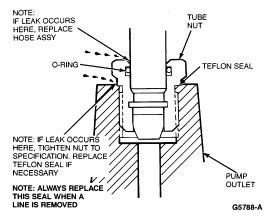
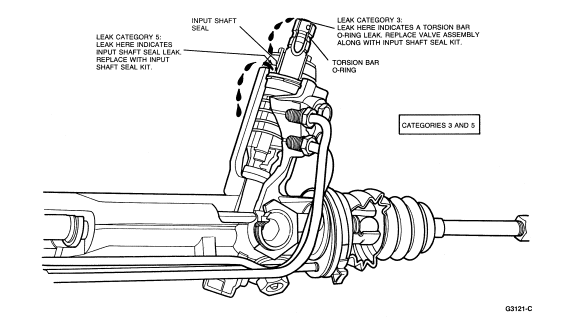
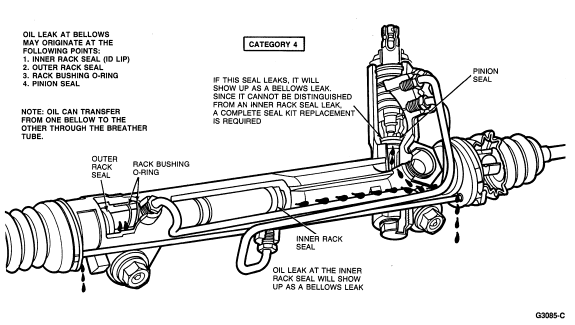
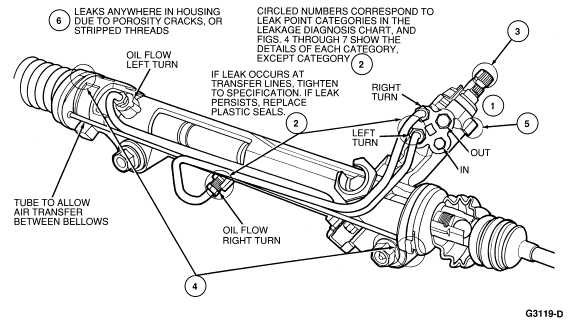
  1. Power steering gear assembly leaks fall into several categories as listed in the Leakage Diagnosis chart. The category determines which seals or parts to replace. Refer to the corresponding illustrations for the leak category.

    LEAKAGE DIAGNOSIS
    Leak Category Part Required to Service
    1. Hose fittings.
    • Loose—Tighten to specification—Do not over-tighten.
    • Plastic seals at tube nut—Plastic seals should be replaced each time hose is disconnected.
    • O-ring leaks—Replace hose.
    2. Leak at (right or left) transfer line.
    • Loose—Tighten to specification—Do not over-tighten.
    • Replace plastic seals.
    • Replace line assembly as required.
    3. Leak at input shaft seal.
    • Replace input shaft seal kit. Rack and tie rod assembly removal is not required.
    4. Leak at either or both bellows.
    • Replace all gear housing and rack bushing seals. Do not disturb transfer lines.
    5. Leak at end of input shaft.
    • Replace input shaft valve assembly along with input shaft seal kit. Rack and tie rod assembly removal is not required.
    6. Housing—porosity, cracked or stripped threads.
    • Replace the housing assembly.

    NOTE: Whenever a gear assembly is disassembled for seal replacement, the gear seal contact surfaces should be checked for roughness and cleaned. Replace components such as input shaft/valve assembly or rack assembly only if the sealing surfaces cannot be cleaned satisfactorily with crocus cloth.


    NOTE: When replacing hose due to leak the hose is supplied with tube nut.