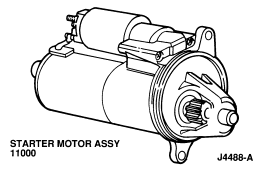
CAUTION: Make sure that the starter is securely mounted in bench vise while
energizing, as starter will move or jump.
CAUTION: Make sure that the starter is securely mounted in bench vise while
energizing, as starter will move or jump.
Section 03-06: Starting System | 1993 Mustang Workshop Manual |
Tools Required:
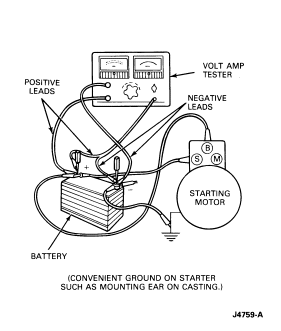
Starter No-Load Test
The starter no-load test will uncover such conditions as open or shorted windings, or rubbing armature. The starter can be tested, at no-load, on the test bench only.
CAUTION: Make sure that the starter is securely mounted in bench vise while
energizing, as starter will move or jump.
Armature Open Circuit Test
An open circuit armature may sometimes be detected by examining the commutator for evidence of burning. A burn spot on the commutator is caused by an arc formed every time the commutator segment, connected to the open circuit winding, passes under a brush.
Grounded Armature Test
This test will determine if the winding insulation has been damaged,
permitting a conductor to touch the frame or armature core. To determine if the
armature windings are grounded, check with a Rotunda Digital Volt-Ohmmeter
007-00001 or equivalent. Infinite resistance indicates a normal condition. 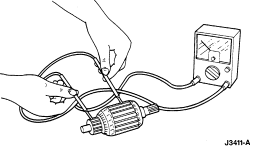
Starter Solenoid Test
Ensure that the solenoid is isolated electrically from the motor. Using a DVOM, check for continuity between S terminal and M terminal, and between S terminal and ground (frame). If there is no continuity, the following conditions may exist: