Section 00-04: Noise, Vibration and Harshness | 1993 Mustang Workshop Manual |
NVH DIAGNOSIS
Axle Noise
- Gear noise is the typical howling or whining of the
ring gear and pinion due to an improper gear pattern, gear damage, or improper
bearing preload. It can occur at various speeds and driving conditions, or it
can be continuous.
- Chuckle is a particular rattling noise that sounds
like a stick against the spokes of a spinning bicycle wheel. It occurs while
decelerating from 64 km/h (40 mph) and can usually be heard all the way to a
stop. The frequency varies with the speed of the vehicle.
- Knock is very similar to chuckle, though it may be
louder and occurs on acceleration or deceleration. The teardown will disclose
what has to be corrected.
- Chatter on corners is a condition where the whole
rear end vibrates only when the vehicle is moving. The vibration is plainly
felt as well as heard. In conventional axles, extra differential thrust washers
cause a condition of partial lockup that creates this chatter. Chatter noise on
Traction-Lok axles can usually be traced to erratic movement between adjacent
clutch components and can sometimes be corrected with a lubricant change and
the addition of a friction modifier.
- Click at engagement is a condition on axles of a
slight noise, distinct from a clunk, that happens in REVERSE or DRIVE
engagement. Check for the presence of a pinion oil slinger.
- Axle shaft noise is similar to gear noise and pinion
bearing whine. However, rear wheel bearing noise will normally distinguish
itself from gear noise by occurring in all driving modes (drive, coast and
float) and will persist with transmission in NEUTRAL while vehicle is moving at
difficult speed. If upon ride evaluation vehicle displays above noise
condition, remove suspect axle shafts, replace wheel seals, and install a new
set of axle shafts. Re-evaluate vehicle for noise before removing any internal
components.
- Boom is a condition that exists when ring gear teeth
have a runout of more than 0.10mm (0.004 inch). Refer to Boom Diagnosis.
Exhaust System
To neutralize exhaust system noise, the following steps must be taken:
- Loosen exhaust inlet pipes to manifolds, the fasteners at the flat flanges
and the U-clamp at muffler inlet pipe.
- Place a stand supporting muffler. Raise muffler to a height so that the
system is parallel to the frame and the muffler hanger is unloaded.
- Tighten flat flanges.
- Position exhaust inlet pipes to manifolds and tighten. Ensure that catalyst
heat shields do not contact frame rails.
- Prior to tightening U-clamp on muffler inlet pipe, ensure that tail pipe
over axle assembly is spaced evenly between upper control arm and rear
suspension spring. Tighten U-clamp.
- With complete exhaust system tight (and in cold condition) the rear hanger
strap should be angling forward, to allow the system to expand rearward, when
heated to normal running temperature.
Chuckle
Chuckle that occurs on the driving phase is usually caused by excessive
clearance due to differential gear wear or by a damaged tooth on the coast side
of the pinion or ring gear.
Any damage to a gear tooth on the coast side can cause a noise identical
to chuckle. Even a very small tooth nick or ridge on the edge of a tooth is
enough to cause the noise.
This condition can be corrected and the noise eliminated by cleaning up
the gear tooth nick or ridge with a small grinding wheel. If the cleaned up or
damaged area is larger than 3.2mm (1/8 inch), it is advisable to replace the
gearset.
If either gear is scored or damaged badly, the gearset must be replaced.
Also, if there is metal broken loose, the carrier and housing must be cleaned
to remove particles that could cause damage later. Any other damaged parts in
the axle must be replaced.
To check the gearset, remove as much lubricant as possible from the gears
with clean solvent. Wipe the gears dry or blow them dry with compressed air.
Look for scored or damaged teeth. Also look for cracks or other damage.
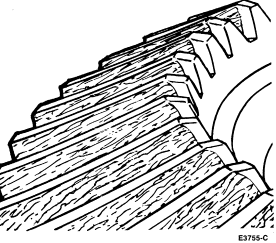
Damaged Gear Teeth
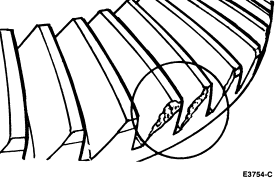
Scored Gear Teeth