1999 PCED On Board Diagnostics II |
SECTION 1: Description and Operation |
Misfire Detection Monitor
The Misfire Detection Monitor is an on-board strategy designed to
monitor engine misfire and identify the specific cylinder in which the misfire
has occurred. Misfire is defined as lack of combustion in a cylinder due to
absence of spark, poor fuel metering, poor compression, or any other cause.
The Misfire Detection Monitor will be enabled only when certain base engine
conditions are first satisfied. Input from the ECT, MAF and CKP sensors is
required to enable the monitor. The Misfire Detection Monitor is also
performed during on demand self-test.
-
The PCM synchronized ignition spark is based on information received
from the CKP sensor. The CKP signal generated is also the main input used in
determining cylinder misfire.
-
The input signal generated by the CKP sensor is derived by sensing the
passage of teeth from the crankshaft position wheel mounted on the end of the
crankshaft.
-
The input signal to the PCM is then used to calculate the time between
CKP edges and also crankshaft rotational velocity and acceleration. By
comparing the accelerations of each cylinder event, the power loss of each
cylinder is determined. When the power loss of a particular cylinder is
sufficiently less than a calibrated value and other criteria is met, then the
suspect cylinder is determined to have misfired.
-
Misfire type A:
Upon detection of a Misfire type A (200 revolutions) which would cause
catalyst damage, the MIL will blink once per second during the actual misfire,
and a DTC will be stored.
Misfire type B:
Upon detection of a Misfire type B (1000 revolutions) which will exceed
the emissions threshold or cause a vehicle to fail an inspection and
maintenance tailpipe emissions test, the MIL will illuminate and a DTC will be
stored.
The DTC associated with multiple cylinder misfire for a Type A or Type
B misfire is DTC P0300.
The DTCs associated with an individual cylinder misfire for a Type A or
Type B misfire are DTCs P0301, P0302, P0303, P0304, P0305, P0306, P0307,
P0308, P0309 and P0310.
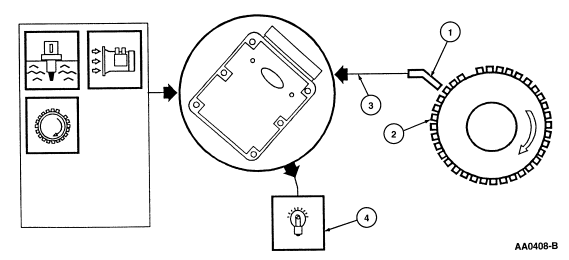
Figure 13: Misfire Detection Monitor