1999 PCED On Board Diagnostics II |
SECTION 1: Description and Operation |
Each vehicle has a decal (Figures 1, 2 and 3) containing emission control information that applies specifically to the vehicle and engine. The specifications on the decal are critical to servicing emissions systems.
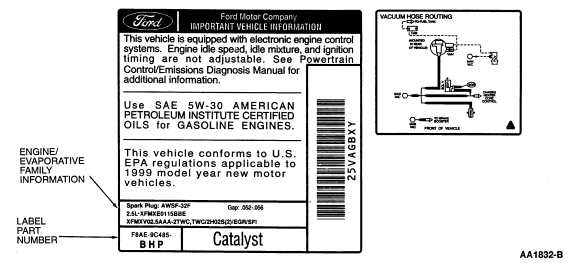
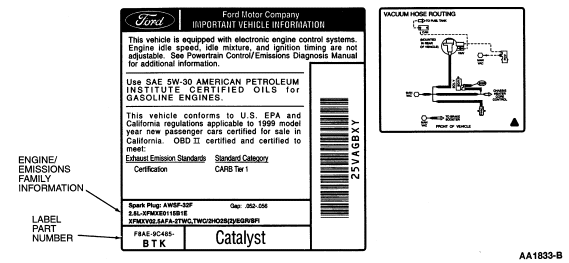
In addition to the tune-up specifications and procedures, the emission decal shows a color-coded (shown in black and white) schematic of the engine vacuum system. The color coding on the schematic represents the actual color coding on the vacuum hoses. However, there will be instances when a hose color does not match the color on the decal.
Typical location of the decal will be on the underside of the hood or the radiator support sight shield.
Powertrain Base Calibration Information is located in the lower right corner of the Vehicle Certification Label. Only the Base Calibration will appear on this label (Figure 3). The Revision Level is no longer printed on the label, however it can be found in On-Line Automotive Service Information System (Oasis). For the 1999 model year Ford Motor Company is using two different Protocols which describe Powertrain Base Calibration. The Protocols are designed to provide worldwide standardization for vehicle calibration. If electronic engine control strategy is carried over to the 1999 model year from 1998, Protocol 1 is used (see Table 1 below). New strategies for the 1999 model year use Protocol 2 (see Table 2 below). For more information on Vehicle Certification Label, refer to the Workshop Manual.
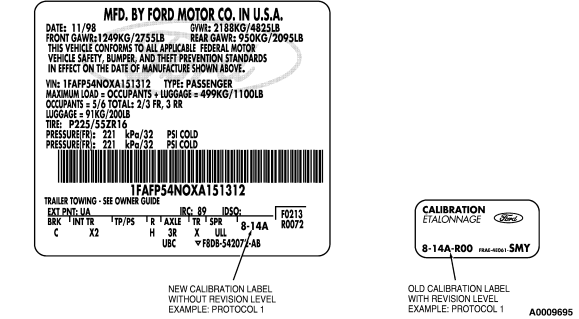
Typical location of Vehicle Certification label is on LH door or door post pillar.
Table 1: Protocol 1—1998 Strategy Carried Over To The 1999 Model Year
| 8 14A R00 | |
|---|---|
| 8 | MODEL YEAR—Model Year in which calibration was first introduced. Example: "8" = 1998. |
| 14A | DESIGN LEVEL—Design level assigned to the engine. |
| R00* | REVISION LEVEL—Revision level of the calibration. Will advance as revisions occur. |
Table 2: Protocol 2—1999 Model Year Strategy, Non-Carryover
| 9 EQ M B A A | |
|---|---|
| 9 | MODEL YEAR—Model year in which calibration was first introduced. Example: "9" = 1999. |
| EQ | ENGINE CODE—Engine description. Example: "EQ" = 2.0L DOHC EFI NA I-4 Zeta. |
| M | TRANSMISSION CODE—Transmission description. Example: "M" = manual, "A" = Automatic |
| B | EMISSION STANDARD—Designates the specific country emission standard. Example: "B" = U.S. California |
| A | DESIGN LEVEL—Design level assigned to the engine. |
| A* | REVISION LEVEL—Revision level of the calibration. Will advance as revisions occur. |