Section 12-03A: Air Conditioning System—Manual A/C-Heater | 1994 Mustang Workshop Manual |
DESCRIPTION AND OPERATION
Refrigerant System
The manual A/C-heater refrigerant system uses the following components:
- A/C compressor (19703).
- A/C condenser core (19712).
- A/C evaporator core (19860).
- A/C evaporator core orifice (19D990) in the condenser to evaporator tube (19835) near the A/C condenser core
.
- A/C cyclic switch (19E561).
- Service access gauge port valves.
- And the necessary refrigerant lines for the system.
Service Access Gauge Port Valves
The refrigerant system has a high-pressure (discharge) and a low-pressure
(suction) gauge port valve. The quick disconnects (Rotunda 176-R0026 R134a Low
Side Quick Disconnect and 176-R0027 R-134a High Side Quick Disconnect or
equivalents) must be used to make the manifold gauge set work.
Always replace the A/C charging valve caps (19D702)
on the service access gauge port valves
after servicing the refrigerant system.
A/C Evaporator Core
NOTE: Replacement of the suction accumulator/drier is not required
when repairing the air conditioning system except when there is
physical evidence of system contamination from a failed A/C
compressor or damage to the suction accumulator/drier.
The A/C evaporator core has the following features:
- It is a multi-pass plate/fin-type mounted in a vertical position.
- Vaporized refrigerant enters the A/C evaporator core
at the lower corner and flows through the first three
plate/fin sections to the other end.
- The refrigerant then reverses and flows through the next three plate/fin
sections to the opposite end; there, the flow again reverses and flows through
the remaining four plate/fin sections to the condenser to evaporator tube
.
- This S-pass flow pattern accelerates the flow of
refrigerant through the A/C evaporator core
which does not have a liquid bleed line.
- The multi-pass A/C evaporator core can be identified by a paint spot on the condenser to evaporator tube
, a blue shipping cap and folded-down locator tabs.
A/C Evaporator Core Orifice
The A/C evaporator core orifice
assembly has the following features:
- It provides a restriction between the high and low pressure liquid
refrigerant.
- It meters the flow of liquid refrigerant into the A/C evaporator core
.
- A/C evaporator core temperature is controlled by sensing the
pressure within the A/C evaporator core
with a pressure-operated electric switch.
- The A/C cyclic switch controls A/C compressor operation as
necessary to maintain the A/C evaporator core pressure within specified limits.
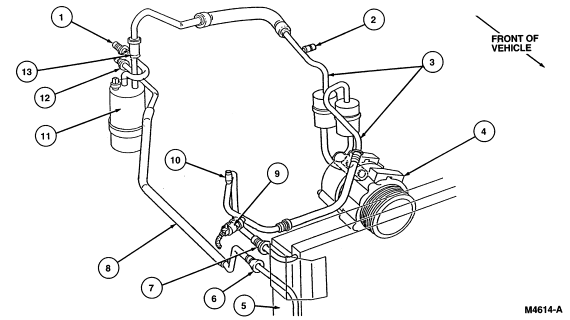
| Item |
Part Number |
Description |
|
1
|
—
|
From Evaporator Core Outlet Tube
|
|
2
|
—
|
Low Side Service Valve Body (Part of 19D734)
|
|
3
|
19D734
|
A/C Manifold and Tube
|
|
4
|
19703
|
A/C Compressor
|
|
5
|
19712
|
A/C Condenser Core
|
|
6
|
—
|
To A/C Evaporator Core
|
|
7
|
—
|
From A/C Compressor
|
|
8
|
19835
|
Condenser to Evaporator Tube
|
|
9
|
19D594
|
A/C Pressure Cut-Off Switch
|
|
10
|
—
|
High Side Service Valve Body (Part of 19D734)
|
|
11
|
19C913
|
Suction Accumulator/Drier
|
|
12
|
—
|
To A/C Evaporator Core
|
|
13
|
—
|
Suction Hose From Accumulator (Part of 19C836)
|
- The A/C evaporator core orifice is located in the condenser to evaporator tube near the A/C compressor
.
- It has filter screens located on the inlet and outlet ends of the tube
body. The filter screens act as a strainer for the liquid refrigerant flowing
through the A/C evaporator core orifice opening.
- O-ring seals (9229), on the tube body, prevent the high pressure liquid refrigerant from
bypassing the A/C evaporator core orifice
.
- Adjustment or services cannot be made to the A/C evaporator core orifice
assembly.
- It must be replaced as a unit.
Suction Accumulator/Drier
The suction accumulator/drier has the following features:
- It is mounted to the engine side of the dash panel (01610)
on the right side of the vehicle.
- The inlet tube of the suction accumulator/drier
attaches directly to the A/C evaporator core outlet
tube.
- Refrigerant enters the suction accumulator/drier canister through the
inlet tube and the heavier oil-laden refrigerant falls to the bottom of the
canister. A small-diameter oil bleed hole is located in the side of the outlet
tube near the bottom of the canister. This bleed hole is covered with a filter
and allows a small amount of the heavier liquid refrigerant and oil mixture to
re-enter the suction line at a controlled rate.
- When the heavier liquid refrigerant and oil mixture enters the suction
line, it has a second opportunity to vaporize and circulate through the A/C compressor
without causing damage to the A/C compressor
due to refrigerant slugging.
Suction Accumulator/Drier
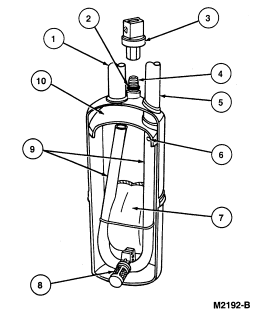
| Item |
Part Number |
Description |
|
1
|
—
|
Inlet From A/C Evaporator Core (Part of 18C836)
|
|
2
|
37937-S
|
O-Ring Seal
|
|
3
|
19E561
|
A/C Cyclic Switch
|
|
4
|
—
|
A/C Cyclic Switch Fitting (Part of 18C836)
|
|
5
|
—
|
Outlet to A/C Compressor (Part of 18C836)
|
|
6
|
—
|
Anti-Siphon Hole (Part of 18C836)
|
|
7
|
—
|
Desiccant Bag (Part of 18C836)
|
|
8
|
—
|
Oil Return Orifice Filter (Part of 18C836)
|
|
9
|
—
|
Vapor Return Tube (Part of 18C836)
|
|
10
|
—
|
A/C Dehydrator and Receiver Tank Dome (Part of 18C836)
|
- A desiccant bag is mounted inside the suction accumulator/drier canister
to absorb any moisture which may be in the refrigerant system.
- A fitting located on the top of the canister is used to attach the A/C cyclic switch
. A long-travel Schrader-type valve stem core is
installed in the fitting opening to prevent refrigerant loss when the A/C cyclic switch
is removed.
A/C Cyclic Switch
The A/C cyclic switch has the following features:
- It is mounted on a Schrader valve-type fitting on the top of the suction accumulator/drier
assembly.
- A valve depressor, located inside the
threaded end of the A/C cyclic switch
, presses in on the Schrader valve stem as the A/C cyclic switch
is mounted.
- This allows the suction pressure inside the suction accumulator/drier
canister to control A/C cyclic switch
operation.
- The switch contacts are normally open when the suction pressure is
approximately 152-193 kPa (22-28 psi); switch contacts close when the suction
pressure rises to approximately 276-324 kPa (40-47 psi) or above.
- Lower ambient temperatures (below approximately 10°C or
50°F) will also open the A/C cyclic switch contacts due to the
pressure/temperature relationship of the refrigerant in the system.
- The A/C cyclic switch contacts control the electrical circuit to the A/C compressor clutch field coil (2987)
.
- When the electrical switch contacts are closed, the A/C compressor clutch field coil
is energized and the A/C clutch (2884)
is engaged to drive the A/C compressor
.
- When the switch contacts are open, the A/C compressor clutch field coil
is de-energized, the A/C clutch
is disengaged and the A/C compressor
does not operate.
- The A/C cyclic switch controls the A/C evaporator core pressure at
a point where the plate/fin surface temperature will be maintained slightly
above freezing. This prevents A/C evaporator core from icing and the
blockage of airflow.
A/C Condenser Core
The A/C condenser core has the following features:
- It is an aluminum fin and tube design heat exchanger.
- It is located in front of the vehicle radiator (8005)
.
- It cools compressed refrigerant gas by allowing air to
pass over the fins and tubes to extract the heat and condenses the gas to
liquid refrigerant as it is cooled.
- The A/C condenser core inlet and outlet connections are the male part of
a spring lock coupling.
- A special service tool is required to disconnect the refrigerant lines
from the A/C condenser core.
A/C Compressor
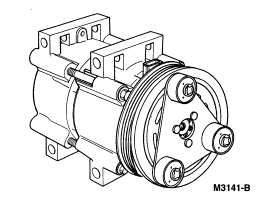
The A/C compressor has the following features:
- It is Ford built.
- It has a displacement of 170cc (10.4 cubic inch).
- It is lubricated by a charge of Motorcraft YN-12 or equivalent
refrigerant oil in the refrigerant system.
- The A/C manifold and tube (19D734) is mounted on the rear face of the A/C compressor
and secured by a single bolt.
- The A/C compressor pressure relief valve is located in the A/C compressor to condenser discharge line (19972)
.
NOTE: Whenever an A/C compressor
is replaced, it will be necessary to replace the suction accumulator/drier
and perform a filtering procedure.
FS-10 A/C Compressor
Spring Lock Coupling
The spring lock coupling, shown in a disconnected state, is a refrigerant
line coupling held together by a garter spring inside a circular cage. When the
coupling is connected, the flared end of the female fitting slips behind the
garter spring inside the cage of the male fitting. The garter spring and cage
then prevent the flared end of the female fitting from pulling out of the cage.
- Two O-ring seals are used to seal between the two halves of the coupling.
These O-ring seals are made of special green material and must
be replaced with an O-ring seal made of the same
green material. The O-ring seals normally used in refrigerant system
connections are not the same material and should not be
used with the spring lock coupling. Use only the O-ring seals listed in the
Ford Master Parts catalog for the spring lock coupling.
- A plastic indicator ring is used on spring lock couplings to indicate,
during vehicle assembly, that the coupling is connected. Once the coupling is
connected, the indicator ring is no longer necessary but will remain captive by
the coupling near the cage opening.
- The indicator ring may also be used during service operations to indicate
connection of the coupling. After the coupling has been cleaned, new green
O-ring seals should be lubricated with clean refrigerant
and installed. Insert the tabs of the indicator ring into the cage opening.
Then connect the coupling together by pushing with a slight twisting motion.
When the coupling is connected, the indicator ring will snap out of the cage
opening but will remain captured on the coupling by the refrigerant line.
Spring Lock Coupling
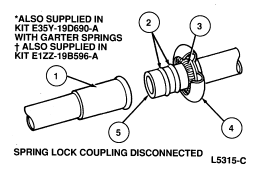
| Item |
Part Number |
Description |
|
1
|
—
|
Female Fitting
|
|
2
|
391302-S100
391303-S100
391304-S100
391305-S100
|
3/8 inch O-Ring
1/2 inch O-Ring**
5/8 inch O-Ring**
3/4 inch
O-Ring*
|
|
3
|
—
|
Garter Spring
|
|
4
|
—
|
Cage
|
|
5
|
—
|
Male Fitting
|
*Also supplied in Kit E35Y-19D690-D with Garter Springs.
**Also supplied in Kit E35Y-19D690-D with Garter Springs and
in Kit E177-19B596-A.
A/C Compressor Pressure Relief Valve
- An A/C compressor pressure relief valve is installed on the A/C compressor
to relieve excessive high-pressure buildup (3103 kPa or
450 psi and above) and prevent damage to the A/C compressor and other A/C components.
- The A/C compressor pressure
relief valve is located on the discharge side of the (high pressure) A/C manifold and tube
.
A/C Pressure Cut-Off Switch
The A/C pressure cut-off switch (19D594) is located in the discharge line between the A/C compressor
and A/C condenser core
.
The A/C pressure cut-off switch has two sets of contacts. One electrical
contact is normally closed. When compressor head pressure rises to
approximately 2896 kPa (420 psi), the contacts open and the compressor
operation is shut off. When head pressure drops to approximately 1724 kPa (250
psi), the contacts again close and allow operation of the A/C compressor
. Shutting down compressor operation prior to the
pressure relief valve set point ensures containment of the refrigerant in the
A/C system.
The switch contains a second set of electrical contacts for the high
speed cooling fan which are normally open. When discharge line pressure reaches
approximately 2241 kPa (325 psi), these contacts close and engage the high
speed radiator electric motor. When pressure drops to approximately 1896 kPa
(275 psi), the contacts again open and the high speed radiator electric motor
is disengaged.