Section 14-01: Battery | 1994 Mustang Workshop Manual |
REMOVAL AND INSTALLATION
Battery
 WARNING: BATTERIES NORMALLY PRODUCE EXPLOSIVE GASES WHICH CAN CAUSE PERSONAL
INJURY. THEREFORE, DO NOT ALLOW FLAMES, SPARKS OR LIGHTED SUBSTANCES TO COME
NEAR THE BATTERY. WHEN CHARGING OR WORKING NEAR A BATTERY, ALWAYS SHIELD YOUR
FACE AND PROTECT YOUR EYES. ALWAYS PROVIDE VENTILATION.
WARNING: BATTERIES NORMALLY PRODUCE EXPLOSIVE GASES WHICH CAN CAUSE PERSONAL
INJURY. THEREFORE, DO NOT ALLOW FLAMES, SPARKS OR LIGHTED SUBSTANCES TO COME
NEAR THE BATTERY. WHEN CHARGING OR WORKING NEAR A BATTERY, ALWAYS SHIELD YOUR
FACE AND PROTECT YOUR EYES. ALWAYS PROVIDE VENTILATION.
Removal
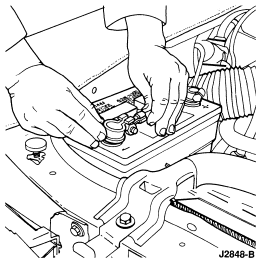
- Remove battery cables from battery (10653)
terminals
( battery ground cable (14301) first).
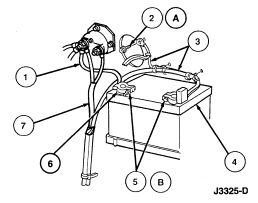
| Item |
Part Number |
Description |
|
1
|
14300
|
Battery to Starter Relay Cable Assy
|
|
2A
|
N803991-S36
|
Screw (3 Req'd)
|
|
3
|
14301
|
Battery Ground Cable
|
|
4
|
10653
|
Battery
|
|
5B
|
—
|
Battery Clamp Nut
|
|
6
|
374043-S100
|
Felt Washer (Positive Post Only)
|
|
7
|
14300
|
Battery to Starter Relay Cable
|
|
A
|
|
Tighten to 4-5.6 Nm (36-49 Lb-In)
|
|
B
|
|
Tighten to 7.6-10.4 Nm (68-92 Lb-In)
|
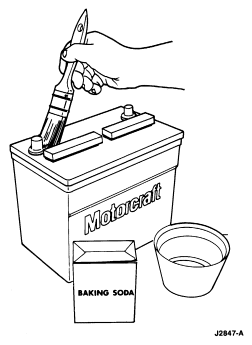
- Clean cable terminals using an acid-neutralizing solution and terminal
cleaning brush.
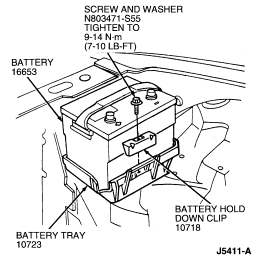
- Remove battery hold down clamps (10718)
.
WARNING: WHEN LIFTING A PLASTIC-CASED BATTERY, EXCESSIVE PRESSURE ON THE END
WALLS COULD CAUSE ACID TO SPEW THROUGH THE VENT CAPS, RESULTING IN PERSONAL
INJURY. LIFT WITH A BATTERY CARRIER OR WITH YOUR HANDS ON OPPOSITE CORNERS.
- Remove battery
from vehicle.
- Test battery
and determine if it should be:
- Placed back in service.
- Recharged before placing back in service.
- Replaced with a Motorcraft or equivalent battery
.
Installation
- Clean cable terminals and battery hold down clamp
with a wire brush. Replace all cables or parts that are worn
or frayed.
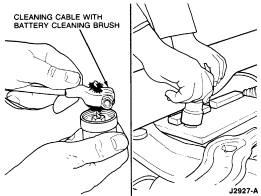
- Clean battery tray (10732)
with a wire brush and scraper.
- Place battery
in battery tray
with positive and negative terminals in same position as
previous battery
. Assemble and tighten battery hold down clamp
so battery
is secure. Do not over-tighten.
- Secure cables ( battery to starter relay cable (14300)
first) to proper terminals. Do not
over-tighten. Apply petroleum jelly to terminals.
NOTE: When the battery
is disconnected and reconnected, some abnormal driving
symptoms may occur while the powertrain control module (PCM) (12A650)
(PCM) relearns its adaptive strategy. The vehicle may need
to be driven 10 miles or more to relearn the strategy.