Section 12-00: Climate Control System—Service | 1994 Mustang Workshop Manual |
SERVICE PROCEDURES
A/C Evaporator Core and/or A/C Condenser Core On-Vehicle Leak Test
If an A/C evaporator core (19860)
or A/C condenser core (19712)
is suspected of leaking, the leak must be verified
prior to removing the component from the vehicle. This leak test should be
performed as outlined below. DO NOT rely solely on the results of an electronic
leak detector as chemicals other than R-134a will activate the leak detector.
NOTE: To perform this test, use a manifold gauge set for an R-12 refrigerant
system, as the manifold gauge set for the R-134a refrigerant system cannot be
attached to the leak test adapters.
- Verify that the manifold gauge set is capable of holding vacuum.
- Connect the RED and BLUE hoses together using a
1/4-inch flare coupling.
- Connect the gauge set YELLOW hose to a known good vacuum pump.
- Turn the vacuum pump ON and open both gauge set valves.
- Operate the vacuum pump for one minute and close both gauge set valves. The
low side gauge should indicate approximately 101 kPa (30 in-Hg) of vacuum.
- Allow the gauge set. with vacuum applied, to set for at least 30 minutes.
- If the gauge reading drops during that time, the gauge set hose
connections, gauges, or valves are leaking and should be repaired before
proceeding with the leak test.
- Disconnect the liquid and suction accumulator from the evaporator core
tubes. DO NOT leak test an evaporator core with the suction
accumulator attached to the core tubes, refrigerant outgassing from oil and
desiccant in the suction accumulator/drier will indicate a false leak condition.
- Clean the evaporator core tube fittings.
For threaded connections, wipe any dirt or debris from sealing surfaces
with a clean lint free cloth.
If the evaporator core tube fittings are the female spring lock design,
check the inside of each fitting for scratches, corrosion, or debris from
deteriorated O-rings. If scratches, corrosion or debris are found, the leak
test results may not be accurate unless the fitting is properly cleaned as
follows.
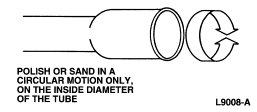
- Remove any surface residue from the inside of the female spring lock
coupling by polishing with 400 grit emery cloth (or equivalent). Polish the
female surface by using a twisting motion so that any scratches made will not
cross the o-ring sealing surface.
- Perform additional polishing of surface using 600 grit emery cloth or
equivalent.
- Remove all residue from polishing the fitting by wiping with a lint-free
cloth.
- Connect the appropriate test fittings from Leak Test Adapter Kit
D880-19703-B to the evaporator tube connections.
- Connect the RED and BLUE hoses from the manifold
gauge set to the test fittings on the evaporator core. Connect the YELLOW hose to a known good vacuum pump.
NOTE: The automatic shut-off valves on some gauge set hoses do not open when
connected to the test fittings. If available, use hoses without shut-off
valves. If hoses with shut-off valves are used, check to be sure the valve
opens when attached to the test fittings or install an adaptor which will
activate the valve. The test is not valid if the shut-off valve does not open.
- Open both gauge set valves and start the vacuum pump. Turn the A/C system
blower on low and allow the vacuum pump to operate for a minimum of 30 minutes
after the gauge set low pressure gauge indicates 101 kPa (30 in-Hg). The
one-half hour evacuation is necessary to remove any refrigerant from oil left
in the evaporator core. If the refrigerant is not completely removed from the
oil, outgassing will occur and degrade the vacuum and appear as a refrigerant
leak.
- If the low pressure gauge reading will not drop to 101 kPa (30 in-Hg) when
the valves on the gauge and manifold set are open and the vacuum pump is
operating, close the gauge set valves and observe the low pressure gauge. If
the pressure rises rapidly to zero, a large leak is indicated. Recheck the test
before replacing the evaporator core.
- If the low pressure gauge reading rises 34 or more kPa (10 or more in-Hg)
of vacuum from the 101 kPa (30 in-Hg) position in ten minutes, a leak is
indicated. If a very small leak is suspected, wait 30 minutes and observe the
vacuum gauge. If a small amount of vacuum is lost, operate the vacuum pump with
gauge valves open or an additional 30 minutes with the system blower on low to
remove any remaining refrigerant from the oil in the evaporator core. Then,
recheck for loss of vacuum as outlined. If a very small leak is suspected,
allow the system to set over night with vacuum applied and check for vacuum loss.
Always remember that a leaking fitting, gauge set or hose connection will
appear as a leaking evaporator core.
- If the evaporator core does leak, as verified by the above procedure,
install a new evaporator core as outlined.