Section 12-00: Climate Control System—Service | 1994 Mustang Workshop Manual |
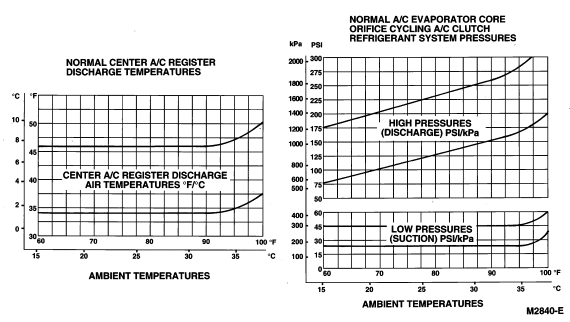
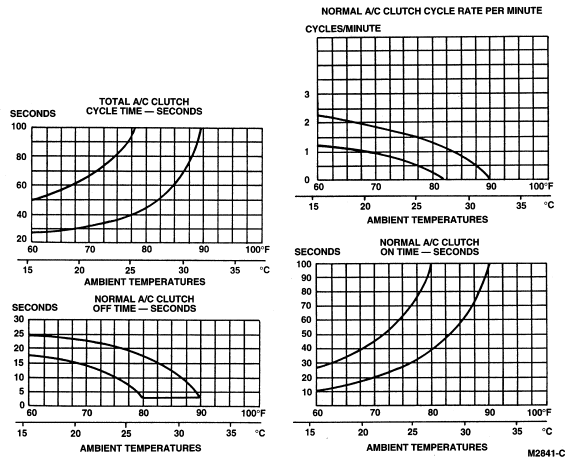
The best way to diagnose a concern in the refrigerant system is to note the system pressures (shown by the manifold gauges), and the A/C clutch cycle rate and times. Then compare the findings to the values shown in the following charts.
Important—Test Requirements
The following test conditions must be established to obtain accurate pressure readings:
NOTE: When ambient temperature exceed 38°C (100°F), engine should be run at normal idle speed only. For tests in ambient temperatures between 38°C (100°F) and 43°C (110°F), system performance pressures will be the same as those for ambient. Temperatures shown on the chart in the 32°C (90°F) to 38°C (100°F) range. Center A/C register discharge temperatures will also be similar to those shown in the chart in the 32°C (90°F) to 38°C (100°F) range.

The following test conditions must be established to obtain accurate pressure readings:

The following procedure is recommended for achieving accurate diagnosis results in the least amount of time:
NOTE: The test conditions, specified at the top of each chart, must be met to obtain accurate test results.
The discharge (high) pressure should operate the reverse of the suction pressure. When the suction pressure is dropping, the discharge pressure should increase. When the suction pressure is increasing, the discharge pressure should decrease.
If the point where the two lines cross on each of the charts falls within the dark band, the system is operating normally. If the lines cross outside the dark band on one or more of the charts, there is a concern and the specific cause must be determined. This is easily done by using the Refrigerant System and Clutch Cycle Timing Evaluation Chart.
Additional cause components are listed for poor A/C compressor operation or a damaged A/C compressor condition at the bottom of the following evaluation chart.
| HIGH (DISCHARGE) PRESSURE | LOW (SUCTION) PRESSURE | A/C CLUTCH CYCLE TIME | COMPONENT—CAUSES | ||
|---|---|---|---|---|---|
| RATE | ON | OFF | |||
| High | High | Continuous Run | Continuous Run | Continuous Run | A/C Condenser Core—
Inadequate Airflow |
| High | Normal to High | Continuous Run | Continuous Run | Continuous Run | Engine Overheating |
| Normal to High | Normal | Continuous Run | Continuous Run | Continuous Run | Refrigerant Overchargea Air in Refrigerant Humidity or Ambient Temp Very Highb |
| Normal | High | Continuous Run | Continuous Run | Continuous Run | A/C Evaporator Core Orifice—
O-Rings Leaking/Missing |
| Normal | Normal | Slow or No Cycle | Long or Continuous | Normal or No Cycle | Moisture in Refrigerant System Excessive Refrigerant Oil |
| Normal | Low | Slow | Long | Long | A/C Cyclic Switch—Low Cut-Out |
| Normal to Low | High | Continuous Run | Continuous Run | Continuous Run | A/C Compressor—Low Performance |
| Normal to Low | Normal to High | Continuous Run | Continuous Run | Continuous Run | A/C Suction Line—Partially Restricted or Pluggedc |
| Normal to Low | Normal | Fast | Short | Normal | A/C Evaporator Core—Low or Restricted Airflow |
| Normal to Low | Normal | Fast | Short to Very Short | Normal to Long | A/C Condenser Core, A/C Evaporator Core Orifice or A/C Liquid Line—Partially Restricted or Plugged |
| Normal to Low | Normal | Fast | Short to Very Short | Short to Very Short | Low Refrigerant Charge |
| Normal to Low | Normal | Fast | Short to Very Short | Long | A/C Evaporator Core—Partially Restricted or Plugged |
| Normal to Low | Low | Continuous Run | Continuous Run | Continuous Run | A/C Suction Line—Partially Restricted or Pluggedd A/C Cyclic Switch—Sticking Closed |
| Erratic Operation or A/C Compressor Not Running | — | — | — | A/C Cyclic Switch—Dirty Contacts or Sticking Open.
Poor Connection at A/C Clutch Connector or A/C Cyclic Switch Connector A/C Electrical Circuit Erratic—See A/C Electrical Circuit Wiring Diagram |
|
| ADDITIONAL POSSIBLE CAUSE COMPONENTS ASSOCIATED WITH INADEQUATE A/C COMPRESSOR OPERATION | |||||
| A/C Compressor Drive Belt | — | — | — | — | A/C Compressor Drive Belt Loose |
| A/C Clutch | — | — | — | — | A/C Clutch Slipping |
| A/C Compressor Clutch Field Coil | — | — | — | — | A/C Compressor Clutch Field Coil Open—Shorted, or Loose Mounting |
| Control Assembly Switch | — | — | — | — | Control Assembly Switch—Dirty Contacts or Sticking Open |
| A/C Clutch Wiring Circuit | — | — | — | — | A/C Clutch Wiring Circuit—High Resistance, Open or Blown Fuse |
| A/C Compressor Not Operating | — | — | — | — | A/C Compressor Operation Interrupted by PCM |
| ADDITIONAL POSSIBLE CAUSE COMPONENTS ASSOCIATED WITH A DAMAGED A/C COMPRESSOR | |||||
| A/C Cyclic Switch | — | — | — | — | A/C Cyclic Switch—Sticking Closed or A/C Clutch Seized |
| A/C Dehydrator and Receiver Tank | — | — | — | — | A/C Suction Accumulator Drier Tank—Refrigerant Oil Bleed Hole Plugged |
| Refrigerant Low | — | — | — | — | Refrigerant Leaks |
The diagnosis charts provide the most direct and sure way to determine the cause of any concern in a poorly performing refrigerant system.
After servicing and correcting a refrigerant system concern, take additional pressure readings and observe the suction pressure and A/C clutch cycle rate while meeting the conditional requirements from previous charts to ensure the condition has been corrected.
In ambient temperatures above 27°C (81° F), the A/C clutch will not normally cycle off. This will depend on local conditions and engine/vehicle speed. Also, A/C clutch cycling will normally not occur when the engine is operating at curb idle speed.
If the system contains no refrigerant or is extremely low on refrigerant, the A/C clutch will not engage for A/C compressor operation. A rapid cycling A/C clutch is usually an indication that the system is low on refrigerant.
The following tests cover: burned-out fuses, loose wire connections, damaged wires, or collapsed hoses.
Checking for A/C Leaks
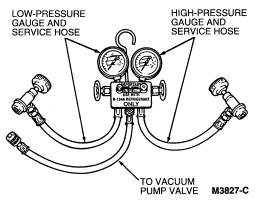
Attach the manifold gauge set. Leave both manifold gauge valves at the maximum clockwise (closed) position. Both gauges should show approximately 483-551 kPa (70-80 psi) at 24°C (75°F) with engine not running. If very little or no pressure is indicated, leave the vacuum pump valve closed, open the Refrigerant 134-a cylinder valve and set the low-pressure (suction) manifold gauge valve to the counterclockwise position. This opens the system to cylinder pressure.
WARNING: GOOD VENTILATION IS NECESSARY IN THE AREA WHERE A/C LEAK TESTING IS TO
BE DONE. IF THE SURROUNDING AIR IS CONTAMINATED WITH REFRIGERANT GAS, THE LEAK
DETECTOR WILL INDICATE THIS GAS ALL THE TIME. ODORS FROM OTHER CHEMICALS SUCH
AS ANTIFREEZE, DIESEL FUEL, DISC BRAKE CLEANER OR OTHER CLEANING SOLVENTS CAN
CAUSE THE SAME CONCERN. A FAN, EVEN IN A WELL VENTILATED AREA, IS VERY HELPFUL
IN REMOVING SMALL TRACES OF AIR CONTAMINATION THAT MIGHT AFFECT THE LEAK
DETECTOR.
Check all systems connections, the compressor head gasket and shaft seal
for leaks using a good leak detector. Pass leak detector along underside of all
points being checked. Refrigerant is heavier than air and will show most
readily in those locations.
R-134a Manifold Gauge Set
Leak Detector, Electronic
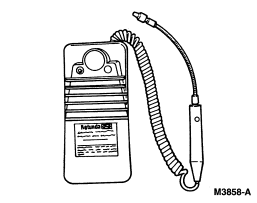
Use Rotunda R-134a Halogen Leak Detector 161-R0010 or equivalent.
The electronic leak detector is operated by moving the control switch to
the ON position. The detector automatically calibrates itself when it is turned
on. Move the probe at approximately 25mm (1 inch) per second in the suspected
area. When escaping refrigerant gas is located, the ticking/beeping signal will
increase in ticks/beeps per second. If the gas is relatively concentrated, the
signal will be increasingly shrill. Follow the instructions included with the
detector to improve handling and operating techniques.
Leak Detector—Electronic