Section 13-01: Instrument Cluster—Conventional | 1994 Mustang Workshop Manual |
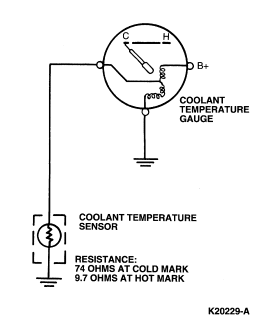
The temperature indicating system is a magnetic-type indicating system, consisting of:
The water temperature indicator sender unit changes resistance according to the temperature of the engine coolant, which varies the current flow through the instrument cluster temperature gauge . The pointer position varies proportionally to the current flow. The instrument cluster temperature gauge resistance is high when the coolant temperature is low, and low when the coolant temperature is high.
The pointer of the magnetic instrument cluster temperature gauge remains in position when ignition switch (11572) is turned to the OFF position. It will move to the correct indication whenever the ignition switch is turned back to ON position.
The gauge pointer may indicate at the top of the normal band with the
coolant temperature within specification, under certain driving conditions such
as heavy traffic or stop and go driving in hot weather.
Coolant Temperature Gauge
The magnetic instrument cluster temperature gauge movement consists of three primary coils, one of which is wound at a 90 degree angle to the other two. The coils form a magnetic field which varies in direction according to the variable resistance of the sender unit. A primary magnet, to which a shaft and pointer are attached, rotates to align to this primary field, resulting in pointer position. The bobbin/coil assembly is pressed into a metal housing which has two holes for dial mounting. There is no adjustment, calibration or maintenance required for this instrument cluster temperature gauge .
 CAUTION: Do not remove magnetic gauge pointers; the instrument cluster temperature gauge
cannot be recalibrated.
CAUTION: Do not remove magnetic gauge pointers; the instrument cluster temperature gauge
cannot be recalibrated.
NOTE: An instrument voltage regulator (IVR) is not required for this system.
Water Temperature Indicator Sensor Unit
The water temperature indicator sender unit is installed on the engine into an engine coolant passage. The engine water temperature indicator sender unit reacts to the engine coolant temperatures. Its resistance decreases as the engine coolant temperature increases.