Section 07-03: Transmission, Manual—T5OD | 1994 Mustang Workshop Manual |
CLEANING AND INSPECTION
Transmission
Cleaning
 CAUTION: Do not clean, wash or soak transmission seals in cleaning solvents or
transmission seals could be damaged. Dry all parts with compressed air.
CAUTION: Do not clean, wash or soak transmission seals in cleaning solvents or
transmission seals could be damaged. Dry all parts with compressed air.
- Wash all parts except ball bearings, O-rings and seals in a
suitable cleaning solvent. Brush or scrape all foreign matter from the parts.
Be careful not to damage any parts with the scraper.
- Rotate ball bearings in a cleaning solvent until all lubricant is removed.
Hold bearing assembly to prevent it from rotating and dry it with compressed
air.
- Lubricate bearings with Multi-Purpose Grease D0AZ-19584-AA or equivalent
meeting Ford specification ESR-M1C159-A and ESB-M1C93-A, and wrap them in a
clean, lint-free cloth or paper until ready for use.
- Clean the magnet in the bottom of the case (7005)
with kerosene or mineral spirits.
Inspection
- Inspect transmission case
for cracks, worn or damaged bearing bores, damaged
threads or any other damage that could affect operation of the transmission.
- Inspect the front face of the case
for small nicks or burrs that could cause misalignment
of the transmission with the flywheel housing (6392)
. Remove all small nicks or burrs with a fine file.
- Replace any cover that is bent or distorted.
- Check the condition of the shift levers, forks, shift rails, and the lever
and shafts.
- Inspect the ball bearings. Refer to Ball Bearing Inspection.
- Replace roller bearings that are broken, worn or rough, and check their
respective races.
- Replace the countershaft cluster gear (7113)
if the teeth are chipped, broken or worn. Replace the countershaft cluster gear
if it is bent, scored or worn.
- Replace the reverse idler gear and bushing (7141)
or sliding gear if the teeth are chipped, worn or
broken. Replace the reverse idler gear shaft (7140)
if bent, worn or scored.
- Replace the input shaft (7017)
and gear if the splines are damaged or if the teeth are
chipped, worn or broken. If the roller bearing surface in the bore of the gear
is worn or rough, or if the cone surface is damaged, replace the gear and the
gear rollers.
- Replace all other gears that are chipped, broken or worn.
- Check the synchronizer (7124)
sleeves for free movement on their hubs. Make sure that
the alignment marks (if present) are properly indexed.
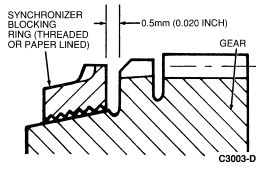
- Inspect the synchronizer blocking rings (7107)
for widened index slots, rounded clutch
teeth, and smooth internal surfaces (must have machined grooves). With the synchronizer blocking ring
on the front wheel bearing inner cone and roller (1201)
, the distance between the face of the synchronizer blocking ring
and the clutch teeth on the gear must not be less than
0.5mm (0.020 inch).
- Replace speedometer drive gear (17285)
if teeth are stripped or damaged. Make certain to
install correct size replacement speedometer drive gear
.
- Replace the output and fifth gear drive shaft (7061)
if there is any evidence of wear or if any of the
splines are damaged.
- Inspect extension housing bushing (7A034)
and input shaft and extension housing seal (7052)
in the extension housing (7A039)
, and replace if worn or damaged. The extension housing bushing
and/or input shaft and extension housing seal
should be replaced after the extension housing
has been installed on the transmission.
- Replace the input shaft and extension housing seal
.
Case Service
If an aluminum transmission case
thread is damaged, service kits may be purchased from
local jobbers. To service a damaged thread, the following procedures should be
carefully followed.
- Drill out the damaged threads, using the same drill size as
the thread OD. For example, use a 5/16-inch drill for a 5/16-18 thread.
- Select the proper special tap and tap the drilled hole. The tap is marked
for the size of the thread being serviced. Thus, the special tap marked 5/16-18
will not cut the same thread as a standard 5/16-18 tap. It does cut a thread
large enough to accommodate the insert, and after the insert is installed the
original thread size (5/16-18) is restored.
- Select the proper coil-inserting tool. These tools are marked with the
thread size being serviced. Place the insert on the tool and adjust the sleeve
to the length of the insert being used. Press the insert against the face of
the tapped hole. Turn the tool clockwise and wind the insert into the hole
until the insert is one-half turn below the face.
- Working through the insert, bend the insert tang straight up and down until
it breaks off at the notch.
- Improperly installed inserts can be removed with the extractor tool. Place
the extractor tool in the insert so that the blade rests against the top coil
one-fourth to one-half turn away from the end of the coil. Tap the tool sharply
with a hammer so that the blade cuts into the insert. Exert downward pressure
on the tool and turn it counterclockwise until the insert is removed.
These tools are marked with the thread size being serviced.
Place the insert on the tool and adjust the sleeve to the length of the insert
being used. Press the insert against the face of the tapped hole. Turn the tool
clockwise and wind the insert into the hole until the insert is one-half turn
below the face.