Transmission Test Plate
Section 07-01: Transmission, Automatic—AODE | 1994 Mustang Workshop Manual |
Reverse Clutch
Apply air pressure to the reverse clutch passage in the service tool plate. A dull thud can be heard when the reverse clutch piston (7D402) applies. In addition, movement of the reverse clutch drum (7D044) may also be detected.
Forward Clutch
Apply air pressure to the forward clutch apply passage in the service tool plate. A dull thud can be heard or movement of the clutch piston (7A262) can be felt on the case (7005) as the clutch piston is applied.
Intermediate Clutch
Apply air pressure to the intermediate clutch passage in the service tool plate. A dull thud can be heard or felt when the intermediate clutch piston (7E005) applies.
Direct Clutch
Apply air pressure to the direct clutch apply passage. A dull thud should be heard or felt on the driveshaft if the clutch is operating.
Overdrive Servo
| Description | Tool Number |
|---|---|
| AODE Transmission Test Plate | T92P-7006-A |
Apply air pressure to the overdrive (O/D) servo apply passage in AODE
Transmission Test Plate T92P-7006-A. Operation of the band is indicated by the
tightening of the band around the reverse clutch drum. The O/D servo will return to the release position as a result of force
from the overdrive servo piston return spring (7F201). Also, when the servo returns to the release position, a thud can be
felt on the O/D servo cover. The band will then relax.
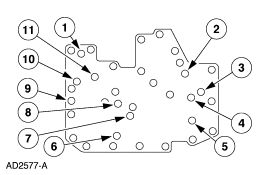
Transmission Test Plate
| Item | Part Number | Description |
|---|---|---|
| 1 | Converter Bypass | |
| 2 | Direct Clutch | |
| 3 | Forward Clutch | |
| 4 | 2-3 Accumulator Top | |
| 5 | 2-3 Accumulator Bottom | |
| 6 | Overdrive Servo Apply | |
| 7 | Reverse Servo | |
| 8 | Overdrive Servo Release | |
| 9 | Intermediate Clutch | |
| 10 | Reverse Clutch | |
| 11 | 1-2 Accumulator Apply |
Low-Reverse Servo
Apply air pressure to the low-reverse servo passage in the service tool plate. A dull thud can be heard when the low-reverse band tightens around the planetary assembly drum surface. Also, movement of the ring gear (7A153) can be detected.
2-3 Accumulator
Apply air pressure to the 2-3 accumulator passage. The accumulator piston (7F251) should unseat. This can be detected by inserting a metal rod into the 2-3 piston hole. When the accumulator piston unseats, the rod will move. Also, a thud can be heard when the accumulator piston applies.