Section 07-01: Transmission, Automatic—AODE | 1994 Mustang Workshop Manual |
DIAGNOSIS AND TESTING
Transmission Fluid Leakage Checks
Check the vehicle speed sensor (VSS) (9E731), output shaft speed sensor and the connector at transmission. Replace
the rubber seal, if necessary.
NOTE: Fluid from other external sources can collect between the case (7005) and pan rail and give the appearance of a oil pan to case gasket (7A191)
leak. If fluid is present check the following positions as outlined.
Check for leakage at oil pan to case gasket.
Leakage at the oil pan to case gasket often can be stopped by tightening the retaining bolts to 12-15 Nm
(108-132 lb-in). Do not over-tighten transmission oil pan (7A194) bolts. If necessary, replace the oil pan to case gasket.
Check the oil filler tube (7A228) connection at the transmission case or transmission oil pan. If leakage is found here, install a new O-ring and press the oil filler tube to the case. The filler tube bracket should align properly and be
attached to the transmission or engine.
Check the fluid lines and fittings between the transmission and the transmission oil cooler (7A095)
in the radiator tank for looseness, wear or damage. When fluid is found
to be leaking between the case and the transmission oil cooler inlet tube (7A030) or oil cooler tube (7A031), tighten the fitting to 31 Nm (23 lb-ft). Do not
try to stop the fluid leak by increasing the torque beyond specification. This
may cause damage to the case threads.
If the leak continues, replace the cooler line fitting and tighten to
20-26 Nm (15-19 lb-ft). The same procedure should be followed
for fluid leaks between the transmission oil cooler and cooler line fittings.
Check the engine coolant in the radiator (8005). If transmission fluid is present in the coolant, the transmission oil cooler
in the radiator is probably leaking.
The transmission oil cooler can be further checked for leaks by disconnecting the oil cooler tube
and transmission oil cooler inlet tube from the cooler fittings and applying 345-517 kPa (50-75 psi) air
pressure to the fittings. Remove the radiator cap (8100) to relieve the pressure buildup at the exterior of the oil cooler tank.
If the transmission oil cooler is leaking and/or will not hold pressure, the transmission oil cooler must be replaced. Refer to Section 03-03 for transmission oil cooler replacement procedure.
If leakage is found at the manual control lever (7A256), replace the manual control lever oil seal (7B498).
Pipe Plugs
The transmission has five pipe plugs: four on the RH side of the case
and one on the LH side. Inspect the plugs for leakage. Ensure they are
tightened to 8-16 Nm (6-12 lb-ft). If tightening does not stop
the leak, replace the plug.
When a converter drain plug leaks, remove the drain plug with a six-point
wrench. Coat the threads with Pipe Sealant with Teflon®
D8AZ-19554-A (WSK-M2G350-AZ and ESR-M18P7-A) or equivalent and install plug.
Tighten the drain plug to 28-30 Nm (21-23 lb-ft). Fluid
leakage from the converter housing may also be caused by engine oil leaking
past the rear main bearing seal, or from oil galley plugs. Verify the exact
cause of the leak before starting service procedures.
Oil soluble aniline or fluorescent dyes premixed at the rate of 2.5ml
(1/2-teaspoon) of dye powder to 0.231 (1/2-pint) of transmission fluid have
proved helpful in locating the source of fluid leakage. Such dyes may be used
to determine whether an engine oil or transmission fluid leak is present, or if
the fluid in the oil cooler leaks into the engine coolant system. A black light
must be used with the fluorescent dye solution.
Oil Cooler Tube Leakage
When fluid leakage is found at the transmission oil cooler, the transmission oil cooler must be replaced. Refer to Section 03-03.
When one or more of the oil cooler tubes must be replaced, each replacement oil cooler tube must be fabricated
from the same size steel tubing as the original oil cooler tube.
Using the old oil cooler tube as a guide, bend the new oil cooler tube as required. Add the necessary fittings and install the oil cooler tube
After the fittings have been tightened, add fluid as needed and check for
fluid leaks.
Leakage in Torque Converter Area
When internal wear or damage has occurred in the transmission, metal
particles, clutch plate material, or band material may have been carried into
the torque converter (7902) and transmission oil cooler. These contaminants are a major cause of recurring transmission
troubles and MUST be removed from the system before the transmission is put
back into service.
 CAUTION: Whenever a transmission has been disassembled to replace worn or
damaged parts or because the main control valve body (7A100) sticks from foreign material, the main control valve body, transmission oil cooler and transmission oil cooler inlet tube and oil cooler tube MUST be cleaned and flushed by using the Rotunda Torque Converter
Cleaner 014-00028 or equivalent. Under NO circumstances should an attempt be
made to clean torque converter
by hand agitation with solvent.
CAUTION: Whenever a transmission has been disassembled to replace worn or
damaged parts or because the main control valve body (7A100) sticks from foreign material, the main control valve body, transmission oil cooler and transmission oil cooler inlet tube and oil cooler tube MUST be cleaned and flushed by using the Rotunda Torque Converter
Cleaner 014-00028 or equivalent. Under NO circumstances should an attempt be
made to clean torque converter
by hand agitation with solvent.
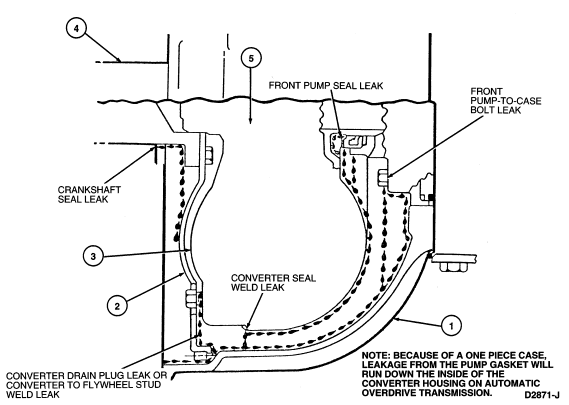
In diagnosing and correcting fluid leaks in the front pump support and gear (7A103) and torque converter area, use the following procedures to locate the exact cause of the
leakage. Leakage at the front of transmission, as evidenced by fluid around the
torque converter housing, may have several sources. By careful observation, it
is possible, in many instances, to pinpoint the source of leak before removing
the transmission from the vehicle. The paths which the fluid takes to reach the
bottom of the torque converter housing are shown in the following illustration.
Possible Leak Points
| Item |
Part Number |
Description |
|
1
|
—
|
Torque Converter Housing (Part of 7902)
|
|
2
|
6375
|
Flywheel
|
|
3
|
7902
|
Torque Converter
|
|
4
|
6303
|
Crankshaft
|
|
5
|
—
|
Impeller (Part of 7902)
|
- Fluid leaking by the oil pump gasket lip will tend to move along the
impeller hub and onto the back of the impeller housing. Except in the case of a
total seal failure, fluid leakage by the lip of the oil pump gasket (7A136) will be deposited on the inside of the torque converter housing only,
near the outside diameter of the housing.
- Fluid leakage by the outside diameter of the oil pump gasket and front pump body will follow the same path which the leaks by the
front pump seal follow.
- Fluid that leaks by a front pump-to-case bolt will be deposited on the
inside of the torque converter housing only. Fluid will not be deposited on the
back of the torque converter.
- Fluid leakage from the converter drain plugs or converter-to-flywheel stud
weld will appear at the outside diameter of the torque converter on the back face of the flywheel (6375), and in the converter housing only near the flywheel. Fluid leaks from the torque converter will leave a ring of fluid around the inside of the torque converter
housing.
NOTE: White tissue paper may aid in determining the color (red is transmission
fluid) and source of the leaking fluid.
- Engine oil leaks are sometimes improperly diagnosed as transmission oil pump gasket
leaks. The following areas of possible leakage should also be checked
to determine if engine oil leakage is causing the concern.
- Leakage at the valve cover gasket (6584) may allow oil to flow over the torque converter housing or seep down
between the torque converter housing and cylinder block (6010)
causing oil to be present in or at the bottom of the torque converter
housing.
- Oil galley plug leaks will allow oil to flow down the rear face of the cylinder block
to the bottom of the torque converter housing.
- Leakage at the crankshaft rear oil seal (6701) will work back to the flywheel, and then into the torque converter housing.
- Leakage at oil pressure sender (9278).
- Fluid leakage from other areas, such as the power steering system forward
of the transmission, could cause fluid to be present around the torque
converter housing due to blowback or road draft. The following procedures
should be used to determine the cause of the leakage before service.
- Remove the oil level indicator (7A020) and note the color of the fluid. Original factory fill fluid is dyed
red to aid in determining if leakage is from the engine or transmission. Unless
a considerable amount of makeup fluid has been added or the fluid has been
changed, the red color should assist in pinpointing the leak. However, a power
steering leak may be mistaken for a transmission leak since both fluids are
dyed red. Check the power steering system for leaks that could be misidentified
as a transmission leak. Refer to Section 11-00.
- Remove the torque converter housing cover. Clean off any fluid from the top
and bottom of the torque converter housing, front of the case and rear face of the engine and oil pan (6675). Clean the torque converter area by washing with a suitable
non-flammable solvent and blow dry with compressed air.
- Wash out the torque converter housing, the front of the flywheel and the converter drain plugs. The torque converter housing may be
washed out using cleaning solvent and a squirt-type oil can. Blow all washed
areas dry with compressed air.
- Start and run the engine until the transmission reaches its normal
operating temperature. Observe the back of the cylinder block and top of the torque converter housing for evidence of fluid leakage.
Raise the vehicle on a hoist and run the engine at fast idle, then at engine
idle, occasionally shifting to the OVERDRIVE and REVERSE ranges to increase
pressure within the transmission. Observe the front of the flywheel, back of the cylinder block (in as far as possible), and inside the torque converter housing and
front of the case. Run the engine until fluid leakage is evident and the probable source
of leakage can be determined.
Torque Converter Leakage Check
If welds on the torque converter indicate leakage, remove the torque converter and make the following check:
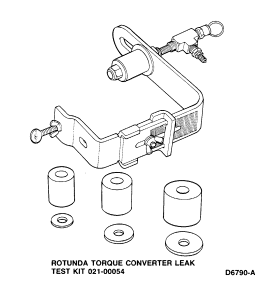
Assemble Rotunda Torque Converter Leak Detector 021-00054 or equivalent
to the torque converter. Test torque converter for leaks, following the directions supplied with the detector kit.