Section 06-03: Brakes, Front Disc | 1994 Mustang Workshop Manual |
Rotor Minimum Thickness
Rotor minimum thickness must not be less than the number cast on the inside of the front disc brake rotor (1125) after refinishing. Lateral runout of the braking surfaces must not exceed 0.05mm (0.002 inch), and the surface finish is to be in the 15 to 125 micro-inch range.
Rotor Machining
Do not machine, cut, or true up new front disc brake rotors prior to installation on vehicle. Making a light cut on a new front disc brake rotor may cause excessive runout and result in brake shudder several thousand miles later. It is best to clean oil film off a new front disc brake rotor with solvent and install it on vehicle.
Never use a brake lathe that cuts only one face of the front disc brake rotor at a time. It must be a simultaneous straddle cut. All front disc brake rotor refinishing must adhere to the rule that equal amounts of front disc brake rotor stock are removed from each braking surface each time a front disc brake rotor is refinished.
On-vehicle brake lathes machine the front disc brake rotor while it is on the wheel hub (1104) and is turning on the same axis as the wheel hub . This procedure reduces front disc brake rotor lateral runout to near zero by cutting the front disc brake rotor perpendicular to the axis of the hub therefore cancelling the effect of stacked tolerance of the wheel hub (1104), front disc brake rotor and front wheel spindle (3105) . Follow the on-vehicle brake lathe manufacturer's instructions on machining procedures.
A bench mounted disc brake lathe machines the front disc brake rotor to the axis of the lathe arbor and will not reduce total lateral runout associated with stacked tolerance of the wheel hub , front disc brake rotor and front wheel spindle . Follow manufacturer's instructions on machining procedures.
With both types of brake lathes, set cutting tool to just contact the high spots on the front disc brake rotor , then adjust cutting tool to the minimum depth required to clean up front disc brake rotor face. Best results are obtained with a first cut that totally removes the old front disc brake rotor surfaces followed by a second light finish cut. The total material removed (combination of both sides) must not exceed the minimum lathe thickness that is marked on the inside of the front disc brake rotor.
To improve initial brake pedal feel and surface finish on a machined front disc brake rotor, lightly sand front disc brake rotor surface with 120 grit paper prior to road testing.
Runout Check
NOTE: Whenever front disc brake rotor has been separated from hub face, clean any rust or foreign material from mating surface on hub face and front disc brake rotor . Failure to do this may result in increased lateral runout of the front disc brake rotor and brake pulsation.
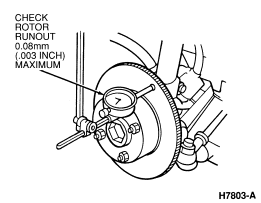
Install front disc brake rotors on wheel hub and hold in place by using inverted wheel hub bolt nuts (1012) and washers to seat front disc brake rotors to wheel hub . Tighten wheel hub bolt nuts to 115-142 Nm (85-105 lb-ft).
Using a dial indicator, measure front disc brake rotor lateral runout as
shown. The dial indicator should be centered on braking surface. Rotate front disc brake rotor
while measuring runout. If runout is greater than 0.05mm
(0.002 inch), front disc brake rotor
must be repositioned (indexed) on wheel hub
to obtain the lowest possible runout.
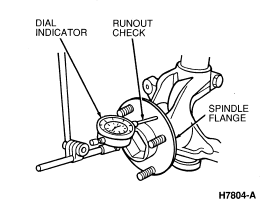
If lateral runout of front disc brake rotor is above 0.05mm (0.002 inch) after repositioning (indexing), the wheel hub and front wheel bearing (1215) assembly must be inspected. Using a dial indicator, measure wheel hub and front wheel bearing (1215) assembly face runout as shown. Wheel hub runout must be less than 0.03mm (0.001 inch). If wheel hub face runout is greater than 0.03mm (0.001 inch), a new wheel hub must be installed.
NOTE: If front disc brake rotor lateral runout remains greater than 0.05mm
(0.002 inch) after the following service procedures, this indicates that the
brake lathe requires service:
NOTE: Rotunda Disc Brake Lathe 054-00080 or equivalent should be used to refinish front disc brake rotor .
Brake roughness (vibration or pedal pulsation) that is present during service brake application is caused by either rotor thickness variation or corrosion buildup on the rotor braking surfaces. This thickness variation can occur with rotor wear in excess of 19,311 km (12,000 mile) use. Front disc brake rotor turning may thus be necessary beyond the warranty period. The front disc brake rotor should only be turned as a last resort. The suspension and brake systems are designed and built to tolerate rotor thickness variations well above previous brake designs. Front disc brake rotor replacement should only be required for such circumstances as damaged front disc brake rotor or heavy rotor scoring where rotor turning is not possible.
If pedal pulsation occurs, attempt stopping the vehicle with the transmission in neutral. If roughness is gone, the drivetrain should be inspected. If the roughness remains, inspect the brakes. If corrosion buildup is the cause, hand sand the brake shoe and lining (2001) and rotor braking surfaces to remove the scale. If buildup is light, the condition should disappear after a few brake applications.
Use Rotunda Disc Brake Lathe 054-00080 or equivalent to refinish front disc brake rotor .