Section 06-00: Brake System—Service | 1994 Mustang Workshop Manual |
Runout
NOTE: Whenever front disc brake rotor (1125) has been separated from hub face, clean any rust or foreign material from mating surface on hub face and front disc brake rotor . Failure to do this may result in increased lateral runout of the front disc brake rotor and brake pulsation.
Install front disc brake rotors on wheel hub (1104) and hold in place by using inverted wheel hub bolt nuts (1012) and washers to seat front disc brake rotors to wheel hub . Tighten wheel hub bolt nuts to 115-142 Nm (85-105 lb-ft).
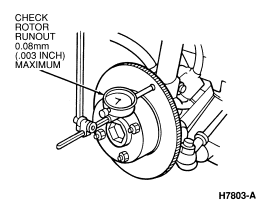
Using a dial indicator, measure front disc brake rotor lateral runout as
shown. The dial indicator should be centered on braking surface. Rotate front disc brake rotor
while measuring runout. If runout is greater than 0.05mm
(0.002 inch), front disc brake rotor
must be repositioned (indexed) on wheel hub
to obtain the lowest possible runout.
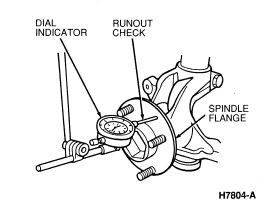
If lateral runout of front disc brake rotor is above 0.05mm (0.002 inch) after repositioning (indexing), the wheel hub and front wheel bearing (1215) assembly must be inspected. Using a dial indicator, measure wheel hub and front wheel bearing (1215) assembly face runout as shown. Wheel hub runout must be less than 0.03mm (0.001 inch). If wheel hub face runout is greater than 0.03mm (0.001 inch), a new wheel hub must be installed.
NOTE: If front disc brake rotor lateral runout remains greater than 0.05mm
(0.002 inch) after the following service procedures, this indicates that the
brake lathe requires service:
NOTE: Rotunda Disc Brake Lathe 054-00080 or equivalent should be used to refinish front disc brake rotor .
Brake roughness (vibration or pedal pulsation) that is present during service brake application is caused by either rotor thickness variation or corrosion buildup on the rotor braking surfaces. This thickness variation can occur with rotor wear in excess of 19,311 km (12,000 mile) use. Front disc brake rotor turning may thus be necessary beyond the warranty period. The front disc brake rotor should only be turned as a last resort. The suspension and brake systems are designed and built to tolerate rotor thickness variations well above previous brake designs. Front disc brake rotor replacement should only be required for such circumstances as damaged front disc brake rotor or heavy rotor scoring where rotor turning is not possible.
If pedal pulsation occurs, attempt stopping the vehicle with the transmission in NEUTRAL. If roughness is gone, the drivetrain should be inspected. If the roughness remains, inspect the brakes. If corrosion buildup is the cause, hand sand the brake shoe and lining (2001) and rotor braking surfaces to remove the scale. If buildup is light, the condition should disappear after a few brake applications.
Use Rotunda Disc Brake Lathe 054-00080 or equivalent to refinish front disc brake rotor .
Refinishing
All rotor refinishing must adhere to the rule that equal amounts of rotor stock are removed from each braking surface each time a disc brake rotor is refinished.
The minimum allowable overall rotor thickness continues to be stamped on the disc brake rotor and must not be exceeded.
NOTE: Using a micrometer to measure rotor thickness simplifies previous rotor measurement procedure, but it is mandatory that an equal amount of material be removed from each side of the disc brake rotor each time the disc brake rotor is turned.