CAUTION: After the final operation in either of the two refinishing methods
described and prior to checking the piston fit, thoroughly clean with a
detergent and water solution and then oil the cylinder walls.
CAUTION: After the final operation in either of the two refinishing methods
described and prior to checking the piston fit, thoroughly clean with a
detergent and water solution and then oil the cylinder walls. Section 03-00: Engine—Service | 1994 Mustang Workshop Manual |
| Description | Tool Number |
|---|---|
| Engine Cylinder Hone Set | T73L-6011-A |
Honing is recommended for refinishing cylinder walls only when no cross-hatch pattern is visible on cylinder walls, or for fitting pistons (6108) to the specified clearance. The grade of hone to be used is determined by the amount of metal to be removed. Follow the instructions of the hone manufacturer. If coarse stones are used to start the honing operation, leave enough material so that all hone marks can be removed with the finishing hone which is used to obtain the proper piston clearance. After honing, thoroughly clean cylinder bores with a detergent and water solution.
NOTE: Only experienced technicians should be allowed to perform this work.
NOTE: Before any cylinder is refinished, all crankshaft main bearing caps must be in place and tightened to the proper torque so that the crankshaft bearing bores will not become distorted from the refinishing operation.
Cylinder walls that are severely marred and/or worn beyond the specified limits should be refinished. Hone only the cylinder or cylinders that require refinishing. All pistons are the same weight, both standard and oversize; therefore, various sizes of pistons can be used without upsetting engine balance. Refinish the cylinder with the most wear first to determine the maximum oversize. If the cylinder will not clean up when refinished for the maximum oversize piston recommended, replace the cylinder block (6010) .
Refinish the cylinder to within approximately 0.038mm (0.0015 inch) of the required oversize diameter. This will allow enough stock for the final step of honing so that the correct surface finish and pattern are obtained. For the proper use of the refinishing equipment, follow the instructions of the manufacturer.
Use a motor-driven, spring pressure-type Engine Cylinder Hone Set T73L-6011-A, hone at a speed of 300-500 rpm. Hones of grit sizes 180-220 will normally provide the desired bore surface finish of 18-38 AA.
CAUTION: After the final operation in either of the two refinishing methods
described and prior to checking the piston fit, thoroughly clean with a
detergent and water solution and then oil the cylinder walls.
When honing the cylinder bores, use a lubricant mixture of equal parts of kerosene and engine oil XO-10W30-QSP or -DSP or equivalent meeting Ford specification ESE-M2C153-E. Operate the hone in such a way as to produce a cross-hatch finish on the cylinder bore. The cross-hatch pattern should be at an angle of approximately 30 degrees to the cylinder bore. Mark the pistons to correspond to the cylinders in which they are to be installed. When the refinishing of all affected cylinders has been completed and all pistons are fitted, thoroughly clean the entire cylinder block and oil the cylinder walls.
Refinish cylinders that are deeply scored, out-of-round, and/or taper
exceeds specification. If the cylinder walls have minor surface imperfections,
but the out-of-round and taper are within limits, it may be possible to remove
the imperfections by honing the cylinder walls and installing new service
piston rings, providing the piston clearance is within specification. For
Specifications, refer to Section 03-01A (3.8L) or Section 03-01B (5.0L). 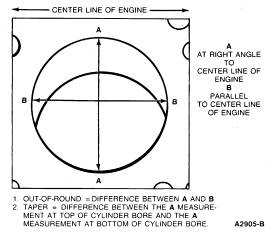
Cleaning
CAUTION: If these procedures are not followed, rusting of the cylinder bore(s)
may occur.
After any cylinder bore service operation, such as honing or deglazing, clean the bore(s) with soap or detergent and water. Then, thoroughly rinse the bore(s) with clean water to remove the soap or detergent, and wipe the bore(s) dry with a clean, lint-free cloth. Finally, wipe the bore(s) with a clean cloth dipped in engine oil XO-10W30-QSP or -DSP or equivalent meeting Ford specification ESE-M2C153-E.
If the engine is disassembled, thoroughly clean the cylinder block with solvent. Remove old gasket material from all machined surfaces. Remove all pipe plugs that seal oil passages and clean out all the passages. Blow out all passages, then bolt holes, and other openings, with compressed air. Ensure threads in the cylinder head bolt holes are clean. Dirt in the threads may cause binding and result in a false torque reading. Use a tap to true-up threads and to remove all deposits. Thoroughly clean the grooves in the crankshaft main bearings (6333) and bearing retainers.
Inspection
After the cylinder block has been thoroughly cleaned, check it for cracks. Tiny, invisible cracks may be detected by coating the suspected area with a mixture of 25 percent kerosene and 75 percent light engine oil. Wipe the part dry and immediately apply a coating of zinc oxide dissolved in wood alcohol. Do not use rubbing alcohol as a substitute. If cracks are present, the coating will become discolored at the damaged area. Replace the cylinder block if it is cracked.
Check all machined surfaces for burrs, nicks, scratches and scores. Remove minor imperfections with an oil stone.
Check the cylinder block for flatness of the cylinder head gasket surface following the procedure and specifications recommended for the cylinder head. The cylinder block can be machined to bring the cylinder head gasket surface within the flatness specifications listed in Section 03-01A (3.8L) or Section 03-01B (5.0L), but not to exceed 0.254mm (0.010 inch) stock removal from the original gasket surface.
Replace all plugs that show evidence of leakage. Inspect the cylinder walls for scoring, roughness or other signs of wear. Check the cylinder bore for out-of-round and taper. Measure the bore with an accurate bore gauge following the instructions of the manufacturer. Measure the diameter of each cylinder bore at the top, middle and bottom with the gauge placed at right angles and parallel to the centerline of the engine. Use only the measurements obtained at 90 degrees to the engine centerline when calculating the piston-to-cylinder bore clearance.
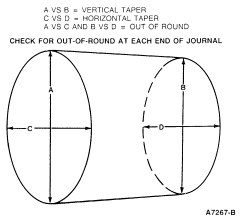
Inspect the main and connecting rod journals for cracks, scratches,
grooves, scores or rough finish. Inspect the crankshaft oil seal surface for
nicks, sharp edges or burrs that might damage the oil seal during installation
or cause premature oil seal wear.