Section 03-00: Engine—Service | 1994 Mustang Workshop Manual |
SERVICE PROCEDURES
Intake Manifold Vacuum Test
Bring the engine to normal operating temperature. Connect Vacuum Gauge
059-00008 or equivalent to the intake manifold (9424)
. Run the engine at the specified idle speed.
The vacuum gauge should read between 15 and 22 inches depending upon the
engine condition and the altitude at which the test is performed. SUBTRACT ONE
INCH FROM THE SPECIFIED READING FOR EVERY 1,000 FEET OF ELEVATION ABOVE SEA
LEVEL.
The reading should be quite steady. It may be necessary to adjust the
gauge damper control (where used) if the needle is fluttering rapidly. Adjust
damper until needle moves easily without excessive flutter.
Interpreting Vacuum Gauge Readings
A careful study of the vacuum gauge reading while the engine is idling
will help pinpoint trouble areas. Always conduct other appropriate tests before
arriving at a final diagnostic decision. Remember that vacuum gauge readings,
although helpful, must be interpreted with care.
Most vacuum gauges have a NORMAL band indicated on the gauge face.
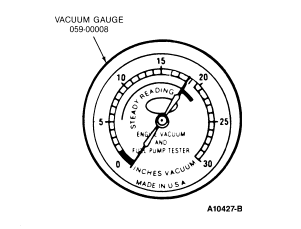
The following are potential gauge readings. Some should be considered as
normal; others should be investigated further.
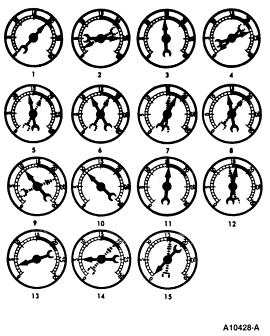
- NORMAL READING: Needle between 15 and 22 inches and holding steady.
- NORMAL READING DURING RAPID ACCELERATION AND DECELERATION: When the engine
is rapidly accelerated (dotted needle), the needle will drop to a low (not to
zero) reading. When the throttle is suddenly released, the needle will snap
back up to a higher than normal figure.
- NORMAL FOR HIGH LIFT CAMSHAFT WITH LARGE OVERLAP: Needle will register as
low as 15 inches but will be relatively steady. Some oscillation is normal.
- WORN PISTON RINGS OR DILUTED OIL: When the engine is accelerated (dotted
needle), the needle drops to zero inches. Upon deceleration, the needle runs
slightly above 22 inches.
- STICKING VALVE(S): When the needle (dotted) remains steady at a normal
vacuum but occasionally flicks (sharp, fast movement) down and back about four
inches, one or more valves may be sticking.
- BURNED OR WARPED VALVES: A regular, evenly spaced, downscale flicking of
the needle indicates one or more burned or warped valves. Insufficient
hydraulic valve tappet clearance will also cause this action.
- POOR VALVE SEATING: A small but regular downscale flicking can mean one or
more valves are not seating.
- WORN VALVE GUIDES: When the needle oscillates (swings back and forth) over
a four-inch range at idle speed, the valve guides could be worn. As engine
speed is increased, the needle will become steady if the guides are responsible.
- WEAK VALVE SPRINGS: When the needle oscillation becomes more violent as
engine rpm is increased, weak valve springs (6513)
are indicated. The reading at idle could be
relatively steady.
- LATE VALVE TIMING: A steady but low reading could be caused by late valve
timing.
- IGNITION TIMING RETARDING: Retarded ignition timing will produce a steady
but low reading.
- INSUFFICIENT SPARK PLUG GAP: When spark plugs (12405)
are gapped too close, a regular, small
pulsation of the needle can occur.
- INTAKE LEAK: A low, steady reading can be caused by an intake manifold
or throttle body gasket leak.
- BLOWN HEAD GASKET: A regular drop of fair magnitude can be caused by a blown head gasket (6051)
or warped
cylinder head-to-cylinder block surface.
- RESTRICTED EXHAUST SYSTEM: When the engine is first started and is idled,
the reading may be normal. But, as the engine rpm is increased, the
back-pressure caused by a clogged muffler (5230)
, kinked tail pipe, etc., will cause the needle to slowly
drop to zero. The needle then may slowly rise. Excessive exhaust clogging will
cause the needle to drop to a low point even if the engine is only idled.
When vacuum leaks are indicated, search out and correct the condition.
Excess air leaking into the system will upset the fuel mixture and cause
conditions such as rough idle, missing on acceleration, or burned valves. If
the leak exists in an accessory unit, the unit will not function correctly.
ALWAYS FIX VACUUM LEAKS.