Section 00-04: Noise, Vibration and Harshness | 1994 Mustang Workshop Manual |
ADJUSTMENTS
Driveshaft Balancing
Vibration shudder that is noticeable either on fast acceleration, when
coasting, or when using the engine for braking may be caused by the rear axle housing (4010)
being loose on the rear springs (5560)
, improper tire balance, improper driveline
installation, or driveline balance.
If detailed parts of the driveshaft (4602)
are replaced and shaft vibration is encountered after
installation, disconnect the shaft at the driveshaft slip yoke (4841)
. Rotate the driveshaft slip yoke
180 degrees. Reconnect the driveshaft
to the driveshaft slip yoke
. If the vibration persists, disconnect the driveshaft
at the rear axle universal joint flange (4851)
. Rotate the rear axle universal joint flange
180 degrees and reconnect the driveshaft
to the rear axle universal joint flange
.
If rotating the driveshaft
180 degrees does not eliminate vibration, the driveshaft
may be balanced, using the following procedure. Two
people are required to perform this operation; one in the vehicle, and one
under the vehicle making adjustments.
- Raise the vehicle on a twin-post hoist so that both the front and rear axle housings
are safety supported with all wheels (1007)
free to rotate.
- With the transmission in gear, increase the vehicle speed to the maximum
vibration level. Note and record the speedometer speed of this vibration period
as a baseline speed.
- Check the attachment of all U-joint bearing caps of the driveshaft
to the driveshaft slip yoke
, driveshaft slip yokes
for improper installation or damaged U-joint
bearing cap locating lugs. All yokes with worn, shaved, or damaged locating
lugs must be replaced.
- Check the driveshaft
for correct phasing.
 WARNING: DO NOT WEAR LOOSE CLOTHING THAT COULD GET CAUGHT ON THE ROTATING SHAFT.
- With the transmission in gear, run the vehicle with the driveshaft
rotating at a speedometer speed of 65-80 km/h (40-50
mph), carefully bring a crayon, piece of chalk, or colored pencil up until it
just barely contacts the rear end, center and front end of the driveshaft
. The chalk marks will indicate the heavy side of the driveshaft
. Use caution when checking the driveshaft
near the balance weights to prevent injury to the hands.
- Install two screw-type hose clamps on the driveshaft
so that their heads are located 180 degrees from the
chalk mark, starting at the rear axle universal joint flange end of the driveshaft
. Tighten the clamps and cut off the excess band from the
clamps.
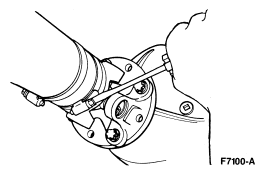
- Run the vehicle up to the baseline speed. If vibration is still evident,
rotate the clamps approximately 45 degrees away from each other and test for
correction of vibration.
- If necessary, continue to rotate the clamps apart in smaller increments
until the vibration is eliminated or begins to be reduced.
- If the vibration is not completely eliminated, repeat the foregoing
procedure and balance the front end of the driveshaft
, checking for elimination or reduction in the vibration
level.

- To completely eliminate the driveline vibration, it may be necessary to
balance the coupling shaft, following the same procedure as for the driveshaft
. To prevent overheating, do not run the vehicle on the
hoist for an extended period.
- Remove the vehicle from the hoist and road test.