Section 00-04: Noise, Vibration and Harshness | 1994 Mustang Workshop Manual |
DIAGNOSIS AND TESTING
Noise Diagnostic Procedure
Non-Axle Noise
There are a few other conditions that can sound just like axle noise and
have to be considered while performing road test diagnosis. The five most
common are transmission, exhaust, tires, roof racks and trim mouldings.
Therefore, ensure that none of the following conditions are the cause of
the noise before proceeding with an axle teardown and diagnosis.
- In certain conditions, the pitch of the exhaust may
sound very much like gear whines. At other times, it can be mistaken for a
wheel bearing rumble.
- Tires, especially snow tires, can have a high-pitched
tread whine or roar, similar to gear noise. Radial tires, to some degree, have
this characteristic. Also, any non-standard tire with an unusual tread
construction may emit a roar or whine-type noise.
- Trim and mouldings can also cause whistling or
whining noise.
- Clunk may be a metallic noise heard when the
automatic transmission is engaged in REVERSE or DRIVE, or it may occur when
throttle is applied or released. It is caused by backlash somewhere in the
driveline; it is felt or heard in the axle.
- Bearing whine is a high-pitched sound similar to a
whistle. It is usually caused by malfunctioning pinion bearings, which are
operating at driveshaft speed. Roller wheel bearings may whine the same way if
they run completely dry. Bearing noise occurs at all driving
speeds; this distinguishes it from gear whine, which usually comes and
goes as speed changes.
- Bearing rumble sounds like marbles being tumbled.
This condition is usually caused by a malfunctioning rear wheel bearing (1225)
. The lower pitch is because the rear wheel bearing
turns at about one-third of driveshaft speed.
- Bearing noise. Rear wheel bearing noise might be
mistaken for differential pinion bearing noise, so always look at the rear wheel bearings
carefully before tearing down the rear axle housing (4010)
. As noted earlier, pinion bearings make a high-pitched,
whistling noise, usually at all speeds. However, if there is only one differential pinion bearing (4630)
that is malfunctioning, the noise may vary in different
driving phases. If a differential pinion bearing
is suspected, refer to Section 05-00 for service
procedures.
Bearings should not be replaced unless they are actually scored or damaged.
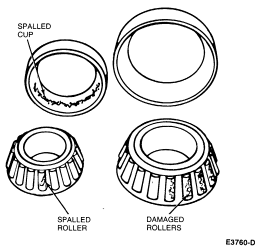
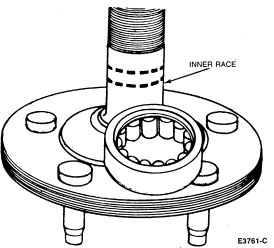
Rear wheel bearing is pressed into the axle
housing, making it more difficult to check it. However, the axle shaft (4234)
is the inner race for the bearing. So if the rear wheel bearing
is damaged, the roller surface on the shaft will be
damaged as well. The rollers run on about the center of the polished surface.
Noise Conditions
- Gear noise is the typical howling or whining of the differential ring gear and pinion (4209)
due to an improper gear pattern, gear damage, or
improper bearing preload. It can occur at various speeds and driving
conditions, or it can be continuous.
- Chuckle is a particular rattling noise that sounds
like a stick against the spokes of a spinning bicycle wheel. It occurs while
decelerating from 64 km/h (40 mph) and can usually be heard all the way to a
stop. The frequency varies with the speed of the vehicle.
Chuckle that occurs on the driving phase is usually caused by
excessive clearance due to differential gear wear or by a damaged tooth on the
coast side of the differential ring gear and pinion
.
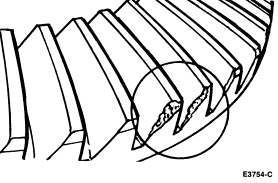
Any damage to a gear tooth on the coast side can cause a noise
identical to chuckle. Even a very small tooth nick or ridge on the edge of a
tooth is enough to cause the noise.
This condition can be corrected and the noise eliminated by
cleaning up the gear tooth nick or ridge with a small grinding wheel. If the
cleaned up or damaged area is larger than 3.2mm (1/8 inch), it is advisable to
replace the gearset.
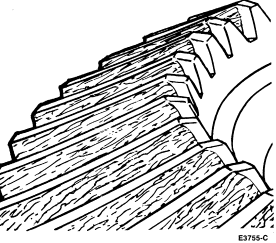
If either gear is scored or damaged badly, the differential ring gear and pinion
must be replaced. Also, if there is metal broken loose,
the rear axle housing
must be cleaned to remove particles that could cause
damage later. Any other damaged parts in the axle must be replaced.
To check the differential ring gear and pinion
, remove as much lubricant as possible from the gears
with clean solvent. Wipe the gears dry or blow them dry with compressed air.
Look for scored or damaged teeth. Also look for cracks or other damage.
- Knock is very similar to chuckle, though it may be
louder and occurs on acceleration or deceleration. The teardown will disclose
what has to be corrected.
Knock, which can occur on all driving phases, has several
causes. In most cases, one of the following conditions has occurred:
- A gear tooth damaged on the drive side is a common cause of the knock. This
can usually be corrected by grinding the damaged area.
- Knock is also characteristic of excessive end play in the axle shaft
. Up to 0.762mm (0.030 inch) is allowed in most axles.
The frequency of knock will be less because the axle shaft speed is slower than
the driveshaft
.
NOTE: Be sure to measure the end play with a dial indicator, not by feel. A
guess usually feels like far more end play than there actually is.
On the integral axle, end play is allowable up to 0.762mm
(0.030 inch). It is controlled by the rear axle shaft retaining u-washer (4N237)
that holds the axle shaft
in the pocket of the differential side gear (4236)
.
- Chatter on corners is a condition where the whole
rear end vibrates only when the vehicle is moving. The vibration is plainly
felt as well as heard. In conventional axles, extra differential side gear thrust washers (4228)
cause a condition of partial lockup that
creates this
chatter. Chatter noise on Traction-Lok axles can usually be traced to erratic
movement between adjacent clutch components and can sometimes be corrected with
a lubricant change and the addition of a friction modifier.
- Click at engagement is a slight noise, distinct from
a clunk, that happens in REVERSE or DRIVE engagement. Check for the presence of
a pinion oil slinger.
- Axle shaft noise is similar to gear noise and pinion
bearing whine. However, rear wheel bearing noise will normally distinguish
itself from gear noise by occurring in all driving modes (drive, coast and
float) and will persist with transmission in NEUTRAL while vehicle is moving at
a certain speed. If upon ride evaluation vehicle displays above noise
condition, remove suspect axle shafts
, replace inner wheel bearing oil seals (1177)
and install a new set of axle shafts
. Re-evaluate vehicle for noise before
removing any internal components.
- Boom is a condition that exists when ring gear teeth
have a runout of more than 0.10mm (0.004 inch).
Damaged Gear Teeth
Scored Gear Teeth
Gear Howl and Whine
When disassembling the axle to diagnose and correct gear noise, it is
assumed that the tires, exhaust, and trim items have first been checked and
negated as possible causes.
The noises described under Road Test usually have specific causes that
can be diagnosed by observation as the unit is disassembled. The initial clues
are, of course, the type of noise heard on the road test and the driving
conditions.
Leakage Conditions
Most rear axle lubricant leakage conditions can be corrected without a
teardown. However, it is important to clean up the leaking area enough to
identify the exact source.
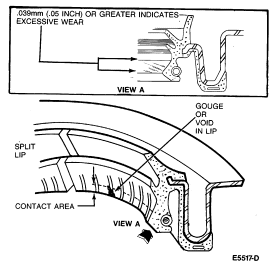
A plugged axle vent will cause excessive seal lip wear due to internal
pressure buildup. When a leak occurs, check the vent which is located near the
top of the differential housing. Ensure the vent hose is not kinked. Remove the
vent hose from the vent nipple and make sure the hose is clear of dirt or other
foreign materials. While hose is removed, pass a length of mechanics' wire or
small diameter Allen wrench in and out of the vent nipple to clean it of any
dirt or foreign materials. Install vent hose.
NOTE: If vent cannot be cleared, it must be replaced.
Ensure axle lubricant is level with bottom of fill hole.
Flange Yoke Seal
When the drive pinion seal leaks, it is usually because it was not
installed carefully or properly, or because of poor quality on the seal journal
surface.
Any damage to the seal bore (dings, dents, gouges, etc.) will distort the
seal casing and allow leakage past the outer edge of the seal.
The seal lip can be torn, cut or gouged if it is not assembled carefully.
The spring that holds the seal lip against the circular companion flange may be
knocked out and allow leakage past the lip.
The rubber lips can occasionally become hard (like plastic) accompanied
by cracks at the oil lip contact point. The contact point on the circular
companion flange is usually black, indicating excessive heat. Marks, nicks,
gouges or rough surface texture on the seal journal of the circular companion
flange will also cause leaks. Excessive seal lip wear will be noted. The
circular companion flange should be replaced if any of these conditions exist.
Metal chips or sand, trapped at the sealing lip also may cause oil leaks.
This can cause a wear groove on the circular companion flange and heavy seal
lip wear.
Pinion Nut
On some high mileage units, there have been instances of oil leaking past
the threads of the pinion nut. The condition can be corrected by removing the
nut and applying Pipe Sealant With Teflon® D8AZ-19554-A
(ESG-M4G194-A and ESR-M18P7-A) or equivalent on the threads and nut face.
NOTE: Be sure to follow the correct procedure for setting the bearing preload
when the nut is installed.