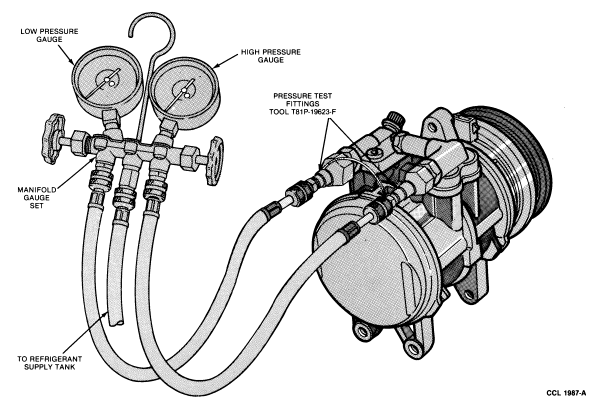
Remove the hoses from the manifolds. Install Pressure Test Caps
T81P-19623-F on the compressor manifolds. If brazed (steel) manifolds are used,
remove the manifolds from the compressor and install Pressure Test Plates
D88L-19703-A or equivalent on the compressor.
Connect the high and low-pressure lines of a manifold gauge set to the
corresponding fittings on the manifold pressure test fittings.
External Leaks—Testing
Attach the center hose of the manifold gauge set to a refrigerant drum
standing in an upright position.
Open the low-pressure gauge valve, the high-pressure gauge valve, and the
valve on the refrigerant drum to allow the refrigerant vapor to flow into the
compressor.
Using a leak detector, such as Rotunda Leak Detector 055-00015 or
equivalent, check for leaks at the compressor rear head seal, compressor front
head seal, the compressor shaft seal, the center joint seal and around the
cylinder bolt heads. After checking, turn off the manifold gauge valves.
If an external leak is found at either head, either manifold or at the
shaft seal, service as necessary. If an external leak is found at the center
joint of the compressor body, install a new compressor assembly.
If a refrigerant leak is found around the head of a cylinder bolt, install
a new brass washer on the bolt and leak test as outlined. If the leak cannot be
corrected with a new brass washer, install a new head cylinder bolt and brass
washers.
Disconnect the manifold gauge hoses from Pressure Test Caps T81P-19623-F.
Reinstall the brazed (steel) manifolds, if used. Tighten the retaining bolts to
28-36 Nm (21-26 lb-ft) for suction manifold or 20-27 Nm
(15-19 lb-ft) for discharge manifold.