Section 12-03A: Air Conditioning System | 1993 Mustang Workshop Manual |
REMOVAL AND INSTALLATION
Compressor
Vehicles that have an inoperative A/C compressor, due to internal causes,
should have the refrigerant system cleaned to remove any debris or contaminants
that may be present, to prevent damage to the replacement compressor.
When a compressor fails and internal damage occurs, A/C system
contamination can be produced in several ways. Refrigerant loss, poor
lubrication and internal component failure can cause a number of physical and
chemical reactions inside the compressor, resulting in the addition of
contaminants to the A/C system.
Regular flushing procedures will not remove this type of contamination
from the system. Therefore, the following A/C system flushing procedure MUST
be performed before a new compressor can be installed. A new
compressor should never be installed without performing this mandatory
filtering procedure.
A/C System Filtering
Two A/C service kits have been released to provide the necessary
equipment and information to perform the new, mandatory A/C system filtering
procedure. Filter kits with the service part number suffix "A" are to be used
on vehicles that have a nylon lined suction hose between the suction
accumulator/drier and the compressor. Filter kits with the service part number
suffix "B" are for vehicles with rubber lined suction hose.
 CAUTION: Follow all refrigerant system safety and service precautions as
outlined.
CAUTION: Follow all refrigerant system safety and service precautions as
outlined.
- To determine that the compressor has failed and must be replaced, remove
the orifice tube and liquid line, if necessary. Look for a dirty orifice tube
and/or a liquid line containing black refrigerant oil and particles.
- Remove the damaged compressor and drain the oil into a calibrated container.
NOTE: The proper amount of refrigerant oil must be added to the new compressor
before it can be installed. The procedure for the FX-15 is given here. However,
the procedure is the same for all compressors. Refer to Section 12-00 for the
quantity of oil required.
- A new FX-15 service replacement compressor contains 207 ml (7 oz.) of
refrigerant oil. If the amount of oil drained from the removed compressor is
between 90 and 148 ml (3 oz. to 5 oz.), pour the same amount of clean oil into
the new compressor. If the amount of oil drained from the old compressor is
greater than 148 ml (5 oz.), pour only 149 ml (5 oz.) of clean refrigerant oil
into the new compressor. If the amount of refrigerant oil drained from the old
compressor is less than 90 ml (3 oz.), pour 90 ml (3 oz.) of clean refrigerant
oil into the new compressor.
NOTE: It will be necessary to transfer the magnetic clutch from the old
compressor to the new compressor.
- Install the new compressor. Be sure the compressor mounting bolts are
tightened to the proper specification. Check the tension of the compressor
drive belt. Adjust, if necessary.
- Remove the suction accumulator/drier assembly and drain the oil into a
calibrated container.
- Add clean refrigerant oil to the new accumulator/drier in the same amount
that was removed from the old unit, plus an additional 60 ml of new refrigerant
oil.
- Install the suction accumulator/drier in the vehicle.
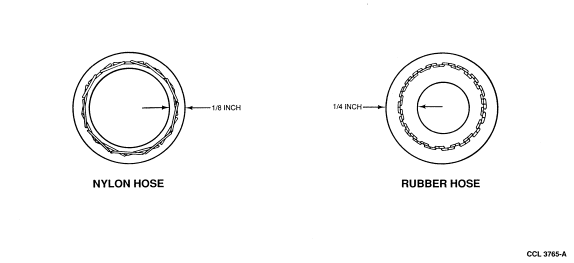
- Determine the type of suction hose with which you are working. To do this,
cut the suction hose into two pieces (make the cut closer to the compressor
than the accumulator) and measure the hose wall thickness. Rubber lined hose
has a wall thickness of 1/4 inch and nylon lined hose has a wall thickness of
1/8 inch.
- Get the proper service kit for the vehicle on which you are working. Filter
kits with the service part number suffix "A" are to be used on vehicles with a
nylon lined suction hose. Filter kits with the service part number suffix "B"
are for vehicles with rubber lined suction hose. The label on the filter shows
with which hose it is to be used.
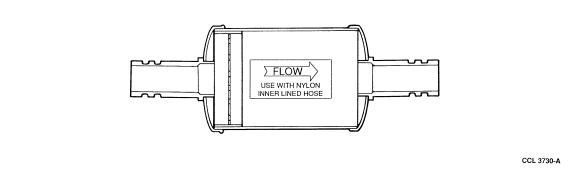
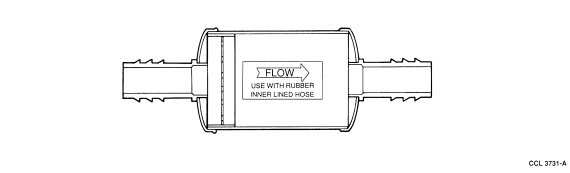
- Remove a length of suction hose to accommodate the suction filter and
install the filter using the hose clamps provided with the kit. Be sure filter
is correctly oriented for refrigerant system flow. Check the label on the
filter. On the filter for nylon lined hose, install O-rings (two on each filter
tube, properly seated in the grooves on the tube). Tighten the hose clamps
securely.
- Install a new orifice tube. If the orifice tube in the vehicle on which you
are working is located in the liquid line between the condenser and the
evaporator, replace the liquid line assembly. Refer to Section 12-00.
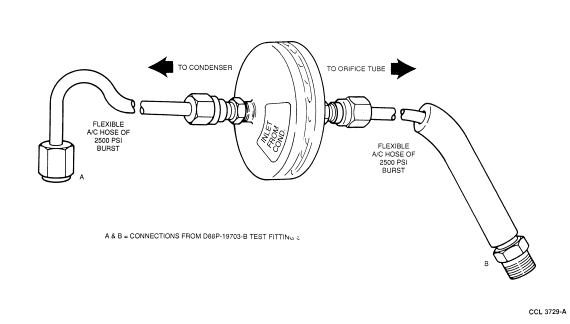
- Install a pancake filter in the liquid line between the condenser and the
orifice tube. Be sure the filter inlet is toward the condenser. Connections can
be made using A/C Test Fitting Set D88P-19703-B or equivalent, and flexible
refrigerant hose of 2500 psi burst rating. Individual fittings are also
available.
- Evacuate, charge and leak test the system.
- Check all refrigerant system hoses, lines and the positioning of the newly
installed filters to be sure they do not interfere with other engine
compartment components. If necessary, use tie straps to make adjustments.
- Provide adequate air flow to the front of the vehicle (with a fan, if
necessary), set the A/C control at MAX A/C. Set the blower on HI and
temperature control at full cool. Start the engine and let it idle briefly.
Make sure the A/C system is operating properly.
- Gradually bring the engine up to 1200 rpm by running it at lower rpms for
short periods (first at 800 rpm, than at 1000 rpm). Set the engine at 1200 rpm
and run it for an hour with the A/C system operating.
- Stop the engine.
- Allow the engine to cool sufficiently to remove the fittings, flexible
hoses and pancake filter from the liquid line. (It will be necessary to
discharge the system first).
- Discard the pancake filter. It can be used ONE TIME ONLY.
- Reconnect the liquid line back into the system.
- Evacuate, charge and leak test the system. Make any necessary adjustments.
- Check the operation of the system in all modes.
6P148, 5.0L Engine
Removal
NOTE: Whenever a compressor is replaced, it will be necessary to replace the
suction accumulator/drier.
- Discharge the system following the recommended service procedures. Observe
all safety precautions. Refer to Section 12-00.
- Disconnect compressor clutch wires at the field coil connector on
compressor.
- Disconnect the discharge and suction hoses from the compressor manifolds.
Cap the refrigerant lines and compressor manifolds to prevent the entrance of
dirt and moisture.
- Remove two screws retaining brace to rear mounting bracket.
- Remove two screws retaining bracket to compressor lower front mounting lugs.
Compressor Installation—5.0L Engine
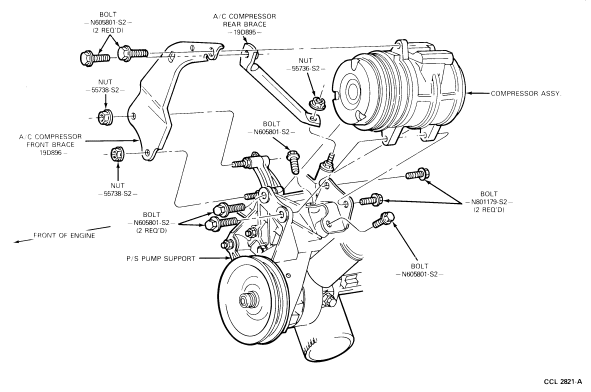
- Remove one screw retaining bracket to compressor upper mounting lug.
- Remove compressor/clutch assembly and rear support from vehicle as unit.
- Remove two screws retaining compressor to rear support and remove rear
support.
- If the compressor is to be replaced, remove the clutch and field coil
assembly from compressor, Section 12-03C.
Installation
- A new service replacement 6P148 compressor contains 295.7ml (10 oz) of the
specified refrigerant oil. Prior to installing the replacement compressor,
drain four fluid ounces of refrigerant oil from the compressor. This will
maintain the total system oil charge within the specified limits.
- Reverse removal procedure.
- Using new O-rings lubricated with clean refrigerant oil, connect the
suction and discharge lines to the compressor manifolds. Tighten each fitting
to specification.
- Connect the clutch wires to the field coil connector.
- Install the drive belt. Adjust the drive belt to specification.
- Leak test, evacuate and charge the system following the recommended service
procedures. Observe all safety precautions.
- Check the system for proper operation.
10P15C, 2.3L
Removal
NOTE: Whenever a compressor is replaced, it will be necessary to replace the
suction accumulator/drier.
- Discharge the system following the recommended service procedures. Observe
all safety precautions, refer to Section 12-00.
- Disconnect compressor clutch wires at the field coil connector on
compressor.
- Disconnect the discharge and suction hoses from the compressor manifolds.
Cap the refrigerant lines and compressor manifolds to prevent the entrance of
dirt and moisture.
- Remove screw and washer assembly from the adjusting bracket.
Compressor Installation, 2.3L
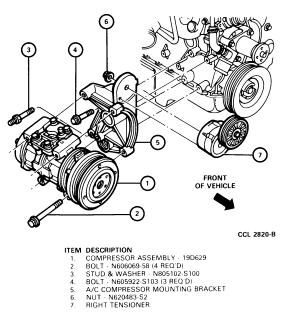
- Rotate compressor outboard and remove drive belts.
- Remove bolt retaining bracket to compressor lower mounting lug.
- Remove compressor and adjusting bracket intact.
- Remove clutch field coil and adjusting bracket from the compressor if the
compressor is to be replaced, refer to Section 12-03B.
Installation
- If compressor is to be replaced, refer to Section 12-03B to maintain
refrigerant oil within specified limits.
- Install the clutch field coil and adjusting bracket if it was removed or if
compressor was replaced, refer to Section 12-03B.
- Reverse removal procedure.
- Refer to Refrigerant Lines—2.3L or Refrigerant Line
Routing—5.0L illustrations for correct procedure to connect
refrigerant lines to compressor.
- Connect the clutch wires to the field coil connector.
- Evacuate, charge, and leak test the system following the recommended
service procedures. Observe all safety precautions.
- Check system for proper operation.