Section 14-02: Generator, Integral Regulator—External Fan Type | 1993 Mustang Workshop Manual |
DIAGNOSIS AND TESTING
On-Bench Tests
Tools Required:
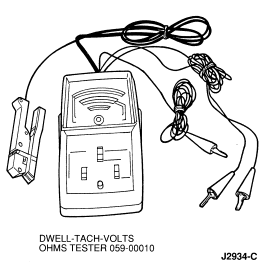
- Rotunda Dwell-Tach-Volts Ohms Tester 059-00010
If system diagnosis has isolated a concern in the integral
generator/regulator assembly, remove it from vehicle for bench testing and
service or replace. Refer to Removal and Disassembly. In some cases, it may be
possible to replace a damaged regulator or brushes without removing the IGR
assembly.
The following tests are performed with an analog (needle-type) ohmmeter.
Test values shown are referenced to Rotunda Dwell-Tach-Volts Ohms Tester
059-00010 or equivalent. THESE VALUES MAY BE DIFFERENT FOR OTHER OHMMETERS. If
a Rotunda Dwell-Tach-Volts Ohms Tester 059-00010 or equivalent is not
available, use known good parts to establish reference values for your own
meter. These values can be written into the spaces provided in the meter
reading charts for future reference.
Rectifier and Stator Grounded Tests
Tools Required:
- Rotunda Dwell-Tach-Volts Ohms Tester 059-00010
This test is performed with an ohmmeter, Rotunda Dwell-Tach-Volts Ohms
Tester 059-00010 or equivalent. Place the Multiply-By setting at 1 and
calibrate the ohmmeter as directed.
NOTE: Text values shown in brackets [ ] ohms are referenced to Rotunda Dwell-Tach-Volts Ohms
Tester 059-00010, and may be different if another tester is used.
 CAUTION: Digital meters cannot be used to perform these rectifier tests.
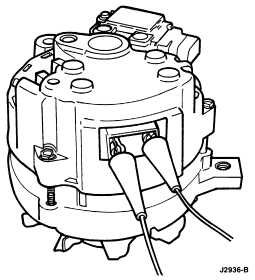
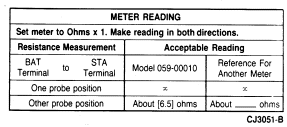
- Contact one ohmmeter probe of one of the generator Battery Positive Voltage
(B+) blade terminals and the other probe to the STA blade
terminal. Then, reverse the ohmmeter probes and repeat the test. Normally,
there will be no needle movement in one direction, indicating the rectifier
diodes are being checked in the reverse current direction and are not shorted.
A low reading of about [6.5] ohms with the probes reversed indicates that rectifier
positive diodes are being checked in the forward current direction. A reading
in both directions indicates a bad positive diode or shorted radio suppression
capacitor. The radio suppression capacitor is built into the rectifier assembly
and is not individually serviceable.
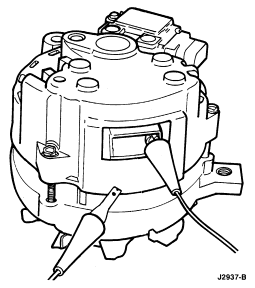
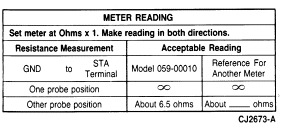
- Perform the same test using the STA blade terminal and generator rear
housing. A reading in both directions indicates either a grounded stator
winding, a damaged negative diode, a grounded stator lead wire or a shorted
radio suppression capacitor.
- If there is no needle movement with the probes in one direction and no
needle movement or high resistance (significantly over [6.5]
ohms) in the opposite direction for
Tests 1 and 2, a bad connection exists in the rectifier assembly.
Field Open or Short Circuit Test
Tools Required:
- Rotunda Dwell-Tach-Volts Ohms Tester 059-00010
This test is performed with an ohmmeter, Rotunda Dwell-Tach-Volts Ohms
Tester 059-00010 or equivalent.
Place the Multiply-By setting at 1 and calibrate the ohmmeter as directed.
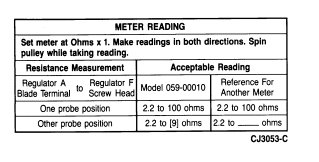
- Contact the regulator 'A' blade terminal with one probe and the regulator
'F' screw head with the other probe. Spin the generator pulley.
Reverse the ohmmeter probes and repeat the test. In one probe
direction, the ohmmeter reading should be between 2.2 and 100 ohms (on Rotunda
meter) and may fluctuate while the pulley is turning. In the other probe
direction, the reading should fluctuate between 2.2 and about [
9] ohms.
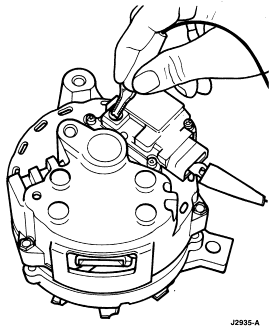
- An infinite reading (no meter movement) in one direction and approximately [
9] ohms in the
other, indicates an open brush lead, worn or stuck brushes, a damaged rotor or
a loose regulator to brush holder retaining screw.
- An ohmmeter reading less than [2.2] ohms in both directions indicates a shorted rotor or
damaged regulator.
- An ohmmeter reading significantly over [9]
ohms in both directions indicates an
inoperative regulator or loose 'F' terminal screw.
- Contact the generator rear housing with one ohmmeter probe and touch the
other probe to the regulator 'F' terminal. Reverse the probes and repeat the
test. The ohmmeter reading should be infinite in one probe direction and
approximately [9] ohms in the other. A reading less than infinite in both directions
indicates a grounded brush lead or an inoperative regulator. A reading
significantly over [9] ohms in both directions indicates an inoperative regulator or a damaged
'A' terminal connection.
Rectifier Assembly Test
Tools Required:
- Rotunda Dwell-Tach-Volts Ohms Tester 059-00010
Remove the rectifier assembly from the generator. Place the ohmmeter,
Rotunda Dwell-Tach-Volts Ohms Tester 059-00010 or equivalent Multiply-By
setting at 1 and calibrate the meter as directed.
CAUTION: Digital meters cannot be used to perform these rectifier tests.
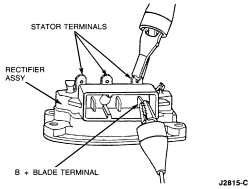
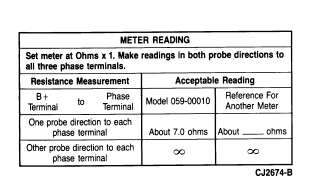
- To test the positive diodes, contact one probe to one of the rectifier
assembly Battery Positive Voltage (B+) blade terminals and
contact each of the three stator terminals with the other probe. Reverse the
probes and repeat the test. All diodes should show a low reading of
approximately [7]
ohms in one direction and an infinite reading (no needle movement) with the
probes reversed. This reading may be checked against a good rectifier if one is
available.
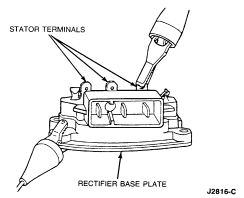
- Perform the preceding tests for the negative diodes by contacting the
rectifier assembly base plate and the three stator terminals.
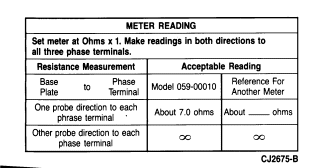
- If the meter readings are not as specified, replace the rectifier assembly.
Radio Suppression Capacitor Open or Short Test
NOTE: This is an open or short circuit test only and does not measure
capacitance value. Actual capacitance value should be measured on a capacitance
bridge at 1 kHz at a maximum voltage of 350 mV rms.
The radio noise suppression capacitor is built into the rectifier
assembly and cannot be serviced by itself. To test the capacitor, place the
ohmmeter, Multiply-By setting at 1000 and zero the meter. Text values shown in
brackets [ ] ohms
are referenced to Rotunda Dwell-Tach-Volts Ohms Tester 059-00010 and may be
different if another tester is used.
CAUTION: Digital meters cannot be used to perform this capacitor test. The
rectifier assembly must be dry.
- Contact one probe to one of the rectifier assembly Battery Positive Voltage
B+ blade terminals and contact the other probe to the rectifier
assembly base plate. Reverse the probes and repeat the test. One position
should give an infinite reading, indicating the reverse current direction
through the diodes and the other position should give a reading of about [
1000] ohms
indicating the forward current direction. The same reading in both directions
indicates an inoperative rectifier assembly.
- To check the capacitor, contact the probes to the rectifier assembly
Battery Positive Voltage (B+) terminal and base plate in the
forward current [1000] ohms reading direction. While observing the meter indicator needle,
reverse the probes and again contact them to the rectifier assembly Battery
Positive Voltage (B+) terminal and base plate. The indicator
needle should jump slightly (indicating that the ohmmeter batteries are
charging the capacitor) and then return to its original position (infinite
reading). If the needle does not jump, the capacitor is open. Replace the
rectifier assembly.
Stator Coil Grounded Test
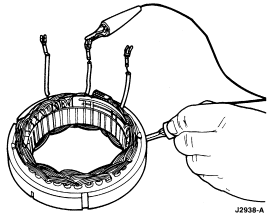
These tests are made to determine if the stator coil is shorted to
ground. Remove the stator from the generator and disconnect it from the
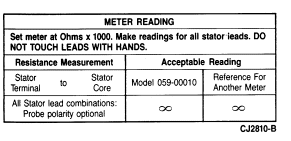
rectifier assembly as outlined. Place the ohmmeter Multiply-By setting at 1000.
- Connect the ohmmeter probes to one of the stator lead terminals and to the
stator laminated core. Ensure that the probe makes a good electrical connection
with the stator core. The meter should show an infinite reading (no needle
movement).
- If the meter does not indicate an infinite reading (needle moves), the
stator winding is grounded to the core and the stator must be replaced.
Stator Coil Open Test
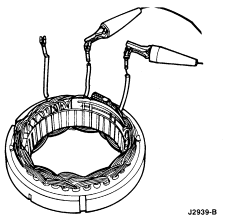
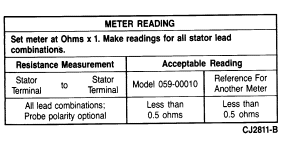
This test determines if there is an open stator circuit. Disconnect the
stator from the rectifier assembly. Place the ohmmeter Multiply-By setting at 1.
- Connect one ohmmeter probe to a stator phase lead terminal and touch the
other probe to another stator lead terminal. Check the meter reading.
- Repeat this test with the other two stator lead combinations. If no meter
movement occurs (infinite resistance) on a lead paired with either of the other
phase leads, that phase is open and the stator must be replaced.
Rotor Open or Short Test
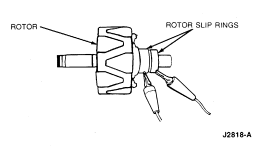
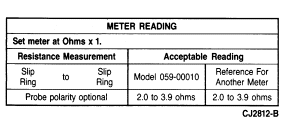
Remove the rotor from the generator. Place the ohmmeter Multiply-By
setting at 1 and calibrate the meter as directed.
- Contact each ohmmeter probe to a rotor slip ring. The meter reading should
be [2.0-3.9] ohms.
- A higher reading indicates a damaged slip ring, welded connection or a
broken wire. A lower reading indicates a shorted wire or slip ring. Replace the
rotor if it is damaged and cannot be serviced.
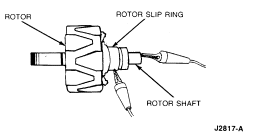
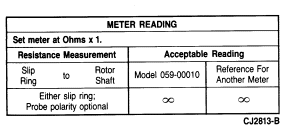
- Contact one ohmmeter probe to a slip ring and the other probe to the rotor
shaft. The meter reading should be infinite (no needle movement).
- A reading other than infinite indicates the rotor coil is grounded to the
shaft. Replace the rotor if it is grounded and cannot be serviced.