Section 14-01: Battery | 1993 Mustang Workshop Manual |
Anyone working with a battery needs the proper tools. Using the right tools will prevent damage to the battery, battery cables and hold-down bracketry.
Tools and equipment manufactured for servicing batteries have parts insulated to help prevent arcing should the tool be dropped or placed accidentally between a terminal and some other contact surface.
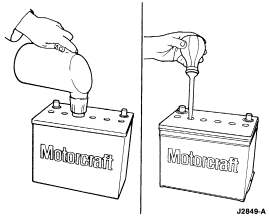
Battery Filling Devices
Batteries with Removable Vent Caps
One of the most important on-vehicle services is to maintain the correct
electrolyte level. Two devices are available for this purpose: a self-leveling
filler which allows the battery to be filled to a predetermined level
automatically, and a syringe-type filler.
Battery Pliers
Battery pliers have jaws specifically designed for gripping cable clamp
bolts securely. Care should be taken when removing or replacing the cable clamp
bolts so that the battery terminal is not subjected to any excessive lateral or
twisting forces. Such forces could cause major damage to the internal
components of the battery, and leakage at the terminals. 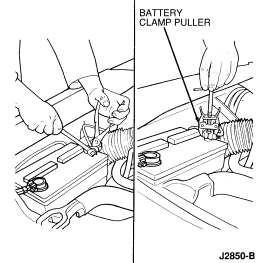
Battery Clamp Puller
Use a clamp puller to remove a cable clamp from the battery terminal. With the jaws gripping the underside of the cable clamp, pull the clamp up by means of pressure exerted against the top of the battery terminal. Proper use of this tool avoids the damaging lateral or twisting forces that result when using a pry bar or pliers.
Battery Clamp Spreader
The spreader is used to expand the cable clamp after it has been removed
from the terminal and the clamp bolt has been loosened. The cable clamp can
then be easily placed in its correct position completely on the terminal. 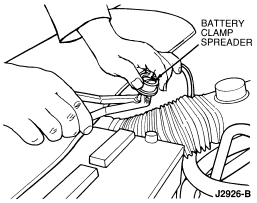
Terminal Cleaning Brush
The terminal cleaning brush is designed with units to clean both the tapered battery terminal and the mating surface of the cable clamp. Refer to illustration under Battery Installation, Step 1.
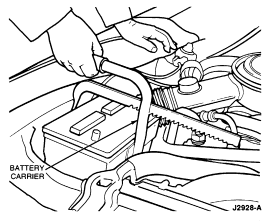
Battery Carrier
Use a suitable battery carrier for lifting and transporting the battery. The illustration shows a clamp-type carrier used to grip the sidewalls of the container just below the lip of the cover. The carrier is used on the sidewalls, rather than the endwalls, since the sidewalls have additional strength from the inner cell partitions. This is particularly important with the plastic-cased battery which has endwalls that are flexible.
 WARNING: BATTERIES NORMALLY PRODUCE EXPLOSIVE GASES WHICH CAN CAUSE PERSONAL
INJURY. THEREFORE, DO NOT ALLOW FLAMES, SPARKS OR LIGHTED SUBSTANCES TO COME
NEAR THE BATTERY. WHEN CHARGING OR WORKING NEAR A BATTERY, ALWAYS SHIELD YOUR
FACE AND PROTECT YOUR EYES. ALWAYS PROVIDE VENTILATION.
WARNING: BATTERIES NORMALLY PRODUCE EXPLOSIVE GASES WHICH CAN CAUSE PERSONAL
INJURY. THEREFORE, DO NOT ALLOW FLAMES, SPARKS OR LIGHTED SUBSTANCES TO COME
NEAR THE BATTERY. WHEN CHARGING OR WORKING NEAR A BATTERY, ALWAYS SHIELD YOUR
FACE AND PROTECT YOUR EYES. ALWAYS PROVIDE VENTILATION.
WHEN LIFTING A PLASTIC-CASED BATTERY, EXCESSIVE PRESSURE ON THE END WALLS COULD CAUSE ACID TO SPEW THROUGH THE VENT CAPS, RESULTING IN PERSONAL INJURY. LIFT WITH A BATTERY CARRIER OR WITH YOUR HANDS ON OPPOSITE CORNERS.