Evaporator Case Assembly
Section 12-03A: Air Conditioning System | 1993 Mustang Workshop Manual |
As shown in the previous illustrations, the function selector knob setting affects air distribution as follows:
MAX A/C
The outside/recirc door is closed to outside air. Air from the passenger compartment is drawn through the recirc opening and blown across the evaporator core. From there, it flows past doors closed to the floor and defroster outlets and out through the panel.
NORM A/C
Airflow follows the same course as MAX A/C except the outside/recirc door is set to draw outside instead of recirc air through the system.
FLOOR
Outside air is drawn into the system and blown past the evaporator core. From there, it passes through the heater core. Vacuum closes the floor-defrost to the defroster outlet and opens it to the floor outlet. When the knob is in the FLOOR position, air is also fed to the demisters.
VENT
Outside air (recirc air door closed) is drawn into the system and blown past the evaporator core. Depending on the blend door setting, air then bypasses the heater core when the cable-operated blend door is closed at the opening to the core. With the blend door closed at the core, air is directed past the closed floor-defrost door. In the VENT position, the panel-defrost door is closed by vacuum to the defroster outlet. Air then flows through the panel outlet and ducts to the instrument panel registers.
MIX
With the function selector knob set in the MIX position, the floor-defrost door receives partial vacuum. As a result, the door opens midway to allow airflow to the floor and demisters, as well as to the defroster and demisters. The panel-defrost door, with no vacuum being applied, closes the outlet to the instrument panel.
Airflow begins with outside air being drawn into the system and past the evaporator core. The cable-operated temperature blend door setting determines how much of the total air input is heated by the core and how much bypasses the core. The blended air continues its flow through the partial openings to the floor and defroster outlets as previously described.
DEFROST
When the function selector knob is turned to the DEFROST position, all vacuum to the system is cut off. As a result, temperature blending is the only variable which can be introduced into the system.
Outside air flows past the evaporator core, through and/or bypassing the heater core, and out through the defroster and demister outlets. Whenever there is a vacuum malfunction in the system, regardless of the function selector knob setting, operation automatically diverts to defroster only operation with heat intensity contingent upon temperature knob (blend door) setting.
Temperature Control
Temperature is controlled by a cable operated air blend door located within the evaporator case. The air blend door can be closed or opened, allowing cooled or outside air to be discharged from the outlets, depending on position of temperature selector lever.
Function Control
The function selector knob actuates a six-port vacuum selector that controls air source intake and air distribution within the system. The function selector knob also operates the blower ON/OFF switch and the A/C compressor clutch operating circuit. However, the actual turning on or off of the compressor clutch is dependent on the position of the function selector knob and the clutch cycling pressure switch. Both switches must be closed to energize the clutch for compressor operation.
Blower Control
Blower speeds are controlled by a four position FAN switch and a resistor assembly located in the evaporator case downstream from the evaporator core. The switch is used to select LO, two intermediate or the HI fan speed. The fan is turned off by the function selector knob when it is in the OFF position. This is accomplished by a switch integral with the control assembly. Refer to System Airflow Schematic (MAX, A/C, FLOOR).
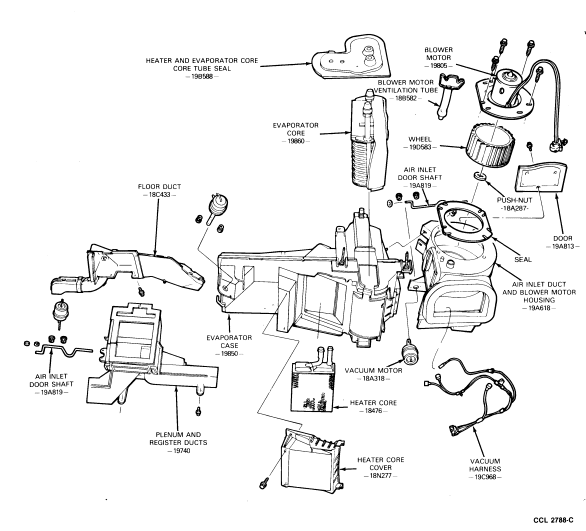
Evaporator Case Assembly
The evaporator assembly is located in the passenger compartment under the
instrument panel on the RH side of the passenger compartment. It contains the
evaporator and heater cores, the blower motor resistor, the cable operated air
blend door and the heat-defrost door. The evaporator case is attached to the
vehicle dash panel.
Evaporator Case Assembly
Air Inlet Duct and Blower Housing Assembly
The air inlet duct and blower housing assembly is located under the RH side of the instrument panel and is attached to the evaporator assembly.
The air inlet duct contains the outside-recirc door and serves as the air passage to supply air to the blower for system operation.
The blower assembly includes the blower housing, motor and wheel. It draws air from the air inlet duct and forces the air into the evaporator housing through the evaporator core. The blower motor should not be removed from the mounting flange because the position of the motor in the mounting flange is preset to prevent interference of the blower housing and blower wheel.
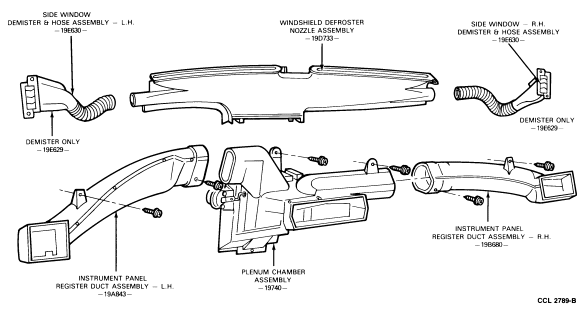
Defroster Nozzle, Demisters and Register Ducts
The defroster nozzle and register ducts are attached to the instrument
panel with self-tapping screws. The demister system has a hose which attaches
to each end of the defroster nozzle and leads to two demisters in opposite
corners of the instrument panel.
Defroster Nozzle, Demisters and Register Ducts
Vacuum Motors
Three vacuum motors are used in the manual A/C-heater system. One is used to operate the outside-recirc door and is located on the air inlet duct behind the glove compartment. The motor opens the outside-recirc door to outside air with no vacuum.
The A/C-defrost door vacuum motor is located on the left side of the A/C-heat distribution duct. This motor opens the A/C-defrost door for defroster operation when there is no vacuum.
The heat-defrost door vacuum motor is a dual diaphragm vacuum motor and is located on the left end of the evaporator case. Vacuum must exist at both diaphragm ports for full travel of the motor arm. Vacuum at the top or end port of the motor will give about half travel of the motor arm. If vacuum is applied to the side port only, motor operation is minimal. If the vacuum hoses to this motor are reversed, the vacuum motor will not operate properly when the function selector lever is in the MIX position (refer to Airflow Schematic—VENT, MIX, DEFROST).