Section 05-02A: Axle, Integral Carrier—7.5 Inch Ring Gear
1993 Mustang Workshop Manual
MAJOR SERVICE OPERATIONS

Drive Pinion and Gearset


Tools Required:

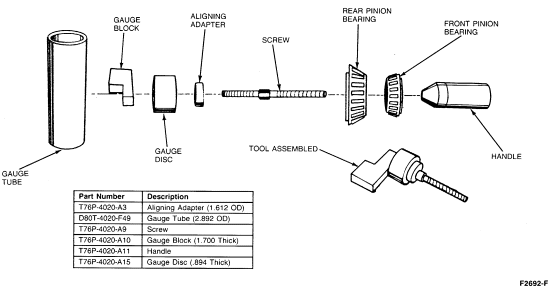
A selected pinion shim 0.254-0.965mm (0.010-0.038 inch) is used between the pinion rear bearing and the pinion head. The shim compensates for machining variations in the carrier, gearset and pinion bearings. The correct shim size will locate the pinion for proper tooth contact with the ring gear. Selecting the correct pinion shim when installing a new gearset can be done by using Pinion Depth Gauge T79P-4020-A. Refer to Pinion Shim Selection (using the Pinion Depth Gauge).


Pinion Depth Gauge Procedure

  1. Assemble the appropriate aligning adapter, gauge disc and gauge block to the screw.


    NOTE: The gauge block must be off-set to obtain an accurate reading.
  1. Place the rear pinion bearing (new, or used if in good condition) over the aligning disc and insert into the pinion bearing cup of the carrier. Place the front bearing into the bearing cap and assemble the tool handle into the screw and tighten to 2.2 Nm (20 lb-in).


  1. Make sure that the gauge handle adapter screw, aligning adapter, gauge disc and gauge block assembly are securely mounted between the front and rear bearing. Check the tool handle torque prior to gauging to ensure that bearings are properly seated, resulting in accurate shim selection. Clean bearing cups and differential bearing bore surfaces thoroughly. Apply only a light oil film on bearing assemblies prior to gauging.
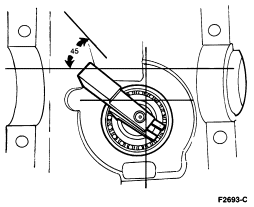
  1. The gauge block should then be rotated several half turns to ensure rollers are properly seated in bearing cups. Rotational torque on the gauge assembly should be 2.2 Nm (20 lb-in) with new bearings. Final position should be approximately 45 degrees across gauge tube to ensure that gauge block is in line with gauge tube high point. This area should be utilized for pinion shim selection. Selection of pinion shim with gauge block not lined up with tube high point will cause improper shim selection and may result in axle noise.

    NOTE: Shims must be flat. Do not use dirty, bent, nicked or mutilated shims as a gauge.

  1. Use pinion shims as the gauge for shim selection. This will minimize errors in attempting to stack feeler gauge stock together or simple addition errors in calculating correct shim thickness.

    NOTE: A tooth pattern check with the marking compound and road testing is not required when Pinion Depth Gauge T79P-4020-A or equivalent is used.

  1. It is important to feel a slight drag on the shim for correct selection. Do not attempt to force the shim between the gauge block and the gauge tube. This will minimize selection of a shim thicker than required which results in a deep tooth contact in final assembly of integral axles.