Section 03-04A: Fuel Charging and Controls—2.3L
1993 Mustang Workshop Manual
REMOVAL AND INSTALLATION

Fuel Charging Assembly

Tools Required:

NOTE: If subassemblies are to be serviced and/or removed, with the fuel charging assembly mounted on the engine, the following steps must be taken:

  1. Open hood and install protective covers.
  1. Ensure ignition switch is in OFF position.
  1. Drain coolant from radiator.
  1. Disconnect negative battery lead and secure it out of the way.
  1. Remove fuel cap to relieve fuel tank pressure.

    NOTE: Not all assemblies may be serviceable while on the engine. In some cases, removal of fuel charging assembly may facilitate service of various subassemblies. To remove entire fuel charging assembly, the following procedure should be performed.

  1. Release pressure from fuel system at fuel pressure relief valve using MFI Pressure Gauge T80L-9974-B. The fuel pressure relief valve is located on the fuel injection supply manifold assembly in the upper RH corner of the engine compartment. To gain access to the fuel pressure relief valve, the valve cap must first be removed.
 

Removal

  1. Disconnect electrical connectors at:
    1. Throttle Position (TP) 9B989 Sensor
    1. Idle Air Control (IAC) Valve
    1. Injector Wiring Harness at main engine harness and at water temperature indicator sensor
    1. Air Intake Temperature (IAT) 12A697 Sensor
    1. Engine Coolant Temperature (ECT) 12A648 Sensor
    1. Ignition Control Module (ICM) 12A279
  1. Disconnect vacuum lines at:
    1. Upper intake manifold vacuum tree. Labeling the hose locations with tape is recommended to aid reinstallation.
    1. EGR valve
    1. Fuel pressure regulator
    1. Canister purge line
  1. Remove throttle linkage shield, and disconnect throttle linkage and cruise control. Unbolt accelerator cable from bracket and position cable out of way.
  1. Disconnect air intake hose and crankcase vent hose.
  1. Disconnect positive crankcase ventilation (PCV) system by disconnecting hose from fitting on underside of upper intake manifold.
  1. Loosen hose clamp on water bypass line at lower intake manifold, and disconnect hose.
  1. Disconnect EGR tube 9D477 from EGR valve by removing flange nut.
  1. Remove five upper intake manifold retaining bolts.
  1. Remove upper intake manifold and air throttle body assembly.
  1. Remove engine oil dipstick bracket retaining bolt.
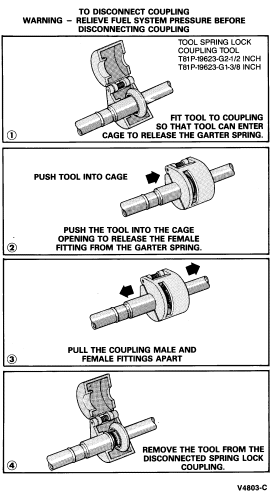
  1. Remove spring lock coupling retainer clips from fuel inlet and return fittings.
  1. Disconnect the push connect fitting at the fuel supply manifold and fuel return lines.


  1. Disconnect the electrical connectors from all four fuel injectors and move harness aside.
  1. Remove two fuel supply manifold retaining bolts. Carefully remove fuel supply manifold and injectors.

    NOTE: Injectors can be removed from the fuel supply manifold at this time by exerting a slight twisting/pulling motion.

  1. Remove four bottom retaining bolts from lower manifold.

    NOTE: The front two bolts also secure an engine lift bracket. Remove lower intake manifold assembly.

  1. Remove four upper retaining bolts from lower manifold.
 

Installation

  1. Clean and inspect the mounting faces of the fuel charging manifold assembly and the cylinder head. Both surfaces must be clean and flat.
  1. Clean and oil manifold bolt threads.
  1. Install a new gasket.
  1. Position the lower manifold assembly to head and install engine lift bracket. Install four upper manifold retaining bolts finger-tight.
  1. Install four remaining manifold bolts. Tighten all bolts to 20-30 Nm (15-22 lb-ft) following the tightening sequence.

    NOTE: Refer to Fuel Injector Installation as outlined in this Section.

  1. Install the fuel supply manifold and injectors with two retaining bolts. Tighten bolts to 20-30 Nm (15-22 lb-ft).
  1. Connect four electrical connectors to injectors.
  1. Ensure that gasket surfaces of upper and lower intake manifolds are clean.
  1. Place a new service gasket on the lower intake manifold assembly. Place the upper intake manifold in position.

    NOTE: The three bolts with stud head go in hole positions 2, 3 and 4.

  1. Install five retaining bolts and tighten in sequence to 20-30 Nm (15-22 lb-ft).
  1. Install engine oil dipstick and retaining bolt.
  1. Connect fuel supply and return lines to fuel supply manifold.
  1. Reinstall spring lock coupling retaining clips on fuel outlet and return fittings.
  1. Connect EGR tube to the EGR valve. Tighten to 25-35 Nm (18-25 lb-ft).
  1. Connect the water bypass line. Tighten clamp to 1.4-2.2 Nm (12-20 lb-in).
  1. Connect the PCV system hose to the fitting on the underside of the upper intake manifold.
  1. Connect upper intake manifold vacuum connections at:
    1. Upper intake manifold vacuum tree
    1. EGR valve
    1. Fuel pressure regulator
    1. Canister purge line
  1. Hold accelerator cable bracket in position on upper manifold and install retaining bolt. Tighten bolt to 13.5-20.5 Nm (10-15 lb-ft).
  1. Install accelerator cable to bracket.
  1. Connect accelerator cable and cruise control. Install throttle linkage shield.
  1. Connect electrical connectors to:
    1. Throttle position sensor
    1. Injector wiring harness
    1. Injector wiring harness at water temperature indicator sensor
    1. Intake air temperature (IAT) sensor
    1. Engine coolant temperature sensor
    1. Ignition control module (ICM)
    1. Idle air control (IAC) valve
  1. Connect air intake hose and crankcase vent hose.
  1. Connect negative battery cable.
  1. Install engine coolant. Refer to Group 03.
  1. Replace fuel pressure relief cap, then build up fuel pressure as follows: without starting the engine, turn key back and forth at least six times from ON to OFF position, leaving key ON for 5 seconds each time. Then, check for fuel leaks.
  1. Use data link connector (DLC) to check proper EEC-IV system functioning.
  1. Start engine and allow to run at idle until engine temperature stabilizes. Check for cooling system leaks.
  1. Verify correct engine idle.
  1. Remove protective covers and close hood.