Section 03-01B: Engine, 5.0L HO and 5.0L Cobra
1993 Mustang Workshop Manual
IN VEHICLE SERVICE

Pistons and Connecting Rods

Tools Required:


Removal

  1. Drain the cooling system and the crankcase. Remove the intake manifold, cylinder heads, oil pan and oil pump, following the procedures in this section.
  1. Remove any ridges and/or deposits from the upper end of the cylinder bores as follows.

     CAUTION: Never cut into the ring travel area more than 0.8mm (1/32 inch) when removing ridges.

  1. Turn the crankshaft until the piston to be removed is at the bottom of its travel and place a cloth on the piston head to collect the cuttings. Remove any ridge and/or deposits from the upper end of the cylinder bores. Remove the cylinder ridge with Rotunda Cylinder Ridge Reamer 014-00292 or equivalent.
  1. Ensure all connecting rod caps are marked so that they can be installed in their original positions.
  1. Turn the crankshaft until the connecting rod being removed is down.
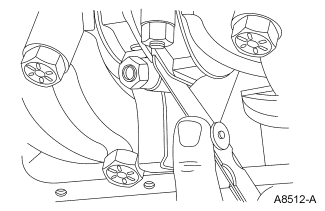
  1. Remove the connecting rod nuts and cap.

     CAUTION: Avoid damage to the crankshaft journal or the cylinder wall when removing the piston and rod.

  1. Push the connecting rod and piston assembly out the top of the cylinder with the handle end of a hammer.
  1. Remove the bearing inserts from the connecting rod and cap.
  1. Install the cap on the connecting rod from which it was removed.
 

Installation

 
  1. If new piston rings are to be installed, and no visible cross-hatch marks remain on the cylinder wall, remove the cylinder wall glaze using a spring-type tool. Follow the instructions of the tool manufacturer. After honing, clean the cylinder walls with a detergent and water solution.
  1. Oil the piston rings, pistons and cylinder walls with clean engine oil XO-10W30-QSP (ESE-M2C153-E) or equivalent. Be sure to install the pistons in the same cylinders from which they were removed or to which they were fitted. The connecting rod and bearing caps are numbered from 1 to 4 in the right bank and from 5 to 8 in the left bank, beginning at the front of the engine. The numbers on the connecting rod and bearing cap must be on the same side when installed in the cylinder bore. If a connecting rod is ever transposed from one block or cylinder to another, new bearings should be fitted and the connecting rod should be numbered to correspond with the new cylinder number.
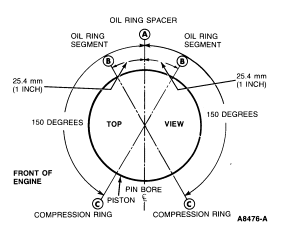
  1. Ensure the ring gaps are properly spaced around the circumference of the piston.


     CAUTION: Install the piston with the indentation notch in the piston head toward the front of the engine.
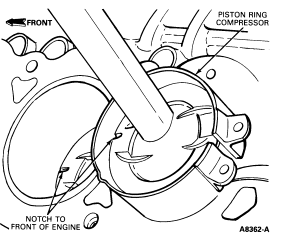
  1. Install Rotunda Piston Ring Compressor 014-00290 or equivalent on the piston and push the piston in with a hammer handle until it is slightly below the top of the cylinder. Be sure to guide the connecting rods to avoid damaging the crankshaft journals.


  1. Check the clearance of each bearing following the procedure in Section 03-00.
  1. After the bearings have been fitted, apply a light coat of engine oil XO-10W30-QSP (ESE-M2C153-E) or equivalent to the journals and bearings.
  1. Turn the crankshaft throw to the bottom of its stroke. Push the piston all the way down until the connecting rod bearing seats on the crankshaft journal.
  1. Install the connecting rod cap. Tighten the nuts to 26-32 Nm (19-24 lb-ft).
  1. After the piston and connecting rod assemblies have been installed, check the side clearance between the connecting rods on each crankshaft journal.


  1. Disassemble, clean, and assemble the oil pump. Clean the oil pump inlet tube screen and the oil pan and block gasket surfaces.
  1. Prime the oil pump by filling either the inlet port or outlet port with engine oil XO-10W30-QSP (ESE-M2C153-E) or equivalent and rotating the pump shaft to distribute the oil within the housing. Install the oil pump, the intermediate shaft and the oil pan.
  1. Install the cylinder heads.
  1. Install the intake manifold.
  1. Fill and bleed the cooling system. Refer to Section 03-03. Fill the crankcase with the proper grade and quantity of engine oil.
  1. Install the air inlet tube and crankcase vent hose.
  1. Start the engine and check and adjust the ignition timing.
  1. Operate the engine at fast idle and check for oil and coolant leaks.