 CAUTION: Do not crank the engine, it could destroy the shunt. Also do not use
the shunt to measure starting currents.
CAUTION: Do not crank the engine, it could destroy the shunt. Also do not use
the shunt to measure starting currents.
Section 14-01: Battery | 1993 Mustang Workshop Manual |
With Clamp-On DC Ammeter
Test Procedure
NOTE: Do not start vehicle with clip on cable.
Test Conclusion
The current reading (current drain) should be less than 0.05 amp. If it exceeds 0.05 it indicates a constant current drain which could cause a discharged battery. Possible sources of current drain are vehicle lamps (underhood, glove compartment, luggage compartment, etc.) that do not shut off properly.
If the drain is not caused by a vehicle lamp, remove fuses from the fuse panel, one at a time, until the cause of the drain is located. If drain is still undetermined, remove fusible links one at a time at the power distribution box to find the problem circuit.
With Voltmeter
This test requires a digital volt-ohmmeter with an appropriate low voltage scale such as Rotunda Digital Volt-Ohmmeter 007-00001 or equivalent. The meter must read within 0.01 millivolt. Also required is a shunt assembly similar to that shown in the illustration.
Test Procedure
NOTE: When the battery is disconnected and reconnected, some abnormal drive symptoms may occur while the powertrain control module (PCM) relearns its adaptive strategy. The vehicle may need to be driven 10 miles or more to relearn the strategy.
CAUTION: Do not crank the engine, it could destroy the shunt. Also do not use
the shunt to measure starting currents.
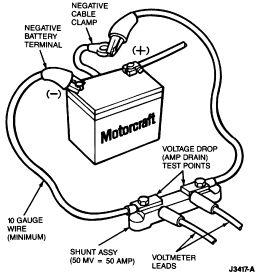
Test Conclusion
The current reading (current drain) should be less than 0.05 amp. If the reading is between 0.2 and 0.9 a possible drain may be a vehicle lamp (glove compartment, underhood, luggage compartment, etc.) that does not turn off. If the problem is not a lamp, remove the fuses from the fuse panel one at a time until the cause of the drain is located. If drain is still undetermined, remove fuses one at a time at the power distribution box to find the problem circuit.
To Test Vehicles with Major Key-Off Loads such as Air Suspension or Load Leveling
Vehicles equipped with these features will have temporary current drains that may last up to 70 minutes after ignition is switched OFF. These drains can range from 0.1 to 20 amps if the compressor is cycling. This action can often mask a problem and must be considered when evaluating test results. To test for this kind of drain proceed as follows.
Test Conclusion
The current reading (current drain) should be less than 0.05 amp. If it is higher, disconnect fuses and fusible links as in the previous test to locate the problem circuit.
If the drain is less than 0.05 amps, reconnect the major key-off load circuits, turn ignition to RUN and then OFF, and wait 70 minutes to make sure they shut off properly. If current drain is still greater than 0.05 amps after 70 minutes, disconnect each of the components one at a time until the cause of the current drain is located.
To Check for Electronic Drains Which Shut Off When the Battery Cable is Disconnected
Test Conclusion
The current reading (current drain) should be less than 0.05 amp. If it exceeds 0.05 after a few minutes, and if this drain did not show in previous tests, the drain is most likely caused by a malfunctioning electronic component. As in previous tests, remove fuses in power distribution box one at a time to locate the problem circuit.