Section 11-00: Steering System—Service | 1993 Mustang Workshop Manual |
Before performing the pump flow and pressure test, complete the following checks for conditions which could cause loss of power assist. Take corrective action if necessary.
If the above items are correct, or have been corrected, and the loss of assist still exists, test the power steering pump flow and pressure to determine whether the trouble is in the pump, power steering gear or hoses.
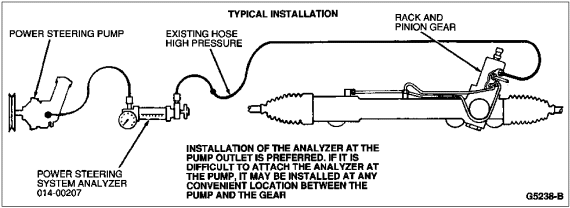
Test Equipment
The test procedure used in conjunction with the Rotunda Power Steering System Analyzer or equivalent provides a method for checking the complete power steering system. The analyzer can be used on integral or non-integral power steering systems to determine the cause of hard steering and/or lack of assist concerns.
The analyzer provides readouts for the following:
The interpretation of the above readouts will determine which of the following conditions or components are the cause of the concern.
Test Procedure
If flow drops to a level lower than the value in the chart, disassemble the pump and replace the cam pack. If the pressure plates are cracked or worn, replace them. Continue with diagnosis.
Check the chart for the pressure specification listed for the applicable vehicle and engine. If the pressure recorded is lower than the minimum specification listed, replace the flow control valve in the pump.
If the pressure recorded is above the maximum specification listed, the flow control valve in the pump should be removed and cleaned or replaced.
If flow exceeds the maximum free flow specified in chart, the flow control valve in the pump should be removed and cleaned or replaced.
Pressure developed at both stops should be nearly the same as maximum pump output pressure.
At the same time, flow should drop below 1.9L (0.5 gallon/min). If the pressure does not reach maximum output or flow does not drop below 1.9L (0.5 gallon/min), excessive internal leakage is occurring. Remove and disassemble steering gear. Replace damaged or broken parts. Pay particular attention to the rack piston and valve seals for damage.
NOTE: If condition still exists, check ball joints, linkage, etc. Refer to Diagnosis.
Remove, disassemble, and clean the rotary valve. If the system is severely contaminated, the gear hoses, control valve, and pump must be completely disassembled and cleaned before reassembly.
| Engine/Model | 2.3L | 5.0L Manual/Auto |
|---|---|---|
| Minimum Flow*
Liters/Min. |
4.9 | 5.1 |
| Minimum Flow*
Gal./Min. |
2.2 | 2.2 |
| Minimum Relief Pressure
kPa |
6550 | 7240 |
| Minimum Relief Pressure
psi |
950 | 1050 |
| Maximum Relief Pressure
kPa |
7790 | 8480 |
| Maximum Relief Pressure
psi |
1130 | 1230 |
| Pump Model | HBC-KA | HBC-KC |
| Maximum Free Flow @1500 RPM
Liters/Min. |
9.8 | 9.8 |
| Maximum Free Flow @1500 RPM
Gal./Min. |
2.6 | 2.6 |
*IMPORTANT: Flow depends on pump model, engine rpm, and pulley drive ratio. Engine idle rpm must be set to specification when checking pump minimum flow capacity.