Section 08-00: Clutch System—Service | 1993 Mustang Workshop Manual |
CLEANING AND INSPECTION
Flywheel Housing Alignment
Inspection and/or alignment of the flywheel housing is indicated when the
following symptoms exist: transmission gear wear, transmission jumping out of
gear, driveline vibration, clutch pedal vibration or scrubby pedal feel, pilot
bearing noise, release bearing noise, or excessive clutch spin time. Common
complaint areas should always be checked and corrected prior to checking
alignment to ensure that the basic system is in proper working order.
Inspection and Alignment Procedure
Lift the clutch pedal to its uppermost position to disengage the pawl and
quadrant. Hold in this position and with a rubber band or tape, disengage cable
ball from release lever.
- On vehicles equipped with 2.3L, OHC or 5.0L engines with five-speed
transmission, remove the transmission and remove the flywheel housing from rear
face of engine. Refer to Section 07-03.
- Inspect, clean and/or remove all nicks, burrs, paint and other foreign
material from the following:
- Front and rear face of flywheel housing.
- Flywheel housing bore surface.
- Rear face of engine block.
- Rear engine plate.
- Flywheel and engine block dowels. (Missing or damaged dowels must be
replaced). Refer to Removal and Installation.
- Install the rear engine plate and flywheel housing, less the clutch release
lever and bearing to the engine, less the transmission.
- Install Clutch Alignment Tool D83P-6392-A, or equivalent with dial
indicator post attached through flywheel housing bore and onto the pressure
plate fingers. The oblong washer is to be forward of the pressure plate
fingers, while the round washer will remain on the rearward side with the tabs
contacting the fingers. Tighten the nut on the end of the post assembly until
the washers grip the pressure plate fingers tightly.
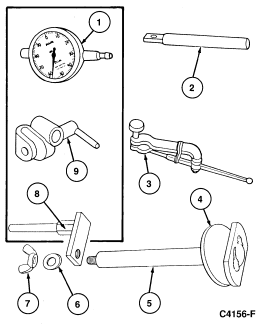
| Item |
Part Number |
Description |
|
1
|
TOOL-4201-C
|
Dial Indicator Assy
|
|
2
|
T75L-4201-B
|
Clutch Housing Alignment Adapter
|
|
3
|
T75L-4201-A
|
Clutch Housing Alignment Adapter
|
|
4
|
—
|
Clamp
|
|
5
|
D83P-6392-A
|
Clutch Alignment Tool
|
|
6
|
—
|
Washer
|
|
7
|
—
|
Attaching Nut
|
|
8
|
—
|
Base Post Part of TOOL-4201-C
|
|
9
|
—
|
Universal Clamp Part of TOOL-4201-C
|
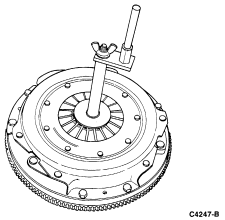
Up, down or side movement of the post assembly must not be
evident during the bore and runout test procedure. If any movement is detected,
loosen the nut and rotate the post assembly to gain better mounting location on
the pressure plate fingers. Otherwise, an erratic reading will result.
- To check face runout, install the dial indicator (part of Dial Indicator
with Bracketry TOOL-4201-C) on the base post using the universal clamp and
short extension bar, Clutch Housing Alignment Adapter T75L-4201-B provided with
the alignment kit. Position the dial indicator so that the indicator button
contacts a circumference just outside the transmission pilot hole. Tighten the
universal clamp securely.
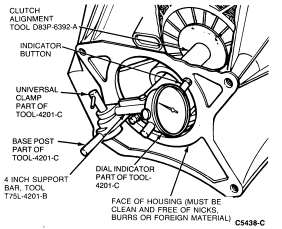
- Push the crankshaft rearward to remove any end play. Zero the dial
indicator.
- Holding the crankshaft in the rearward position, rotate the crankshaft
through one complete revolution by using a wrench on the crankshaft pulley
attaching nut. The dial indicator should return to zero after one revolution
unless end play or a loose alignment post has affected the reading.
- During Step 7, record the greatest variation between indicator readings for
one revolution. A small mirror will be necessary during this procedure to read
the indicator through its complete rotation. Repeat procedure to verify reading.
NOTE: The rubber band should be installed just snug enough to provide a light
pressure of the lever tip on the bore of the housing. If rubber band is too
tight, it may bind the dial indicator or distort reading.
- After completion of the face runout check, install the dial indicator lever
attachment to the dial indicator and position the assembly to check bore
runout. The rubber band shown attached to the lever must be installed as
indicated, prior to installation of the lever, to preload the dial indicator
for bore readings.
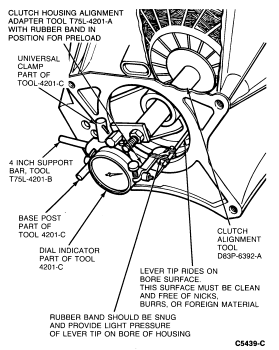
- Zero the dial indicator. Rotate the crankshaft through one revolution as in
Step 7. Record the greatest variation between the indicator readings for the
complete crankshaft revolution. Repeat procedure to verify reading.
- If the maximum variation measurements obtained in Steps 8 and 10 show that
face runout exceeds 0.254mm (0.010 inch) Total Indicator Runout (T.I.R.) and/or
the bore runout exceeds 0.381mm (0.015 inch) T.I.R., replace the flywheel
housing.
Before assembly of the transmission to the flywheel housing, the front
mounting face of the transmission should be inspected and cleaned. Any nicks,
burrs, paint or foreign material must be removed to ensure alignment between
these components. If dowels on the flywheel or rear face of the engine are
missing or damaged, refer to Dowel Removal and Installation.