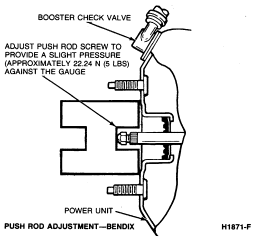
CAUTION: Do not adjust too long or brake drag could result.
Section 06-07: Brake System, Power | 1993 Mustang Workshop Manual |
Some vacuum boosters have an adjustable push rod (output rod) which is used to compensate for dimensional variations in an assembled booster. The push rod length is adjusted after each booster power unit has been assembled in production. A properly adjusted push rod that remains assembled to the booster with which it was matched in production should never require a service adjustment.
A booster that is suspected of having an improper push rod length will indicate either of the following:
NOTE: A locally made push rod gauge of the following dimensions must be used.
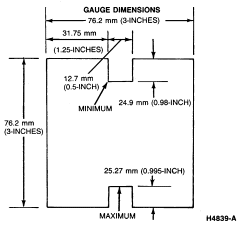
If necessary, a booster push rod length can be verified with a push rod gauge by using the following procedure:
CAUTION: Do not adjust too long or brake drag could result.