Section 06-02: Brakes, Rear Drum | 1993 Mustang Workshop Manual |
ADJUSTMENTS
Brake Shoes
Tools Required:
- Brake Adjustment Gauge D81L-1103-A
After any brake service work, obtain a firm brake pedal before
moving the vehicle. Adjusted brakes must not drag; wheels must turn
freely.
The hydraulic drum brakes are self-adjusting and require a manual
adjustment only after the brake shoes have been relined, replaced, or when the
length of the adjusting screw has been changed while performing some other
service operation. The manual adjustment is performed with the drums removed,
using the tool and the procedure detailed below.
When adjusting the rear brake shoes, check the parking brake cables for
proper adjustment. Ensure that the parking brake link operates freely with the
shoes centered on the backing plate.
Ensure that the upper ends of the brake shoes are seated on the
anchor pin. The parking brake link should have 0.127-0.64mm (0.005-0.025 inch)
end play after overcoming the load of the parking brake link anti-rattle
spring.
To adjust the brake shoes:
- Apply a small quantity of Disc Brake Caliper Slide Grease D7AZ-19590-A
(ESA-M1C172-A) or equivalent to the points where the shoes contact the backing
plate, being careful not to get the lubricant on the linings.
- Determine inside diameter of the drum braking surface, using Brake
Adjustment Gauge D81L-1103-A or equivalent.
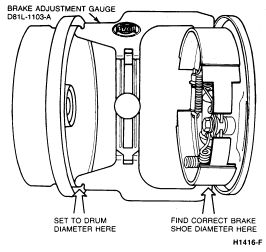
- Adjust the brake shoe diameter to fit the gauge. Hold the automatic
adjusting lever out of engagement while rotating the adjusting screw to prevent
burring the screw slots. Ensure the adjusting screw rotates freely. If
necessary, lubricate the screw threads with a thin, uniform coating of Premium
Long-Life Grease XG-1-C (ESA-M1C75-B) or equivalent.
- Rotate Brake Adjustment Gauge D81L-1103-A or equivalent around the brake
shoes to be sure of the setting.
- Install the drums. Install the drum retaining nuts and tighten securely.
- Install the wheels on the drums, and install the nuts.
- Complete the adjustment by applying the brakes several times with a minimum
of 111 N (25 lb) pressure while backing the vehicle. After each stop, the
vehicle must be moved forward.
- After the brake shoes have been properly adjusted, check the operation of
the brakes by making several stops from varying forward speeds.