Section 05-00: Axle and Driveshaft—Service | 1993 Mustang Workshop Manual |
Most rear axle leakage conditions can be corrected without a teardown. However, it is important to clean up the leaking area enough to identify the exact source.
A plugged or seized jiggle cap vent will cause excessive seal lip wear due to internal pressure buildup. When a leak occurs, check cap by pressing down on it with index finger. If the cap moves up and down freely, it is working properly. If it does not move freely, it must be replaced.
Check axle lubricant level. Adjust as required to 6-14mm (1/4 inch) below bottom of fill plug hole.
Drive Pinion Seal
When the drive pinion seal leaks, it is usually because it was not installed carefully or properly, or because of poor quality on the seal journal surface.
Any damage to the seal bore (dings, dents, gouges, etc.) will distort the seal casing and allow leakage past the outer edge of the seal.
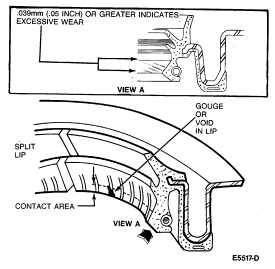
The seal lip can be torn, cut or gouged if it is not assembled carefully. The spring that holds the seal lip against the circular companion flange may be knocked out and allow leakage past the lip.
The rubber lips can occasionally become hard (like plastic) accompanied by cracks at the oil lip contact point. The contact point on the circular companion flange is usually black, indicating excessive heat. Marks, nicks, gouges or rough surface texture on the seal journal of the circular companion flange will also cause leaks. Excessive seal lip wear will be noted. The circular companion flange should be replaced if any of these conditions exist.
Metal chips or sand, trapped at the sealing lip also may cause oil leaks. This can cause a wear groove on the circular companion flange and heavy seal lip wear.
If the axle vent is plugged with dirt and debris, the axle will be
pressurized and may result in excessive seal wear and seal leakage.
Pinion Nut
On some high mileage units, there have been instances of oil leaking past the threads of the pinion nut. The condition can be corrected by removing the nut and applying Pipe Sealant With Teflon® D8AZ-19554-A (ESG-M4G194-A and ESR-M18P7-A) or equivalent on the threads and nut face.
NOTE: Be sure to follow the correct procedure for setting the bearing preload when the nut is installed.
Axle Shaft Seals
Axle shaft seals are susceptible to the same kinds of damage as pinion
seals if improperly installed. The seal bore must be clean and the lip handled
carefully to avoid cutting or tearing it. Axle shaft journal surface must be
free of nicks, gouges and rough surface texture. 
Casting Porosity (Holes in Casting)
Occasionally, there will be a differential carrier leaking through small pockets in the metal. These pockets (casting leakage) are caused by gas bubbles in the casting process and are known technically as a porous condition or porosity.
Because there is always the danger of changing the axle's sound characteristics if torn down to replace the carrier, service is preferable. There are two recommended types of service.
Weld Leaks
Most minor weld leaks can be corrected with epoxy sealer Metallic Plastic
C7AZ-19554-A or equivalent. This includes the "puddle" or fill welds that join
the axle shaft tube to the carrier housing on integral axles. They sometimes
leak and can be sealed easily. Remember, if a weld is broken, the housing must
be replaced. The alignment is too critical for field service. 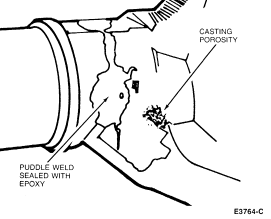
Axle Vent
There have been some occurrences of lubricant leaking through the axle vent. This may be caused by a clogged or sticking axle vent cap. If this is the case, the vent assembly should be replaced, using Stud and Bearing Mount E0AZ-19554-BA (WSK-M2G349-A1) or equivalent, on threads to ensure retention.