Section 04-04: Wheels and Tires | 1993 Mustang Workshop Manual |
ADJUSTMENTS
Tire and Wheel Balance
There are two types of wheel and tire balance: static and dynamic.
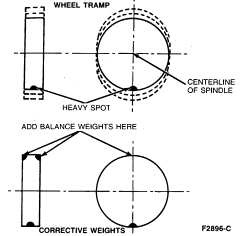
A Static balance is the equal distribution of
weight around the wheel. Wheels that are statically unbalanced cause a bouncing
action called wheel tramp. This condition will eventually cause uneven tire
wear.
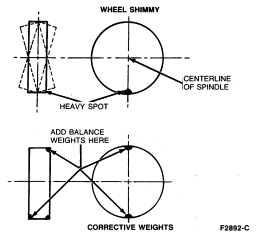
A Dynamic balance is the equal distribution of
weight on each side of the centerline, so that when the tire spins there is no
tendency for the assembly to move from side-to-side. Wheels that are
dynamically unbalanced may cause wheel shimmy.
Deposits of mud, etc. must be cleaned from the inside of the rim. Stones
should be removed from the tread in order to avoid operator injury during spin
balancing and to obtain a good balance. The tire should be inspected for any
damage, then balanced according to the equipment manufacturer's explicit
instructions.
Off-Vehicle Balancing
Tools Required:
- Rotunda Wheel Adapter Set 078-00055 or Accessory Kit 006-01640
- Rotunda Off-Vehicle Wheel Balancer 078-00153 or 006-01699
When balancing wheels off the vehicle, use a balancer that pilots the
wheel by its center hole. If the wheel tramp and vehicle vibration is not
corrected by the off-vehicle balance, an on-vehicle balance may be needed.
When performing an off-vehicle wheel balance on vehicles equipped with
aluminum wire spoke wheels, use one of the following electronic balancers to
provide the proper wheel balance:
- Rotunda Off-Vehicle Wheel Balancer 078-00153 or equivalent with Rotunda
Wheel Adapter Set 078-00055 or equivalent.
- Rotunda Off-Vehicle Wheel Balancer 006-01699 or equivalent with Accessory
Kit 006-01640 or equivalent.
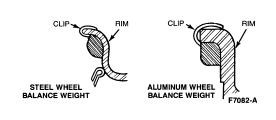
Aluminum wheels have thicker rim flanges and require specially designed
balance weights. Wheel weights for aluminum wheels are coated to prevent
corrosion and should be installed with a plastic mallet.
- Loosen wheel lug nuts of wheel(s) to be balanced. Raise up front or rear of
vehicle, as required. Refer to Section 00-02.
- Remove wheel to be balanced. Remove center cap and mount wheel to balance
machine. Lock hub adapter into spindle.
- The balance equipment should have been calibrated by factory approved
technicians within the last 90 days.
- The equipment mounting surfaces, cones, cone springs, wing nuts, and
mounting cups must be clean and without damage.
- All tire labels, stones, dirt, and any other foreign material must be
removed from the tire/wheel assembly. Particular attention should be paid to
ensuring that the wheel mounting face and pilot hole are clean and free from
foreign material.
- The tire/wheel assembly must be mounted on the machine using a back mounted
cone. Front coning of the assembly is not permitted.
- The machine should be operated in the DYNAMIC mode only.
- The factory balance weights should not be removed
from the wheel before checking the balance status.
- Spin the tire/wheel assembly on the machine in accordance with the balance
equipment manufacturer's instruction.
- Any tire/wheel assembly that shows a machine reading of 0.50 ounces or less
in the DYNAMIC mode cannot be considered outside of factory specifications when
checked on field accurate balance equipment.
- If DYNAMIC correction is required, divide the amount of weight to be added
to the wheel equally as possible between the inner and outer flange. Never add
more than 85g (3 oz) to either rim flange. Always recheck balance after weight
is added.
NOTE: Tire and wheel rebalancing should not be required when rotating tires.
- Remove the tire and wheel assembly from the machine and mount onto the
vehicle.
- Lower the vehicle to the ground. Tighten the wheel lug nuts to 115-142 Nm
(85-105 lb-ft).