Section 04-01: Suspension and Wheel Ends, Front | 1993 Mustang Workshop Manual |
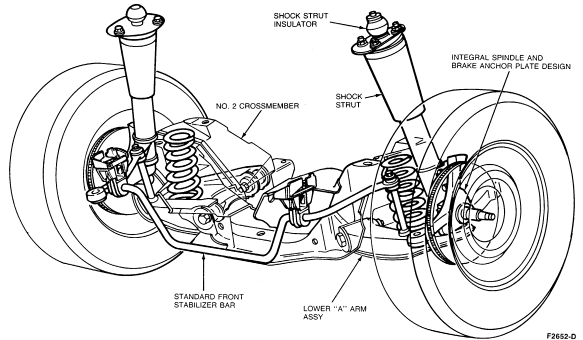
This front suspension is a modified MacPherson strut design. The design
uses shock struts with coil springs mounted between the lower arm and a spring
pocket in the No. 2 crossmember. The shock struts are non-serviceable and they
must be replaced as a unit. The ball joints and lower suspension arm bushings
are not separately serviced and must be replaced as an assembly.
The function of the shock strut in the MacPherson suspension system is to guide, dampen and limit vehicle wheel motion. Acting as a structural member of the suspension system, the shock strut dampens the up and down loads that are placed on a vehicle body when adverse road conditions are met.
In addition to allowing for the wheels up and down movement, the shock strut is part of the axis that is needed for wheel turning. The spindle attachment bracket and outer can assembly is allowed to rotate relative to the shock strut's piston rod. The rotating movement of the shock strut must be free from binding, sticking and friction conditions to ease the vehicle's steering effort. To reduce friction, a garter spring seal surrounding the piston rod shaft and a low-friction bearing surface between the strut's piston and pressure tube has been provided.
Since the shock strut carries a side load at all times on a vehicle, its dampening forces are much higher while on a vehicle than compared to the dampening forces when the strut is out of the vehicle. Side loading increases dampening resistance of a shock strut by providing higher friction internally, and, for this reason, shock struts are designed with low dampening forces while standing in the free state (not on the vehicle).
When a gas-pressurized shock strut is held in a vertical position, it is normal for it to be fully extended.
Due to the preload, it will take up to 222 N (50 lbs) to push the strut
rod down into the cylinder tube (outer can). This is normal and
does not indicate a binding condition.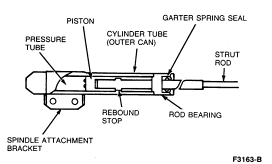
Strut Replacement
The following definitions will indicate when a strut should or should not be replaced because of oil weepage or leakage:
Weepage is a condition in which a thin film of oil may be deposited on the strut outer tube (body), and is normally noticed due to the collection of dust in this area. This condition is normal during the strut seal break-in period of 4827-8045 km (3000-5000 miles) and may or may not occur in some struts. Although the film of oil may be noticed on most of the strut body, the amount of weeped oil required to cause this film is less than one percent of the total strut oil and, therefore, does not affect the performance of the strut. Normally, weepage stops after the initial dampening (wetting) of the strut body and seal break-in period. No sign of new oil is visible.
Leakage is a condition in which the entire strut body is covered with oil that has dripped down onto the lower control arm or onto the pavement during overnight parking. In this case, the strut always shows a wet surface and does not dry as in weepage.
A strut should only be replaced if it shows signs of leakage as described, but not if it falls under the description of weepage.
NOTE: If a shock strut needs replacement, it is not necessary to replace both RH and LH struts. Only the strut in question should be replaced.
If the piston rod does not extend on a strut when removed from the vehicle, the strut should be replaced.