Section 04-00: Suspension—Service
1993 Mustang Workshop Manual
ADJUSTMENTS

Driveshaft—Pinion Angle Checking Procedure


Double Upper Arms

Tools required:

A load must be applied to attain a curb height as shown on the pinion angle chart. This height is measured from the top of the axle housing tube to the jounce bumper bracket on the bottom of the side rail.

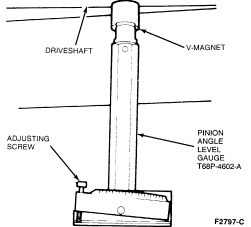
  1. Position the V-magnet part of Pinion Angle Level Gauge T68P-4602-A, on the driveshaft away from welds and balance weights.
  1. From LH side of the vehicle, position Pinion Angle Level Gauge T68P-4602-A on the V-magnet with the adjusting screw to the left. Adjust the dial on the tool until the LH edge of the bubble is exactly on the zero line.


    NOTE: The snap ring must be removed and installed after the reading is completed.
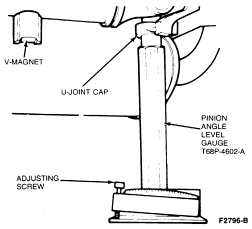
  1. Position the magnetized tool on the bearing cap with the tool in the same relative position as it was on the V-magnet.
  1. Read the position of the bubble's LH edge on the scale to determine the driveshaft pinion angle. Compare with the pinion angle specification.


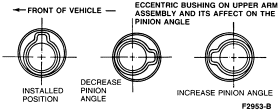
    If the pinion angle is not within specification, install service upper control arms (may not be available for all vehicles, check with your dealer) equipped with cams. Adjust pinion angle as follows:

  1. Remove the upper arms as outlined.

    NOTE: If the cam (located in the bushing inner sleeve) appears to be rusty, tap the cam with a drift to remove the rust, so the cam will rotate.

  1. Using a wide and flat object like a large screwdriver, insert the tool in the slot in the eccentric inner sleeve. It is accessible through the hole from where the retaining bolt was removed.
  1. Rotate the cam inside the inner sleeve clockwise or counterclockwise to raise or lower the pinion nose angle to specification.
  1. After the adjustment is performed, install the upper arms as outlined.

    NOTE: LH and RH upper arms must have same setting.