Section 03-03: Engine Cooling | 1993 Mustang Workshop Manual |
CLEANING AND INSPECTION
Coolant Replacement
- Bring engine to normal operating temperature and turn engine off. With
cooling system under pressure, inspect cooling system hoses and clamped hose
connections for leaks, excessive deterioration, or contact wear. Inspect
radiator installation retention. Note any discrepancies, and proceed.
- Drain coolant as follows:
 WARNING: NEVER REMOVE RADIATOR OR COOLING SYSTEM CAP UNDER ANY CONDITIONS WHILE
ENGINE IS OPERATING. FAILURE TO FOLLOW THESE INSTRUCTIONS COULD RESULT IN
PERSONAL INJURY AND/OR DAMAGE TO THE COOLING SYSTEM OR ENGINE.
WARNING: NEVER REMOVE RADIATOR OR COOLING SYSTEM CAP UNDER ANY CONDITIONS WHILE
ENGINE IS OPERATING. FAILURE TO FOLLOW THESE INSTRUCTIONS COULD RESULT IN
PERSONAL INJURY AND/OR DAMAGE TO THE COOLING SYSTEM OR ENGINE.
WARNING: TO AVOID BURNS FROM SCALDING COOLANT OR STEAM, USE EXTREME CARE WHEN
REMOVING THE RADIATOR PRESSURE CAP.
- Switch the engine OFF and wait until cool. If radiator is still hot,
carefully wrap a thick cloth around the cap and rotate slowly to the first
stop. Step back until the pressure is released.
- Then press down on the cap and rotate until free. Remove the cap.
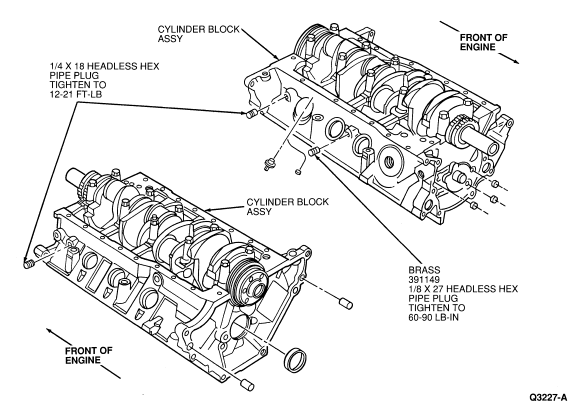
- Open radiator draincock and remove the cylinder block drain plug(s) to
drain the coolant system.
- Disconnect overflow hose from radiator filler neck connection. Remove
coolant recovery reservoir from fender apron and empty fluid. Flush reservoir
with clean water, drain and reinstall reservoir and strap (if so equipped) and
overflow hose and clamp to radiator filler neck.
- Correct/service/replace any components found to be malfunctioning in Step 1.
Cleaning
NOTE: Always remove the thermostat prior to pressure flushing. A pulsating or
reversed direction flow of flushing water will loosen sediment more quickly
than a steady flow in the normal direction of coolant flow. In severe cases
where cleaning solvents will not properly clean the cooling system for
efficient operation, it will be necessary to use the pressure flushing method.
Various types of flushing equipment are available.
To remove rust, sludge and other foreign material from the cooling
system, use an appropriate cooling system flush such as Premium Cooling System
Flush D6AZ-19A503-AA (ESE-M97B44-A and ESE-M97B43-A) or equivalent. Removal of
such material restores cooling efficiency and avoids overheating.
Coolant Refill
Tools Required:
- Rotunda Battery and Anti-Freeze Tester 021-00046
- Refill engine cooling system as follows:
- Close radiator draincock and install cylinder block drain plug(s).
- When refilling the cooling system, use equal parts of water and coolant as
follows:
Coolant Specification: Use only a permanent-type coolant such
as Premium Cooling System Fluid E2FZ-19549-AA (ESE-M97B44-A and ESE-M97B43-A)
or equivalent.
Freeze protection may also be checked by using either a
Rotunda Battery and Antifreeze Tester 021-00046 or equivalent, or a Hydrometer.
A 50/50 mix of coolant concentrate and water will provide approximately
-37°C (-35°F) protection, and provide the
necessary anti-corrosion protection.
On 2.3L only
- Disconnect heater hose at the connection on the thermostat housing.
- Fill radiator until coolant is visible at the connection in the thermostat
housing or the coolant level in the radiator reaches the radiator filler neck
seat.
- Install heater hose and install hose clamp.
Refill the radiator to approximately 0 to 5 cm (0 to 2 inches)
below the filler neck seat.
- Operate engine until thermostat opens and the radiator upper hose becomes
hot.
- Stop the engine and add coolant up to the filler neck seat.
- Install radiator pressure cap.
- Add a 50/50 mixture of coolant and water to the FULL HOT mark on the
coolant reservoir, to provide adequate cooling system fill. Install reservoir
cap, if so equipped.