Section 03-03: Engine Cooling
1993 Mustang Workshop Manual
REMOVAL AND INSTALLATION

Radiator

Tools Required:


Removal

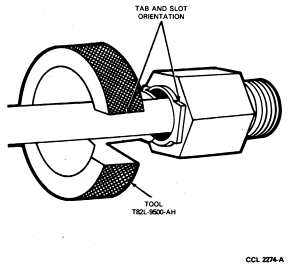
NOTE: Disconnect the automatic transmission fluid cooler inlet and outlet lines from the radiator using Disconnect Tool T82L-9500-AH or equivalent.

  1. Drain cooling system. Disconnect radiator upper and lower hoses and overflow hose from the radiator.
  1. If equipped with fan shroud, remove two upper shroud retaining bolts at radiator support. Lift fan shroud sufficiently to disengage lower retaining clips and lay shroud back over fan.

    Remove radiator upper support retaining bolts and remove support(s). Lift radiator from vehicle.


Installation

  1. If a new radiator is to be installed on vehicles equipped with automatic transmission, transfer the oil cooler line connectors to the new radiator, using Pipe Sealant with Teflon® D8AZ-19554-A (ESG-M4G194-A and ESR-M18P7-A) or equivalent oil resistant sealer.
  1. Position the radiator assembly into the vehicle. Install upper supports and secure with bolts.
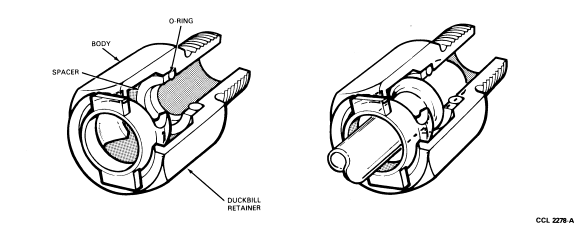
  1. On vehicles with automatic transmission, connect the oil cooler lines.
  1. On 5.0L, place fan shroud into clips on lower radiator support of radiator. Secure to upper support with two bolts. Position shroud to maintain a minimum of 9.7mm (0.38 inch) radial clearance to fan blade tips. On 2.3L, install fan assembly by attaching two lower legs to the lower radiator rail with two retaining bolts. Tighten bolts to 8-10.5 Nm (71-92 lb-in). Install upper legs with two retaining bolts. Tighten to 8-10.5 Nm (71-92 lb-in).
  1. Connect the radiator upper, lower and overflow hoses. Close the draincock. Position the hose clamps at least 50mm (2 inch) from each end of hose and slide hose on the connections.

     CAUTION: Ensure the clamps are beyond the bead and place in the center of the clamping surface of the connections. New hose clamps must be installed inside the hose alignment marks.

    Tighten clamp to 2.2-3.4 Nm (20-30 lb-in) (when using screw-type clamps).

  1. Fill the radiator with the recommended permanent antifreeze and water mixture.

     WARNING: TO AVOID THE POSSIBILITY OF PERSONAL INJURY OR DAMAGE TO THE VEHICLE, DO NOT OPERATE THE ENGINE WITH THE HOOD OPEN UNTIL THE FAN HAS BEEN FIRST EXAMINED FOR CRACKS AND SEPARATION.
  1. Operate the engine and check for leaks at the hose connections and the automatic transmission fluid cooler lines. Check the automatic transmission, radiator and coolant recovery reservoir fluid levels.