Section 03-00: Engine—Service | 1993 Mustang Workshop Manual |
Fitting Pistons
Tools Required:
Pistons are available for service in standard size and oversize shown in the Section 03-01A (2.3L) or Section 03-01B (5.0L) under Specifications.
The standard size pistons are color-coded red, blue or yellow on the dome.
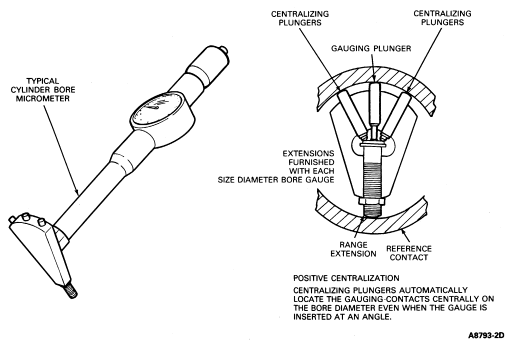
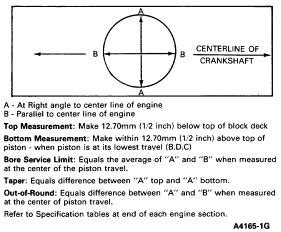
Measure the cylinder bore and select the piston to ensure the proper clearance. When the bore diameter is in the lower one-third of the specified range, a red piston should be used. When the bore diameter is in the middle one-third, a blue piston should be used. When the bore diameter is in the upper one-third, a yellow piston should be used.
NOTE: Cylinder bore must be clean and dry, and engine block must remain at room temperature (21°C/70°F) for eight hours before taking cylinder measurements.
Measure the piston diameter to ensure the specified clearance is obtained. It may be necessary periodically to use another piston (within the same grade size) that is either slightly larger or smaller to achieve the specified clearance.
If none can be fitted, refinish the cylinder to provide the proper clearance for the piston.
When a piston has been fitted, mark it for assembly in the cylinder to which it was fitted.
If the taper, out-of-round and piston-to-cylinder bore clearance
conditions of the cylinder bore are within specified limits, new piston rings
will give satisfactory service.
If new rings are to be installed in a used cylinder that has not been refinished, remove the cylinder wall glaze using only spring-loaded Engine Cylinder Hone Set T73L-6011-A, and only if there is no visible sign of cross-hatch markings on the cylinder walls. (Refer to Cylinder Block, Cylinder Walls, Refinishing.) Always clean the cylinder bore thoroughly with detergent and water solution.
NOTE: After any refinishing operation, allow cylinder bore to cool, and ensure piston and bore are clean and dry before piston fit is checked.
Measure the piston diameter to ensure the specified clearance is obtained. It may be necessary periodically to use another piston (within the same grade size) that is either slightly larger or smaller to achieve the specified clearance.
NOTE: On 2.3L engines, the pistons are measured at 14.58mm (0.58 inch) from the bottom of the piston skirt at 90 degrees to the piston axis.
Fitting Piston Rings
NOTE: Always use a piston ring expanding tool to install rings on a piston.
 CAUTION: Use care to avoid damage to ring or cylinder bore.
NOTE: If lower lands have high steps, piston should be replaced.
Cleaning
Tools Required:
CAUTION: Do not use a caustic cleaning solution or a wire brush to clean
pistons.
Remove deposits from the piston surfaces. Clean gum or varnish from the piston skirt, piston pins, and rings with solvent.
Clean the ring grooves with Piston Ring Groove Cleaner D81L-6002-D or
equivalent. Ensure oil ring slots (or holes) are clean. 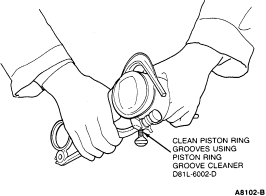
Inspection
Carefully inspect the pistons for fractures at the ring lands, skirts, oil ring slot corners, and pin bosses, and for scuffed, rough or scored skirts. If the lower inner portion of the ring grooves have a high step, replace the piston. The step will interfere with ring operation and cause excessive ring side clearance.
Spongy, eroded areas near the edge of the top of the piston are usually caused by detonation or pre-ignition. A shiny surface on the thrust surface of the piston, offset from the centerline between the piston pin holes, can be caused by a bent connecting rod. Replace pistons that show signs of excessive wear, wavy ring lands or fractures or damage from detonation or pre-ignition.
Check the piston-to-cylinder bore clearance by measuring the piston and bore diameters. Refer to Specifications in the appropriate engine section for the proper clearance. Refer to Cylinder Block Inspection for the bore measurements procedure. Measure the OD of the piston and check the ring side clearance following the procedure under Fitting Pistons, Pins and Rings.
Replace piston pins showing signs of fracture, etching, scoring or wear. Check the piston pin fit in the piston and rod.
Check the OD of the piston pin and the ID of the pin bore in the piston. Replace any piston pin or piston that is not within specifications. For Specifications, refer to Section 03-01A (2.3L) or Section 03-01B (5.0L).
CAUTION: Rings should not be transferred from one piston to another, regardless
of mileage.
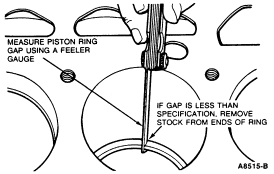
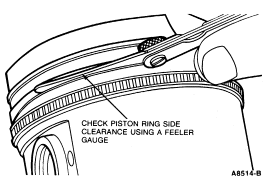
Replace all rings that are scored, broken, chipped or cracked. Check the end gap and side clearance.