Section 03-00: Engine—Service | 1993 Mustang Workshop Manual |
OVERHAUL
Core Plugs
Removal and Installation
Tools Required:
- Impact Slide Hammer T59L-100-B or T50T-100-A
To remove a large core plug, drill a 12.70mm (1/2 inch) hole in the
center of the plug and remove with an Impact Slide Hammer T59L-100-B or
T50T-100-A or pry it out with a large drift punch. On a small core plug, drill
a 6.35mm (1/4 inch) hole in the center of the plug and pry it out with a small
pin punch. Clean and inspect the plug bore.
Prior to installing a core plug, the plug bore should be inspected for
any damage that would interfere with the proper sealing of the plug. If the
bore is damaged, it will be necessary to true the surface by boring for the
next specified oversize plug.
Oversize (OS) plugs are identified by the "OS" stamped in the flat
located on the cup side of the plug.
Coat the plug and/or bore lightly with an oil-resistant (oil galley)
sealer such as Stud and Bearing Mount EOAZ-19554-BA (WSK-M2G349-A1) or
Threadlock 262 E2FZ-19554-B (WSK-M2G351-A6), or equivalent, and install it
following the procedure for cup-type or expansion-type below:
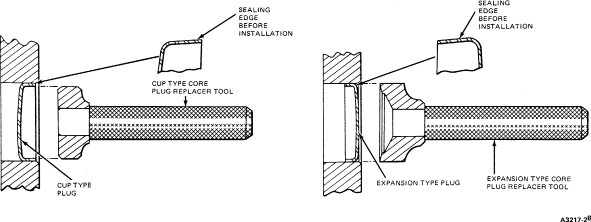
Cup-Type
Cup-type core plugs are installed with the flanged edge outward. The
maximum diameter of this plug is located at the outer edge of the flange. The
flange on cup-type plugs flare outward with the largest diameter of the outer
(sealing) edge.
Expansion-Type
Expansion-type core plugs are installed with the flange edge inward. The
maximum diameter of this plug is located at the base of the flange with the
flange flaring inward.
 CAUTION: It is imperative to push or drive the plug into the machined bore
using a properly designed tool. Under no circumstances is the plug to be driven
using a tool that contacts the crowned portion of the plug. This method will
expand the plug prior to installation and may damage the plug and/or plug bore.
CAUTION: It is imperative to push or drive the plug into the machined bore
using a properly designed tool. Under no circumstances is the plug to be driven
using a tool that contacts the crowned portion of the plug. This method will
expand the plug prior to installation and may damage the plug and/or plug bore.
When installed, the trailing (maximum) diameter must be below the
chamfered edge of the bore to effectively seal the plugged bore.
If the core plug replacing tool has a depth seating
surface, do not seat the tool against a non-machined (casting) surface.
CAUTION: It is imperative to pull the plug into the machined bore by using a
properly designed tool. Under no circumstances is the plug to be driven into
the bore using a tool that contacts the flange. This method will damage the
sealing edge and will result in leakage and/or plug blowout.
NOTE: If the core plug replacing tool has a depth seating surface, do not seat
the tool against a non-machined (casting) surface.
The flanged (trailing) edge must be below the chamfered edge of the bore
to effectively seal the plugged bore.