Section 00-04: Noise, Vibration and Harshness | 1993 Mustang Workshop Manual |
The absence of differential bearing preload causes noise as driving loads tend to move the gear pattern to the outside (heel) of the ring gear. In fact, if the preload is not set right, it can move out to the edge and score the gears.
Both the pinion bearing and differential bearing preload must be checked to be sure that the pattern will stay in place under load.
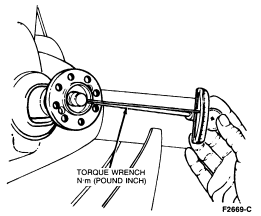
Check the pinion bearing preload by putting a Nm (lb-in) torque wrench on the pinion nut and measuring the torque effort it takes to turn the pinion. Compare the reading with the preload specification for used bearings.
NOTE: The pinion seal will offer a resistance equivalent to 0.056-0.451 Nm (0.5-4.0 lb-in). If the bearings are preloaded, a reading higher than 0.056-0.451 Nm (0.5-4.0 lb-in) on the torque wrench scale must be obtained. If not, there is no preload.
Another indication is some threads protruding from in front of the nut. Normally about 2.29-2.54mm (0.090-0.100 inch) of threads protrude if the preload is set properly. If the nut is flush with the end of the stem, chances are the preload was not set. Refer to Pinion Bearing Preload procedure for resetting the proper preload.
NOTE: The absence of preload here may indicate that collapsible pinon spacer must be replaced if sufficient pinion nut torque is not achieved when tightening new pinion nut to desired rotational torque.
Tighten the pinion nut to a minimum of 217 Nm (160 lb-ft), rotating the pinion occasionally to ensure proper bearing seating. Take frequent drive pinion bearing torque preload readings until the original recorded preload reading is obtained.
If the original recorded preload is lower than specification (used
bearings .9-1.5 Nm (8-14 lb-in); new bearings 1.8-3.3 Nm
(16-29 lb-in)) tighten to specification. If the preload is
higher than specification, tighten to original reading as recorded.