Section 00-04: Noise, Vibration and Harshness | 1993 Mustang Workshop Manual |
Acceleration
Ambient Temperature
Surrounding or prevailing temperature. Normally, the temperature in the service area or outdoors, depending on where testing is taking place.
Boom
A cycling, rhythmic noise often accompanied by a sensation of pressure on the ear drums.
Bound Up
Refers to a stressed, rubber-mounted component that transmits any NVH which would normally be absorbed by the mount. Refer to Neutralize.
Brakes Applied
When vehicle is stationary, service brakes applied with enough force to hold vehicle against acceleration with transmission in gear.
Coast/Neutral Coast
Engine/transmission taken out of gear with driveshaft/driveline by placing transmission selector in NEUTRAL or by depressing clutch in manual transmission.
Controlled Rear Suspension Height
The height at which the components of a particular vehicle should be set
when driveline angle measurements are made.
CPS
Cycles Per Second (Hz).
Cruise
Steady highway speed; neither accelerating nor decelerating; even pressure on accelerator pedal on level ground.
Deceleration
Slowing of vehicle by releasing foot from accelerator at cruise and allowing engine to slow vehicle without application of brakes.
Driveline Angles
Difference of alignment between the transmission output shaft, driveshaft
and rear axle pinion centerline. 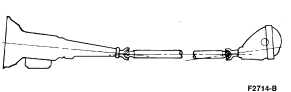
Driveshaft
Rearmost shaft of a driveline which powers the rear axle input shaft (pinion shaft).
Drivetrain
Includes all power transmitting components from the rear of the engine to the wheels, including clutch/torque converter, transmission, driveline and front and rear driving axles.
Drivetrain Damper
A counterweight attached to an arm on the rear of the transmission extension housing and designed to "soak up" or damp unwanted driveline or powertrain vibrations.
Engine Imbalance
Some component in the engine which is normally smoothly balanced now causing a perceptible vibration in the vehicle.
Engine Misfire
One or more cylinders in the engine fails to fire at the proper time.
Engine Runup Test
Operation of engine through normal rpm range while vehicle is sitting. Used for engine vibration check.
Gravelly Feel
A grinding or growl in a component, similar to the feel experienced while driving on gravel.
Harshness
A harder than usual behavior of a component, like riding a vehicle with
overinflated tires.
Hose Clamp
Screw-type hose clamp. 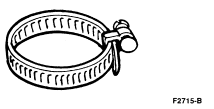
Hz
Hertz (Cycles Per Second).
Imbalance (also Unbalance)
Out of balance; more weight on one side of a rotating component causing shake or vibration.
Inboard
Toward the centerline of the vehicle.
In-Phase
The in-line relationship between the forward coupling shaft yoke and the driveshaft slip yoke of a two-piece driveline.
Isolate
Separate from the influence of other components.
NVH
Noise, Vibration, and Harshness.
Neutralize (Normalize)
To return to unstressed position. Used to describe mounts. Refer to Bound Up.
Outboard
Toward the outside of the vehicle, rather than toward the centerline.
Phase
Referring to the rotational positions of the various elements of a driveline.
Pinion Shaft
The input shaft to a driving axle is usually a part of the smaller driving or input hypoid gear of a ring and pinion gearset.
Pumping Feel
A very slow vibration that results in a movement of vehicle components similar to pumping the service brakes slightly.
Radial/Lateral
Radial is in the plane of rotation, while lateral is at 90 degrees to the fore-and-aft plane of the vehicle.
Ring Gear
A large bevel gear driven by the pinion gear of a ring and pinion driving axle gearset.
Road Test
Operation of vehicle under conditions designed to recreate the condition.
Runout
Out of round or wobble.
Shake
Low frequency vibration, usually results in visual movement of components.
Slip Yoke (Slip Spline)
Driveshaft coupling device (one-half of a Universal joint) which compensates for changes in the shaft length due to articulation of an axle; used at one end of driveshaft.
Tip-In Moan
A light moaning noise is heard when the vehicle is moderately accelerated between 40-64 km/h (25-40 mph).
Tire Deflection
Bending of the body of the tire during rotation.
Tire Force Vibration
Tire vibration caused by variations in the construction of the tire, resulting in a vibration when the tire rotates against the pavement. This condition may be present on perfectly round tires because of variations in the inner construction. May occur at wheel rotation frequency or twice rotation frequency.
T.I.R.
Total indicator runout.
Tires—Flat Spots
Commonly caused by letting vehicle stand when tires are warm. Can be cured by operating vehicle until tires are warm. More likely a concern with Bias Belted Nylon reinforced tires than with radials.
Two-Plane Balance
Radial and lateral balance.
Vibration
Regular movement of a component that results in a sound or feel of movement.
Typical vibration frequencies, measured in cycles per second, (Hz) are: